




Advances for Off-highway Engine Design
As manufacturers continue to drive out cost and meet a worldwide patchwork of regulatory frameworks, the tools for developing those engines are advancing. From showcase prototypes to advanced analytical techniques, suppliers are helping the cause.

“It is an exciting time for commercial engine designers,” said Michael Franke, director, light-duty diesel and commercial engines for FEV. The U.S. Tier 4 Final emissions regulation forced developers to deliver compliance in a shorter-than-normal design cycle. Now that the industry has had an opportunity to optimize Tier 4 Final products, the focus has shifted to longer-term objectives in meeting end-user expectations and responding to competition, according to Franke.
With the excitement are some cautions, especially in the small-engine segment. “While this engine segment was always very cost sensitive, we now see foreign manufacturers [trying] to enter the U.S. with low-cost products,” explained Franke. “China and India are progressing quickly with implementing China VI and Bharat-VI for on-highway applications.” These new OEMs can adapt those technologies to meet off-highway Tier 4 emissions, allowing them to offer off-highway solutions in the U.S. and Europe.
The newer Stage V regulations in Europe will also offer challenges, especially for engines greater than 37 kW. Stage V specifies particulate number limits not present in U.S. regulations, and Franke predicts engine makers will need to use particulate filters to meet it. Integrating filters in the limited space of off-highway machinery is challenging, perhaps requiring SCR (selective catalytic reduction) coated filters. He also notes the challenge in Stage V for engines below 37 kW meeting new HC+NOx limits, perhaps requiring EGR (exhaust gas recirculation) and DOC (diesel oxidation catalyst).
One of the more interesting opportunities for meeting the challenges is hybridization of various sorts, “though any benefits are dependent on the application,” said Franke. “The future requires modular engine architectures that allow the installation of electrified components flexibly to take advantage of hybrid technologies for some applications, while using the same core engine for many other applications.”

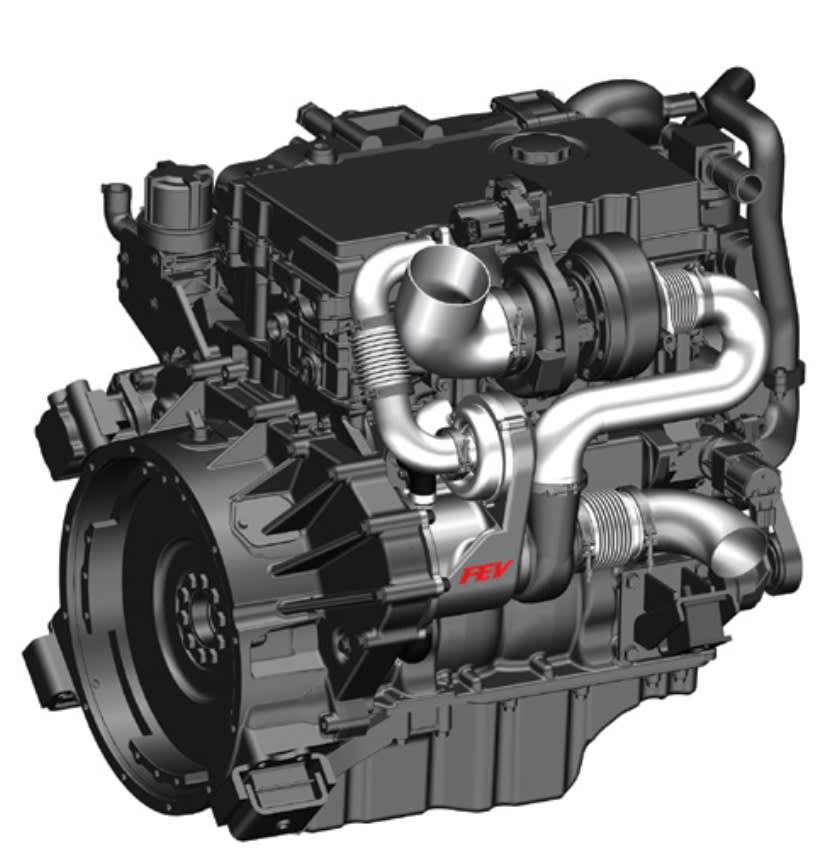
To help the industry understand the possibilities, FEV offers its proprietary ITES system, a solution to integrate turbo-compounding, electrification and supercharging. “FEV has developed modular engine and powertrain architectures to meet customized application requirements, while enabling cost-optimized solutions through a high degree of component sharing and component similarity across a wide range of applications,” he said.
Modularity from systems engineering
“A modular approach to engine design is required,” agrees Thaddaeus Delebinski, business unit director for diesel systems at IAV. In addition to the diversity of applications and regulations in off-highway, there is also the growing diversity of fuels, with natural gas, for example, becoming more important than ever. “But only a limited number of units are sold,” he explained. Cost can easily get out of hand without maximum commonality between engines in low-volume production. An engine maker needs a modular approach for different applications and markets.
Delebinski believes the key is an overall systems engineering approach to achieve that commonality. “IAV has a model-based development approach to reduce testing and validation effort and limit the use of expensive resources, for example from high altitude calibration, engine protection functions or virtual emissions cycles,” he said.
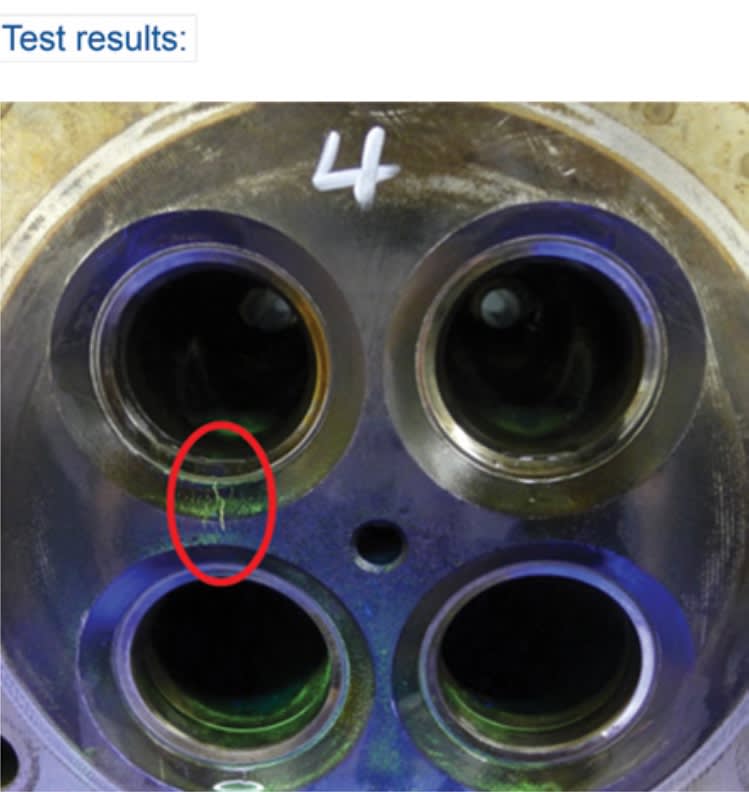
Like others in the industry, IAV offers simulation tools, such as its in-house Velodyn for Com Apps, derived from a vehicle dynamics tool. This is used in co-simulation with commercial tools like Gamma Technologies’ GT Power for engines and Amesim for hydraulics from Siemens, combined with dynamometer testing facilities, up to 1.5 MW in capacity, for correlation.
He stresses that IAV is especially competent in controls development and calibration for emissions, OBD (on-board diagnostics) and predictive advanced diagnostics. “We work with a number of off-highway customers, for example, on understanding aftertreatment characteristics and diagnostics over the lifetime of an application,” he explained. The company also helps customers with electrification, not only to help fuel efficiency, but to gain access to additional functionality like functional safety and diagnostics.
Data is important, according to Delebinski, and it’s getting easier to access and more plentiful. “It allows us to deliver robust datasets and reduce the time for testing and validation,” he said. This could potentially be even more important if real-world testing migrates from its imminent introduction on-highway to off-highway, providing an opportunity for even more data collection.
Tools and cost of ownership
There is a wider net to cast when thinking of systems engineering, especially when considering total-cost-of-ownership. “We spend a lot of time helping our customers with multidisciplinary engineering,” explained Jonathan Dutton, transportation & mobility industry director for Dassault Systemes. Initially famous for its CATIA CAD software, the company now offers a variety of software tools to help with product lifecycle management, simulation, data and data integration, as well as supply chain management.
“Frankly, the tools that we provide are just as applicable to trucks and passenger cars as off-highway engine development — only the requirements are different,” he said. The differences can be as simple as the load case for an engine — on-highway engines typically transition loads smoothly while excavators suddenly have huge load changes when they fill buckets and begin lifting. “But, there is tremendous commonality in the tools each need for development,” he said.
He puts this wider net of tools that Dassault Systemes offers into four domains: multidisciplinary physics simulations; optimization and analysis using mathematical solution search tools like Design of Experiments; new technology simulations aimed at hybridization; and Systems Engineering that encompasses the whole product, including manufacturing and maintaining the link on engine requirements and design through product lifecycle management.
Dassault stresses in its pitch the need to emulate and understand the user experience, in fact terming its platform of applications as the 3DExperience. To understand the requirements of the engine means starting with the user experience while sitting in the cab and simulating the whole machine. This total view of cost and ownership includes common access to CAD designs, mechanical simulations, controls and systems simulations, as well as manufacturing disciplines such as casting and assembly.
The goal is to both reduce engineering cost while producing higher quality designs that meet performance, operating cost, and manufacturing cost objectives. “Our customers are telling us we need to reduce the number of prototypes — that is where simulation comes in,” he said.
Devil in the details

With the focus on new emissions requirements and their effect on engine architectures, other engineering problems that bedevil engines have not disappeared or even become worse. A good example is provided by Michael DeJack, senior technical specialist for AVL — resolving low-cycle fatigue. Like others, AVL employs a blend of commercial tools and its own know-how to solve many a devilish problem like this.
Durability is challenged as never before. “Newer emissions requirements mean advances in combustion, with increases in cylinder gas pressure [and temperatures],” he explained. Those increases mean increased demands in thermal-mechanical fatigue especially in cylinder heads. Thermal-mechanical fatigue comes from low-cycle heating and cooling of engines from start-up to shut-down, in contrast to high-cycle fatigue from operating the engine.
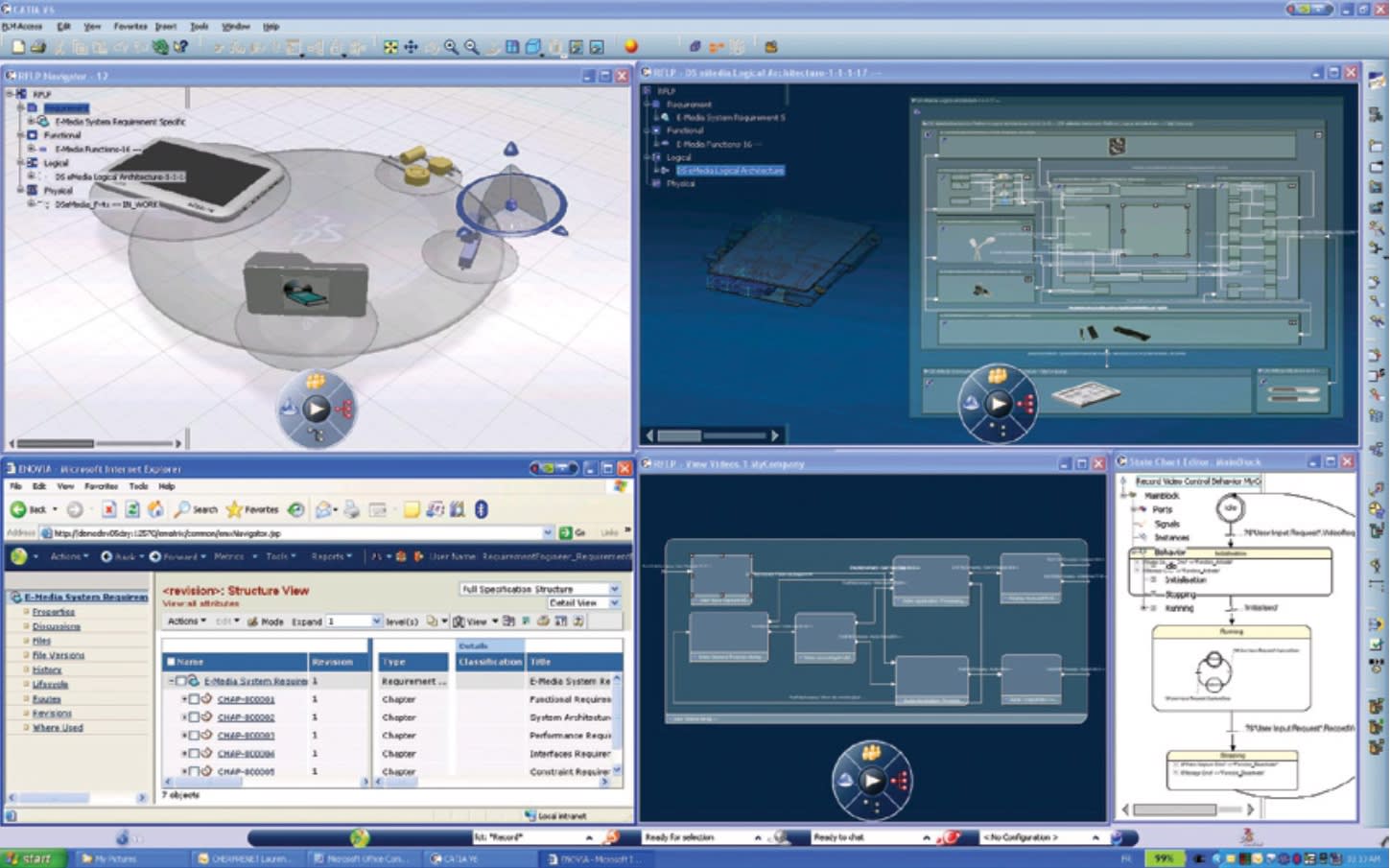
Like all of engineering, the solution involves trade-offs. “You could use different materials to gain strength, but with a trade-off in thermal conductivity. That may require moving the coolant jacket closer to the flame face and designing thinner walls,” he said. Material options include cast iron, compacted graphite iron (CGI), and ductile iron. However, their evaluations are not easy, since this involves complicated finite element models with complex material behavior.
If the devil is in the details, the solution might be in the data. They use the popular non-linear finite element simulation program, Abaqus from Dassault Systemes. “Thermal-mechanical fatigue drives high visco-plasticity in the material which we simulate with more advanced material models using Z-Mat by Northwest Numerics. We have developed and calibrated a library of advanced material models using this Z-Mat capability.” After modeling the plasticity, AVL developed damage models to simulate time to failure due to thermal-mechanical fatigue.
Low-cycle fatigue analysis is only one part of their extensive iCAE tool box that AVL built around Abaqus and other commercial tools. “It is actually a knowledge database where we have detailed work-flows for hundreds of analysis tasks, with access to AVL’s material database, scripts, analysis results, and other codes like AVL Fire for CFD and AVL Excite for dynamics,” he said.
Breakthrough in direct simulation of combustion
One of the more difficult things to simulate are the fine details of injections and in-cylinder combustion, though engineering them well has an enormous impact on emissions and fuel economy. These details are computationally intensive, according to Dr. Sibendu Som, group leader and principal computational scientist for Argonne National Laboratory (ANL). That is why the high-performance super-computing center at ANL remains an important resource for engine developers, including heavy duty and off-highway.
ANL partners include on- and off-highway clients that build truck and locomotive engines. ANL helped develop optimal thermal barrier coatings using advanced heat transfer models and injector designs with precision spray models, for example.
One of the more challenging phenomenon to simulate is the chemical kinetics of in-cylinder combustion. Fuels like gasoline or diesel are typically composed of 3000 to 5000 individual chemical species, which go through hundreds of reactions while burning. Too complicated to simulate to date, engineers typically create a model fuel of 70 or 80 species to replace the complex real fuel. While good enough to model heat release rates and pressure rise, these are not good enough to model particulate formation, or soot — an especially important topic today as the health hazards of soot are better understood.
That limitation has been eliminated with the development of a new model that ANL calls Tabulated Flamelet Model, or TFM. This is useful in both modeling soot better and in capturing low-temperature combustion characteristics, which remains important to OEMs.
“Our new technique requires only 20% more computational time to model the full chemical mechanism of a real fuel, composed of up to 5000 species,” said Som. It could prove an important breakthrough in advancing the fidelity of combustion simulations.
More From SAE Media Group
Off-Highway Engineering
Heavy-Duty Engine Design
Off-Highway Engineering
Expediting Engine Design
Tech Briefs
Making Diesel Engines Nearly Emission-Free
Off-Highway Engineering
Off-highway Calibration Challenges — Big and Complex
Automotive Engineering
Balancing GDI Fuel Economy and Emissions
Off-Highway Engineering
The Complicated Future of Off-Highway Engines
Off-Highway Engineering
Life-cycle Planning — Design and Calibration for Ultimate Efficiency
Off-Highway Engineering
DEF Delivery Modeling for SCR Systems
Off-Highway Engineering
Calibration and Complexity
Automotive Engineering
Renault Applies Model-Based Systems Engineering to Dual-Clutch Transmission
Automotive Engineering
Simulating to Track Soot Formations in Diesel Engines
Off-Highway Engineering
Iveco Pursues Natural Gas in Stralis NP Models
Off-Highway Engineering
Cummins Unveils New B7.2 Diesel Engine
Off-Highway Engineering
Solving Problems and Seeking Big Ideas for Commercial Vehicles
Off-Highway Engineering
Designs on a Diverse Powertrain Future
Off-Highway Engineering
Mahle, Liebherr Develop Active Pre-Chamber for Hydrogen ICE
Off-Highway Engineering
ZM Trucks Starts Production in Fontana, California
Automotive Engineering
Achates Aims at 2025 Light-truck Power
Automotive Engineering
Mazda Plots Wankel-powered Range Extenders, HCCI Mild Hybrids
Off-Highway Engineering
Diesel Isn’t Dead
Automotive Engineering
Powertrain Testing: Coping with Complexity

Photonics & Imaging Technology
New Engine Optics to Fuel Future Research

Tech Briefs
2025 Award Finalists
Off-Highway Engineering
Combustion Modeling in Heavy-duty Diesels
Automotive Engineering
Valve Cuts NVH in GDI Engines
Automotive Engineering
Will ‘Recalls’ Become ‘Upgrades’?
Off-Highway Engineering
Delphi Injects Life into Diesel
Off-Highway Engineering
Many ICE Paths Lead to Reduced Emissions
Top Stories
INSIDERManufacturing & Prototyping
 How Airbus is Using w-DED to 3D Print Larger Titanium Airplane Parts
INSIDERManned Systems
 FAA to Replace Aging Network of Ground-Based Radars
NewsTransportation
 CES 2026: Bosch is Ready to Bring AI to Your (Likely ICE-powered) Vehicle
NewsSoftware
 Accelerating Down the Road to Autonomy
EditorialDesign
 DarkSky One Wants to Make the World a Darker Place
INSIDERMaterials
 Can This Self-Healing Composite Make Airplane and Spacecraft Components Last...
Webcasts
Defense
 How Sift's Unified Observability Platform Accelerates Drone Innovation
Automotive
 E/E Architecture Redefined: Building Smarter, Safer, and Scalable...
Power
 Hydrogen Engines Are Heating Up for Heavy Duty
Electronics & Computers
 Advantages of Smart Power Distribution Unit Design for Automotive...
Unmanned Systems
 Quiet, Please: NVH Improvement Opportunities in the Early Design...
