




Valve Cuts NVH in GDI Engines
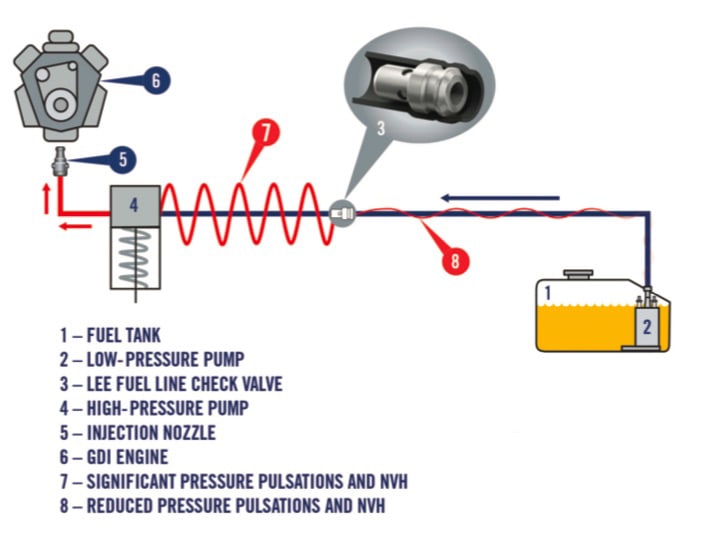
When a leading automotive manufacturer struggled with the release of a new fuel-injection engine technology, the company required an immediate solution to maintain launch scheduling, not to mention corporate reputation. Increasingly stringent global emissions regulations have led many OEMs to implement gasoline direct-injection (GDI) fueling technology, which provides improved fuel economy, reduce emissions, and increase power. But GDI can bring problems.
The automaker found pressure pulsations in the engine’s low-pressure fuel line, upstream of the single-piston high- pressure pump that pressurizes the GDI injectors. Under certain driving conditions these pulsations created noise, vibration, and harshness (NVH) issues for the customer and fatigue-wear issues in the low-pressure fuel system. The problems – identified 10 months prior to the planned vehicle launch – could lead to significant schedule delays.
The Lee Company’s engineering team met with the OEM to discuss the problem, the system layout, mounting options and the high-level performance requirements. The automaker envisioned a component that would dampen pressure spikes returning to the tank, provide a thermal relief function, have a negligible effect on flow to the high-pressure pump, and fit within their system.
In less than a week, Lee engineers designed, built and delivered a uniquely engineered potential solution: a check valve in the fuel line. Testing confirmed the check valve solved the performance problems, reducing the pressure pulsations by up to 90% while fitting within the existing fuel line. The system with the new check valve met all other performance requirements. Over the next six months, the engineers designed and fabricated a completely new production line, supplied Production Part Approval Process (PPAP) parts and initiated production.
The check valve that helped to dampen the pressure spikes is a multi-function valve that combines the performance of a check valve, a pressure dampening restrictor and a thermal relief function, the company said. Conveniently, the valve is easy to install and doesn’t require customized mounting equipment – or add potential external leak paths within the fuel system. The innovative valve can be added to the fuel system to dampen residual pressure pulsations discharged from the high-pressure pump and virtually eliminate NVH and fatigue wear on the low-pressure pump.
The quick transition from initial design concept, through validation and into production helped the OEM launch the vehicle on schedule and safeguard their reputation. Since this initial application, the fuel-line check valve has been adopted by multiple global OEMs. The company said designs are available for a variety of standard fuel-hose materials and sizes and this valve has been proven a reliable solution to any pressure dampening application. There currently are more than 35 million currently in use. To learn more, contact The Lee Company at www.theleeco.com/contact .
Gregg Shanley, Technical Marketing Manager for the Automotive and Industrial markets, The Lee Company.
More From SAE Media Group
Automotive Engineering
First Drive: 2027 Mercedes-Benz CLA Hybrid
Off-Highway Engineering
Reshaping the Mobile-hydraulic Ecosystem
Automotive Engineering
The Soft Underbelly of The EV Transition
Automotive Engineering
Making over the World’s Leading Hybrid
Automotive Engineering
EVs Pressure Supplier Value-add


Off-Highway Engineering
Electrohydraulic Power Steering Pursued for Heavy-Duty Vehicles
Off-Highway Engineering
Mellor Bus Stresses Lightweight Construction for New Midsized Battery-Electric Buses
Automotive Engineering
Dana Opens New Chapter on CVTs
Automotive Engineering
BorgWarner Launches Low-Friction Engine Timing Chain
Off-Highway Engineering
Liebherr Reveals ‘Hybrid’ CFRP Cylinders and Parallel-Pump Concept
Automotive Engineering
SAE Updates Gasoline Fuel-Injection Standards, Additions Expected
Off-Highway Engineering
Pumping Up Hydraulic Capabilities


Automotive Engineering
Ricardo’s Scalable TorqStor Flywheel System Promises FE Gains at Reduced Cost
Aerospace & Defense Tech Briefs
Electric Hybrid Propulsion System
Automotive Engineering
AVSC Develops Best Practices for Traceable AV Safety Inspection Protocols
Tech Briefs
H2-ICE Is Heating Up
Automotive Engineering
CES 2026: Bosch is Ready to Bring AI to Your (Likely ICE-powered) Vehicle
Motion Design INSIDER
Tractor Efficiency Increased, Thanks to Hydraulics Research
Automotive Engineering
EPA Finalizes Tier 3 Program for Lower Vehicle Emissions and Low-Sulfur Gasoline
Automotive Engineering
Inside the Bolt EV

Automotive Engineering
The New EV-driven Regional Supply Focus
Off-Highway Engineering
FEV Simplifies Off-Highway Electrification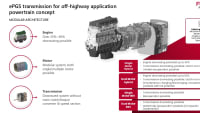
Off-Highway Engineering
AI Influence on ICE Design
Off-Highway Engineering
Komatsu America Launches New Hydraulic Excavator
Off-Highway Engineering
Rexroth Takes Aim at Electrification for Off-Highway Vehicles
Top Stories
NewsRF & Microwave Electronics
 Microvision Aquires Luminar, Plans Relationship Restoration, Multi-industry Push
INSIDERAerospace
 A Next Generation Helmet System for Navy Pilots
INSIDERDesign
 New Raytheon and Lockheed Martin Agreements Expand Missile Defense Production
INSIDERMaterials
 How Airbus is Using w-DED to 3D Print Larger Titanium Airplane Parts
NewsPower
 Ford Announces 48-Volt Architecture for Future Electric Truck
ArticlesAR/AI

Webcasts
Aerospace
 Cooling a New Generation of Aerospace and Defense Embedded...
Automotive
 Battery Abuse Testing: Pushing to Failure
Transportation
 A FREE Two-Day Event Dedicated to Connected Mobility
Unmanned Systems
 Quiet, Please: NVH Improvement Opportunities in the Early Design Cycle
Transportation
 Advantages of Smart Power Distribution Unit Design for Automotive &...
Energy
 Sesame Solar's Nanogrid Tech Promises Major Gains in Drone Endurance