




Microvision Aquires Luminar, Plans Relationship Restoration, Multi-industry Push
The $33-million purchase ends the saga of bankrupt Luminar, once an $11 billion darling of the lidar industry.
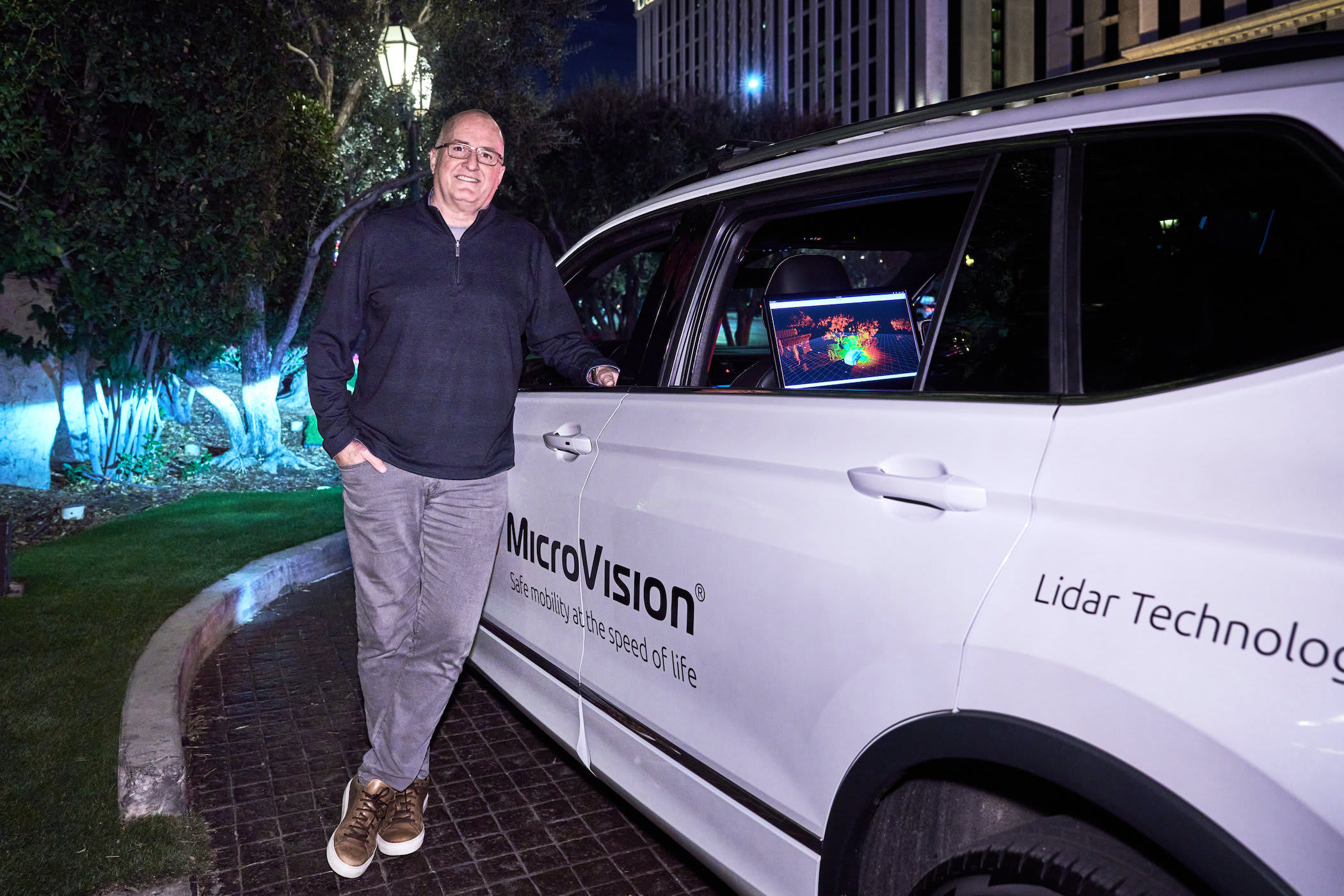
Microvision has completed its acquisition of Luminar, once a shining star of the lidar sector whose story entered its final troubled chapter in December when it filed for Chapter 11 bankruptcy.
In a briefing ahead of the official close of the sale, Microvision CEO Glen DeVos said the company was excited to take control of Luminar’s lidar technology, particularly its 1550nm-powered Halo offering, a compact high-performance (up to 500 meters of range) package that is easy to aesthetically integrate into vehicle design.
DeVos said Microvision had a five-year growth plan, but the opportunity to buy Luminar means a rapid acceleration of the company’s revenue growth forecast. “It pulled forward the revenue component and the customer-engagement component,” he said. DeVos said he’ll soon reach out to Volvo, which contributed to Luminar’s financial troubles by scaling back its purchase orders (by as much as 75%, according to a TechCrunch report ), and other customers, to repair relationships damaged by Luminar’s instability.
DeVos was named CEO in September and had been the company’s CTO since April, 2025. He said Microvision is excited to see what its approach, which relies on software to realize lidar’s full functionality and integration into ADAS systems, can do with Luminar’s hardware.
The company is on a bit of an acquisition tear, having acquired Scantinel Photonics in January. Scantinel is a Germany-based company developing 1550nm frequency-modulated continuous wave (FMCW) lidar. With stiff cost competition from Chinese sensor makers Hesai and RoboSense on the horizon, DeVos said Microvision will have to compete with them in the automotive market. “In my experience, they will set the price,” he said. “We expect to be able to compete.”
DeVos said that Luminar’s people were another attraction. “They have a lot of really talented engineers globally, whether in Japan, Sweden or Orlando, where the company had its headquarters, an R&D office and a lidar manufacturing plant.”
He said that the company sees its own efforts helping develop the automotive market, which they predict will be the biggest market for lidar, by lowering unit prices. 1550nm units now start around $500. Industry experts have said that mass adoption would need a price below $250. The units are seen as critical for the development of SAE Level 3 autonomy.
But a big part of Microvision’s, well, vision, is expanding into the industrial and defense markets. DeVos said that “industrial ADAS doesn’t really exist today” before citing OSHA’s record that there are more than 30,000 injury-producing forklift accidents each year. That means ADAS has a natural market in factories and warehouses, he said. And “for defense,” he said, “being in the U.S. and Germany, that’s impactful.”

Addressing how Microvision’s lineup could be simplified with all the additions to the hardware portfolio, DeVos said that the MEMS (micro electric mechanical system) scanning in its Maven lidar “is fully developed and a technology building block. It tends to have a narrower field of view, so it isn’t the best fit for a 120 (degree) field of view.” He said that’s where a spinning-mirror lidar tends to increase the horizontal field of view. “We’re not so much looking at a replacement, but what can I take out of my approach with Maven and combine that with Halo to get a lower-cost system.”
The Luminar brand will not be used going forward, DeVos said. It is a spectacular flameout for the once-charging bull of the lidar business. During a presentation at CES 2023, CEO and founder Austin Russell said he wanted Luminar’s brand to be so well-known that vehicle shoppers would ask for it by name – perhaps an early reveal of the company’s misunderstanding of the automotive supply business, where most companies are happy to supply white-label solutions that compete at the intersection of quality and unit price.
DeVos said that, in retrospect, Luminar’s “cost structure… was too optimistic about business acquisition. Eventually, the revenue just didn’t come” quickly enough. “In auto supply,” he said, “future revenue is never guaranteed.”
More From SAE Media Group
Autonomous Vehicle Engineering
GM Announces Door-To-Door Ultra Cruise ADAS
ADAS & Autonomous Vehicle Engineering
AV Life After Argo AI
Automotive Engineering
Valeo Debuts New Lidars, EV Tech at CES 2022

Automotive Engineering
Growing Lidar for North America
Sensor Technology
RTK and Sensor Fusion for Autonomous Vehicle Navigation & Guidance
Autonomous Vehicle Engineering
ADAS Over the Horizon

Autonomous Vehicle Engineering
The ‘Buzz’ in Driverless Shuttling
Automotive Engineering
New Lidar Tech Illuminates CES 2022
ADAS & Autonomous Vehicle Engineering
Automated Driving’s Journey: One Step Forward…
Automotive Engineering
Mobileye Ready to Meet FMVSS 127 with Vision-Only System
Automotive Engineering
WCX 2025: Nira Dynamics’ Sensor-Free Tire Pressure Tech Eyes New Opportunities
Off-Highway Engineering
Uhnder and Spartan to Partner on Hi-rez Radar
Automotive Engineering
Sensitive Subjects
Off-Highway Engineering
Strategic Partnerships Target SAE Level-4 Trucks
Autonomous Vehicle Engineering
Velodyne Preps for Volume Lidar

Automotive Engineering
Volvo EX90 Uses AI, NVIDIA SoC to Make Automated Driving Safer
Autonomous Vehicle Engineering
We Finally Have Some Data on ADAS!
Automotive Engineering
DSpace Launches Simphera AV Development Simulator
Off-Highway Engineering
Autonomous Trucking Tech Hits High Gear
Autonomous Vehicle Engineering
Senso-Rama!

Autonomous Vehicle Engineering
The Swedish Word for AV Tech

Automotive Engineering
Full Speed Ahead for Second-Generation Indy Autonomous Racers
Automotive Engineering
Taking Aim at the Drowsy-driver Threat
Autonomous Vehicle Engineering
Purpose, Perceptions for Driver-Assist Tech Solidify
Top Stories
INSIDERManned Systems
 How Airbus is Using w-DED to 3D Print Larger Titanium Airplane Parts
INSIDERAerospace
 FAA to Replace Aging Network of Ground-Based Radars
NewsUnmanned Systems
 Microvision Aquires Luminar, Plans Relationship Restoration, Multi-industry Push
NewsDesign
 CES 2026: Bosch is Ready to Bring AI to Your (Likely ICE-powered) Vehicle
NewsSoftware
 Accelerating Down the Road to Autonomy
INSIDERManned Systems
 Can This Self-Healing Composite Make Airplane and Spacecraft Components Last...
Webcasts
Power
 Hydrogen Engines Are Heating Up for Heavy Duty
Transportation
 Advantages of Smart Power Distribution Unit Design for Automotive...
Automotive
 Quiet, Please: NVH Improvement Opportunities in the Early Design...
Power
 A FREE Two-Day Event Dedicated to Connected Mobility
Connectivity
 E/E Architecture Redefined: Building Smarter, Safer, and Scalable Vehicles
Manufacturing & Prototyping
 How Sift's Unified Observability Platform Accelerates Drone Innovation