





Latest Briefs and News





Top Stories
INSIDERDefense
 New Raytheon and Lockheed Martin Agreements Expand Missile Defense Production
NewsAutomotive
 Ford Announces 48-Volt Architecture for Future Electric Truck
INSIDERManufacturing & Prototyping
 Active Strake System Cuts Cruise Drag, Boosts Flight Efficiency
ArticlesTransportation
 Accelerating Down the Road to Autonomy
INSIDERMaterials
 How Airbus is Using w-DED to 3D Print Larger Titanium Airplane Parts
Road ReadyTransportation




















Latest Stories
INSIDER Connectivity
Fiber Deep Upgrade Improves Cyber Resilience for JBPHH
An Air National Guard fiber cable installation team is implementing the 'Fiber Deep' project on Joint Base Pearl Harbor-Hickam, Hawaii. This project aims to save up to $10 million by...

Articles RF & Microwave Electronics
Are Defense Satellites Ready for Space-Based Laser Communications?
The Department of Defense is developing technology for satellites to communicate via lasers. Laser communications could transmit data faster and more securely than traditional radio frequency communications. Read on to learn more.

Application Briefs Photonics/Optics
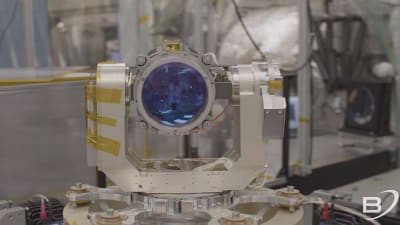
Breakthrough in Long-Haul Laser Communication Capabilities
BlueHalo announced the successful milestone demonstration of its two-terminal long-haul, multi-orbit laser communication system. The achievement marks a significant breakthrough in the development of space-based laser communication technology with far-reaching implications for national security and commercial sectors. Read on to learn more.
Articles Photonics/Optics
Microcomb Chips Could Improve Accuracy of GPS Systems
The optical atomic clocks that exist today are bulky and require complex laboratories with specific laser settings and optical components, making it difficult to use them outside lab environments, such as in satellites, remote research stations, or drones. Now, a research team has developed a technology that makes optical atomic clocks significantly smaller and accessible for more widespread use in society. Read on to learn more.

Articles Weapons Systems
AI Automates Drone Defense With High Energy Lasers
To counter the rapidly mounting threats posed by the proliferation of inexpensive uncrewed autonomous systems, or drones, Naval Postgraduate School researchers and collaborators are applying AI to automate critical parts of the tracking system used by laser weapon systems. Read on to learn more about it.

Application Briefs Photonics/Optics
GOKBERK C-UAS Testing
Turkish defense company Aselsan completed testing of its mobile laser counter unmanned aircraft system platform GÖKBERK against first-person view drones in March. Previously proven effective against rotary- and fixed-wing kamikaze drones, GÖKBERK has now demonstrated its capabilities for detecting, autonomously tracking, and eliminating FPV drones across multiple test scenarios. Read on to learn more.

Briefs Photonics/Optics
Army Researchers Develop Chemical Threat Scanning on the Fly
U.S. Army Combat Capabilities Development Command Chemical Biological Center researchers are developing a way to scan for chemical biological agent on surfaces on the fly. It is called Hyperspectral Threat Anomaly Detection, or HyperThreAD for short. Read on to learn more about it.
INSIDER Design
Microsoft, PsiQuantum Designing Quantum Computer Prototypes for DARPA US2QC Program
The Defense Advanced Research Projects Agency (DARPA) has selected Microsoft and PsiQuantum to move to the final design stage of its Underexplored Systems...
Briefs Physical Sciences
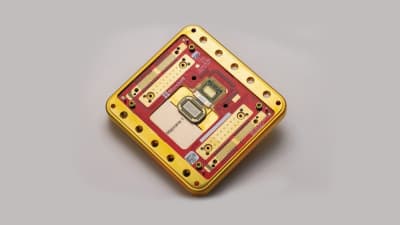
Atomic Fountain for Research in Quantum Sensing Nears Completion of First Phase
Dr. Frank Narducci, Chair of the NPS Department of Physics, and his Ph.D. student U.S. Navy Cmdr. Jens Berdahl, are nearing completion of the first phase of construction in what will be a superlatively precise atomic-based instrument. Read on to learn more about it.

INSIDER Photonics/Optics
Using Squeezed Light to Develop Sensors That Defy Defense Limits
Raytheon’s BBN Technologies is developing next-generation, compact, low-power, deployable photonic sensors that will provide users with better awareness of environmental...

Articles RF & Microwave Electronics
This Laser Clock Could Transform Satellite Navigation Accuracy
A new laser clock from the German Aerospace Center has achieved a record level of accuracy for optical clocks with gas cells: in 30 million years, it would be off by just one second. Read on to learn more about it and what it could mean for satellite navigation accuracy.

Articles Communications
Everyday Life, Improved by Light: GRYPHON’s Photonic Discoveries
GRYPHON will leverage recent developments in nonlinear photonics and photonic-electronic integration to develop microwave sources with noise performance that meets or exceeds that of the best discrete oscillator modules. Read on to learn more about the endeavor.
Articles Electronics & Computers
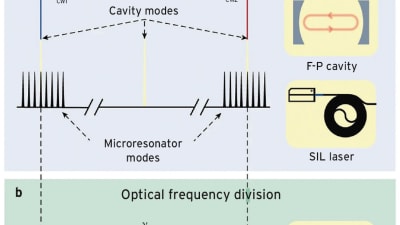
Space Lasers: Aiming Towards Next Leap in Global Communications
Space lasers are transforming the world. Not the far-off future of science fiction, but the universe of how data and communications flow today — everywhere from deep space missions to countless applications here on earth, including consumer internet services, military operations, and banking transactions. Read on to learn more.

Briefs Aerospace
Researchers Demonstrate the First Chip-Based 3D Printer
Imagine a portable 3D printer you could hold in the palm of your hand. Researchers took a major step toward making this idea a reality by demonstrating the first chip-based 3D printer. The prototype chip has no moving parts, instead relying on an array of tiny optical antennas to steer a beam of light. Read on to learn more.

Briefs Electronics & Computers
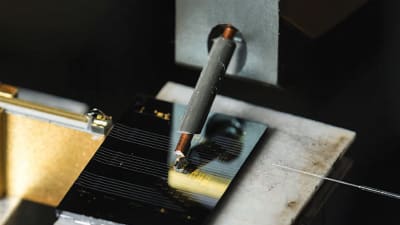
Streamlined Microcomb Design Provides Control With The Flip of a Switch
Researchers at the University of Rochester describe new microcomb lasers they have developed that overcome previous limitations and feature a simple design that could open the door to a broad range of uses. Read on to learn more.
INSIDER Aerospace
Navy, Marine Corps Test New Laser System for Precision Aircraft Painting
A new capability at Fleet Readiness Center East (FRCE) is streamlining the aircraft painting process, allowing the depot to decrease maintenance turnaround time and...

INSIDER Manned Systems
Space Lasers: Aiming Towards Next Leap in Global Communications
Space lasers are transforming the world. Not the far-off future of science fiction, but the universe of how data and communications flow today — everywhere from deep space...
Articles Sensors/Data Acquisition
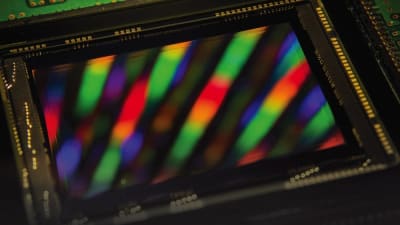
Image Sensors and Cameras Based on Colloidal Quantum Dots for Defense Applications
This article reports on the image sensor technology and the VS20 camera product developed at Emberion. The article describes the image sensor design comprising the sensor stack based on a p-i-n photodiode implementation with PbS QDs sandwiched between thin-film hole transport (HTL) and electron transport (ETL) layers as well as the CMOS ROIC architecture and pixel front-end interfacing the photodiode stack.
Briefs Photonics/Optics
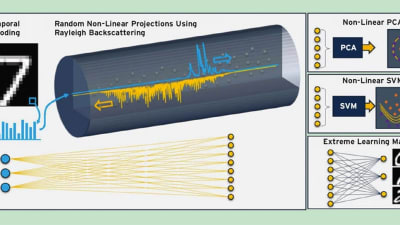
NRL Research Physicists Explore Fiber Optic Computing Using Distributed Feedback
U.S. Naval Research Laboratory (NRL) researchers have outlined a novel contribution in fiber optics computing in a paper recently published in Communications Physics Journal that brings the Navy one step closer to faster, more efficient computing technologies.
Articles Photonics/Optics
NASA’s Optical Communications Demo Transmits Data Over 140 Million Miles
This achievement provides a glimpse into how spacecraft could use optical communications in the future, enabling higher-data-rate communications of complex scientific information as well as high-definition imagery and video in support of humanity’s next giant leap: sending humans to Mars.

Articles Photonics/Optics
Physicists Develop a New Type of Antenna
This research and demonstration presents a simple technique for a remote Rydberg-atom-based RF sensor, which was verified for distances of up to 30 m between the passive sensing unit and the base station — currently limited by the length of the hallway used in the demonstration.

Application Briefs Manned Systems
Quantum Sensing Atomic Gyroscope
The Defense Science Board identified three areas of quantum technology that will be most relevant to the DoD's technological superiority: sensing, encryption, and communications.

Briefs Imaging
Spatial Calibration for Accurate Long Distance Measurement Using Infrared Cameras
All commercially available camera systems have lenses (and internal geometries) that cannot perfectly refract light waves and refocus them onto a two-dimensional (2D) image sensor. This means that all digital images contain elements of distortion and thus are not a true representation of the real world.

Briefs Photonics/Optics
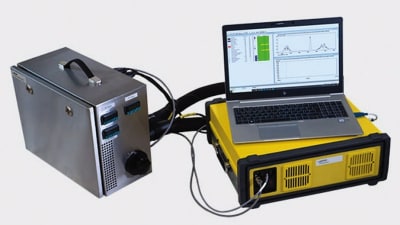
Towards Greater Sensitivity: A Brief FTIR and Infrared-Based Cavity Ring Down Spectroscopy Comparative Study
Cavity Ring-Down spectroscopy (CRDS) is a newer IR absorption-based technique made possible by the use of tunable pulsed lasers. Rather than using a broadband (blackbody) emitter as is done with traditional IR techniques, a pulsed laser is tuned across wavelengths into an optical cavity.
Briefs Photonics/Optics
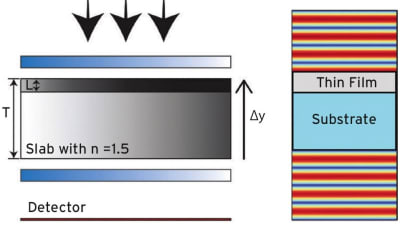
Determining Optical Material Parameters With Motion in Structured Illumination
Ellipsometry measures the amplitude ratio and the phase difference between polarized light reflected from the surface of a film and determines the refractive index or thickness by fitting the experimental data to an optical model that represents an approximated sample structure.
Briefs RF & Microwave Electronics
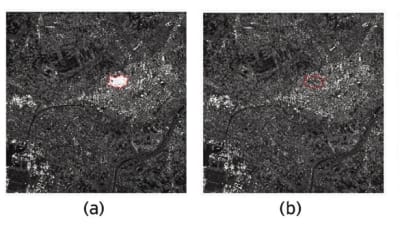
Deep Image Prior Amplitude SAR Image Anonymization
Synthetic Aperture Radar images are a powerful tool for studying the Earth’s surface. They are radar signals generated by an imaging system mounted on a platform such as an aircraft or satellite. As the platform moves, the system emits sequentially high-power electromagnetic waves through its antenna.
Briefs Photonics/Optics
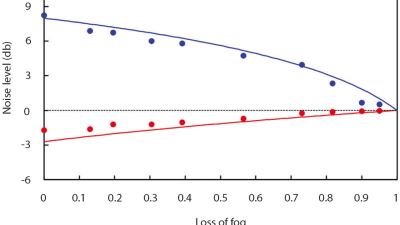
Free-Space Quantum Communications in Harsh Environments
The project aims to explore the possibility of all-weather secure quantum communication using macroscopic quantum states of light.
Articles RF & Microwave Electronics
How Laser Communications Innovation is Finally Coming of Age and Driving Innovation in Defense
Though laser technology has advantages over radio, and those advantages are growing as innovation accelerates, what is essential to realize is that they need not be in competition.

INSIDER Electronics & Computers
Euclid Space Telescope Begins Mission to Study Dark Energy and Matter
ESA’s Euclid spacecraft lifted off on a SpaceX Falcon 9 rocket from Cape Canaveral Space Force Station, Florida, on July 1, 2023. The successful launch marks the...

Webcasts
Electronics & Computers
 Cooling a New Generation of Aerospace and Defense Embedded...
Power
 Battery Abuse Testing: Pushing to Failure
Connectivity
 A FREE Two-Day Event Dedicated to Connected Mobility
Automotive
 Quiet, Please: NVH Improvement Opportunities in the Early Design Cycle
Transportation
 Advantages of Smart Power Distribution Unit Design for Automotive &...
Aerospace
 Sesame Solar's Nanogrid Tech Promises Major Gains in Drone Endurance