




A New Record for Optical Power Beaming
Naval Research Laboratory
Washington D.C.
This email address is being protected from spambots. You need JavaScript enabled to view it.
nrl.navy.mil
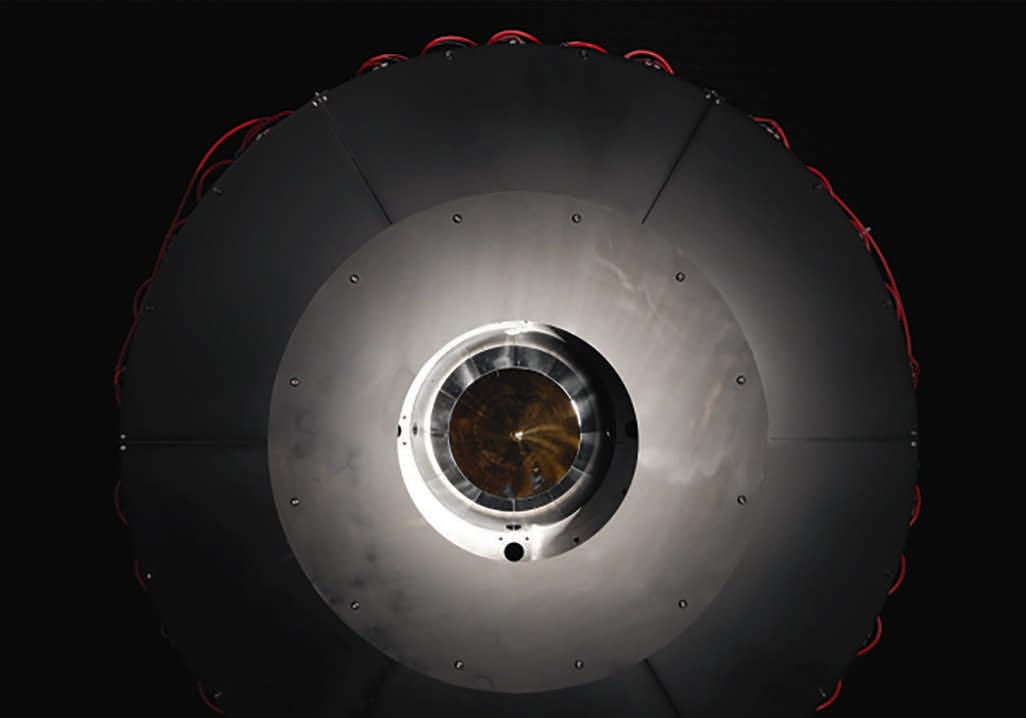
Defense Advanced Research Projects Agency (DARPA) recognized the U.S. Naval Research Laboratory (NRL) during their POWER Phase 2 Industry Day, for contributions to the Persistent Optical Wireless Energy Relay (POWER) program, which shattered existing records for optical power beaming over distance.
Power beaming is a method of transmitting electricity wirelessly through the air using directed energy, such as laser light. Instead of relying on traditional cables, scientists use precisely aimed beams to deliver power over long distances from a stationary source to a remote receiver, such as a drone or forward operating base. This technology functions like wireless charging but operates across much greater ranges, offering a potential breakthrough in energy logistics for both civilian and defense applications.
NRL Electrical Engineer Alex Grede, Ph.D., and Research Physicist Justin Lorentzen performed critical technical contributions for POWER.
In a landmark series of tests at White Sands Missile Range, New Mexico, the POWER team achieved more than 800 watts of power delivered during a 30-second transmission from a laser 8.6 kilometers (5.3 miles) away. Over the course of the campaign, more than one megajoule of energy was successfully transferred, surpassing previous benchmarks by orders of magnitude.
The NRL team measured the record-breaking achievement for DARPA’s POWER Receiver Array Demo (PRAD). Their technical expertise and collaboration with industry and government partners were instrumental in achieving the milestone.
“There’s a statistic that the majority of casualties that were experienced in Iraq and Afghanistan were related to fuel and water delivery,” Lorentzen said. “The idea is to reduce the number of fuel deliveries that are needed by supplementing the power delivery to forward operating positions with power beaming.”
Power beaming can be used to mitigate varying issues that the military is faced with.
“Now in modern warfare, we are seeing an explosion in autonomous systems and platforms, but one of the issues is keeping them powered. This technology could be the solution,” Lorentzen said.
The program is exploring the use of laser-based power beaming to energy transmission to remote locations without traditional infrastructure — a potential game changer for defense, humanitarian assistance, and space applications.
“Marines do a lot of humanitarian efforts. In areas that become inaccessible during a storm, you could just drop receivers and emitters. That way you don’t need to worry about running cabling,” Grede said. “You don’t need to worry about inaccessible roads and areas because you can build wireless infrastructure.”
Visit Here
More From SAE Media Group
Defense INSIDER
Armoring Satellites to Survive and Operate Through Attacks
Power Electronics INSIDER
Powerful and Precise Multi-color Lasers Now Fit on a Single Chip
Defense INSIDER
Army Developing Lasers That Pierce Fog, Dust to Destroy Targets
Aerospace & Defense Tech Briefs
High-Energy Laser Weapon Systems
Power Electronics INSIDER
Stable Optical Wireless Power Transmission for the IoT
Aerospace & Defense Tech Briefs
Nonlinear Effects in Transformation Optics-Based Metamaterial Shields for Counter Directed Energy Weapon Defense


Tech Briefs INSIDER
How to Charge a Smartphone – Using Lasers
Aerospace & Defense Tech Briefs
Wireless Power via Laser
Aerospace & Defense Tech Briefs
Defeating Commercial Drone Threats with Open-Source SDR
Photonics & Imaging Technology
Tunable Laser Light
Photonics & Imaging Technology
A First-Of-Its-Kind Integrated Optical Isolator
Aerospace & Defense Tech Briefs
Counter-Directed Energy Weapons: Defense of Air Assets
Aerospace & Defense Tech Briefs
How Laser Communications Innovation is Finally Coming of Age and Driving Innovation in Defense
Photonics & Imaging Technology
Optical Switching at Record Speeds Opens Door for Ultrafast, Light-Based Electronics and Computers
Aerospace & Defense Tech Briefs
Microcomb Chips Could Improve Accuracy of GPS Systems
Photonics Tech Briefs INSIDER
High-Power Laser Spinoff Proves Versatility is Strength
Aerospace & Defense Tech Briefs
New Diamond Super-Material Enhances Aircraft Survivability
Aerospace & Defense Tech Briefs
sUAS-Based Payload Development and Testing for Quantifying Optical Turbulence
Defense INSIDER
Researchers Test Cooling Solutions for Directed Energy Weapons
Aerospace & Defense Tech Briefs
Streamlined Microcomb Design Provides Control With The Flip of a Switch
Photonics & Imaging Technology
Optimizing Laser Cutting in Semiconductor Advanced Packaging

Photonics & Imaging Technology
New Products
Photonics & Imaging Technology INSIDER
A Compact, Mid-Infrared Pulse Generator
Aerospace & Defense Tech Briefs
Laser Detecting Systems
Aerospace & Defense Tech Briefs
Electronic Warfare: Vying for Control of the Electromagnetic Spectrum
Aerospace & Defense Tech Briefs
Free Space Optical Communications System for Advancing Superiority on the Battlefield
Top Stories
INSIDERDefense
 New Raytheon and Lockheed Martin Agreements Expand Missile Defense Production
NewsAutomotive
 Ford Announces 48-Volt Architecture for Future Electric Truck
INSIDERManufacturing & Prototyping
 Active Strake System Cuts Cruise Drag, Boosts Flight Efficiency
ArticlesTransportation
 Accelerating Down the Road to Autonomy
INSIDERMaterials
 How Airbus is Using w-DED to 3D Print Larger Titanium Airplane Parts
Road ReadyTransportation

Webcasts
Electronics & Computers
 Cooling a New Generation of Aerospace and Defense Embedded...
Power
 Battery Abuse Testing: Pushing to Failure
Connectivity
 A FREE Two-Day Event Dedicated to Connected Mobility
Automotive
 Quiet, Please: NVH Improvement Opportunities in the Early Design Cycle
Transportation
 Advantages of Smart Power Distribution Unit Design for Automotive &...
Aerospace
 Sesame Solar's Nanogrid Tech Promises Major Gains in Drone Endurance