




Wireless Power via Laser
Technology from LaserMotive (Kent, WA) converts electricity to light using lasers, and projects that light onto a specialized solar cell array, which then converts the light back into electricity. The “wireless extension cord” delivers thousands of watts at ranges up to many kilometers.
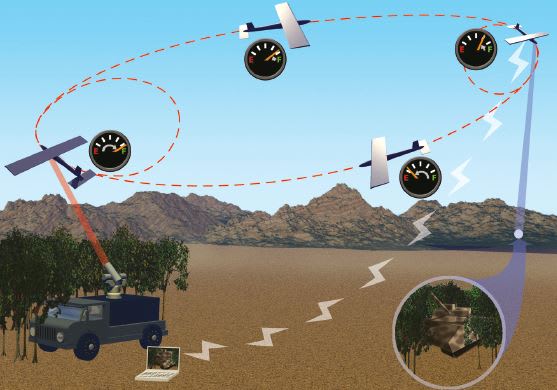
Wireless power increases the endurance of unmanned aerial vehicles and enables larger or more power-hungry payloads. With a demonstrated specific power of 800 W/kg (and designs going above 1,000 W/kg), LaserMotive’s laser power receivers provide energy density and endurance with no impact to payload. UAVs can either be powered continuously while staying within line of sight of the transmitter, or they can recharge and then fly out of sight for extended missions.
LaserMotive has demonstrated wireless power on multiple UAVs. In 2010, the company’s technology continuously supplied the Ascending Technologies Pelican quadrocopter, equipped with only a 5-minute battery, for 12.5 hours. In 2012, its devices powered the Lockheed Martin Stalker fixed-wing UAS for more than 48 hours of continuous operation; the technology demonstrated power-positive outdoor field operation of the entire system. Proof-of-concept flights in desert conditions were demonstrated at ranges up to 600 meters.
Power can be transmitted via fiber optic cable or through open air. Power over Fiber (PoF) enables lightweight, low-drag, neutrally-buoyant power delivery to underwater vehicles and sensors. PoF is also a key feature of the InvisiTower, a small tethered quadrocopter which can be an “instant tower” for portable area surveillance or elevated communications relays. The InvisiTower does not require an operator, and can be rapidly deployed, stowed, and transported.
LaserMotive Kent, WA 253-872-3300 www.lasermotive.com
For Free Info Click Here
More From SAE Media Group
Aerospace & Defense Tech Briefs
Ghoul Tool: The Weapon-Mountable Counter UAS Transmitter
Aerospace & Defense Tech Briefs
Martin UAV VTOL Unmanned Aircraft Taps Persistent Systems Wave Relay Data Link Technology
Aerospace & Defense Tech Briefs
Persistent Systems Auto-Tracking Antenna Adds Aircraft to Network, Enhances Data Sharing
Aerospace & Defense Tech Briefs
Anti-Drone Jammer
Aerospace & Defense Tech Briefs
Communications Infrastructure UAVs
Aerospace & Defense Tech Briefs
AeroVironment Releases New Puma 3
Aerospace & Defense Tech Briefs
Drone Parachute Rescue System
Aerospace & Defense Tech Briefs
Drone Charging System
Aerospace & Defense Tech Briefs
Unmanned Aircraft System Offers Superior Surveillance Imagery
Aerospace & Defense Tech Briefs
Automatic Drone Detection System
Aerospace & Defense Tech Briefs
Maritime Unmanned Aircraft System
Aerospace & Defense Tech Briefs
Multi-Sensor Electro-Optic Platform
Aerospace & Defense Tech Briefs
Connectors Lighten the SWaP Burden in UAV/MUMT Aircraft Electronics
Aerospace & Defense Tech Briefs
Hardening Unmanned Aerial Systems Against High-Power Microwave Threats in Support of Forward Operations
Aerospace & Defense Tech Briefs
Helicopter Load Sensor
Aerospace & Defense Tech Briefs
Fully Autonomous Unmanned Vehicles
Aerospace & Defense Tech Briefs
Bio-inspired Airborne Infrastructure Reconfiguration (BioAIR)
Aerospace & Defense Tech Briefs
A New Record for Optical Power Beaming
Aerospace & Defense Tech Briefs
Advances in Multi-UAV Operations
Aerospace & Defense Tech Briefs
Rotary Unmanned Aerial Systems
Aerospace & Defense Tech Briefs
Counter-UAS Technology
Aerospace & Defense Tech Briefs
Enabling Off-the-Shelf Autonomous Naval Warfare
Aerospace & Defense Tech Briefs
The Sky is No Longer the Limit Celebrating 75 Years of Air Force Technology
Aerospace & Defense Tech Briefs
Mobile Networking for Aircraft
Aerospace & Defense Tech Briefs
Nano-UAV Systems
Aerospace & Defense Tech Briefs
Digital Radar Warning Receiver
Aerospace & Defense Tech Briefs
New Diamond Super-Material Enhances Aircraft Survivability
Aerospace & Defense Tech Briefs
Effectiveness of Inter-Vehicle Communications and On-Board Processing for Close Unmanned Autonomous Vehicle Flight Formations
Aerospace & Defense Tech Briefs
Using SWaP-C Reductions to Improve UAS/UGV Mission Capabilities
Aerospace & Defense Tech Briefs
PAE ISR Engineers Boost Resolute Eagle UAS Networking, Endurance, Payload Capacity with Persistent Systems MPU5
Top Stories
INSIDERDefense
 New Raytheon and Lockheed Martin Agreements Expand Missile Defense Production
NewsAutomotive
 Ford Announces 48-Volt Architecture for Future Electric Truck
INSIDERManufacturing & Prototyping
 Active Strake System Cuts Cruise Drag, Boosts Flight Efficiency
ArticlesTransportation
 Accelerating Down the Road to Autonomy
INSIDERMaterials
 How Airbus is Using w-DED to 3D Print Larger Titanium Airplane Parts
Road ReadyTransportation

Webcasts
Electronics & Computers
 Cooling a New Generation of Aerospace and Defense Embedded...
Power
 Battery Abuse Testing: Pushing to Failure
Connectivity
 A FREE Two-Day Event Dedicated to Connected Mobility
Automotive
 Quiet, Please: NVH Improvement Opportunities in the Early Design Cycle
Transportation
 Advantages of Smart Power Distribution Unit Design for Automotive &...
Aerospace
 Sesame Solar's Nanogrid Tech Promises Major Gains in Drone Endurance