




Defense Tech Briefs - December 2012
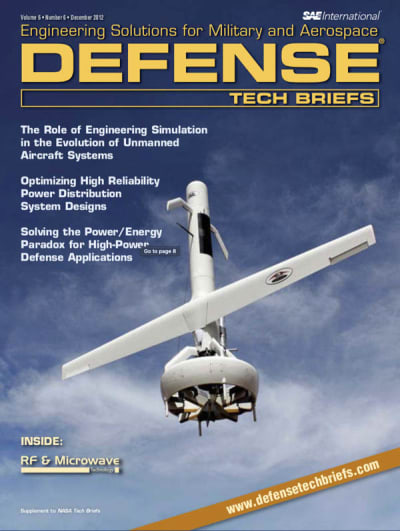
Inside this issue
Supplements

Overview
The December 2012 issue of Defense Tech Briefs presents a comprehensive overview of advancements in defense technology, focusing on engineering simulation, power distribution systems, and communication technologies. This edition is particularly relevant for professionals in the defense sector, engineers, and researchers interested in the latest innovations and applications in unmanned aircraft systems and high-power applications.
Key Features
-
The Role of Engineering Simulation in Unmanned Aircraft Systems: This article discusses how engineering simulation is transforming the design and development of unmanned aircraft systems (UAS). It highlights the importance of simulation in optimizing performance, reducing costs, and accelerating the development cycle. By using advanced modeling techniques, engineers can predict how UAS will behave under various conditions, leading to more efficient designs and improved operational capabilities.
-
Solving the Power/Energy Paradox for High-Power Defense Applications: The issue addresses the critical challenge of balancing power supply and energy consumption in high-power defense applications. It explores innovative solutions that aim to enhance energy efficiency while meeting the demanding power requirements of modern defense systems. The article emphasizes the need for advanced power management strategies and technologies that can support the operational needs of military platforms without compromising performance.
-
Optimizing High Reliability Power Distribution System Designs: This feature focuses on the design and optimization of power distribution systems that are crucial for the reliability of defense applications. It discusses various strategies to ensure that power systems can withstand harsh environments and maintain functionality under stress. The article provides insights into the latest technologies and methodologies that can enhance the reliability and efficiency of power distribution in military systems.
Technology Focus
The magazine also includes a section dedicated to emerging technologies, such as:
-
Materials & Coatings: Innovations in materials science are crucial for developing lightweight, durable components for defense applications. The issue discusses advancements in materials that can withstand extreme conditions while providing necessary performance characteristics.
Solar and Thermal Energy Harvesting Textile Composites for Aerospace Applications: This article explores the integration of energy-harvesting technologies into textile composites, which can be used in aerospace applications. These materials can capture solar and thermal energy, providing a sustainable power source for various systems.
-
Thermo-Elastic Nondestructive Evaluation of Fatigue Damage in PMR-15 Resin: The issue highlights techniques for assessing the integrity of materials used in defense applications, focusing on nondestructive evaluation methods that can detect fatigue damage without compromising the material.
-
Characterization of Ceramic Composite Materials Using Terahertz Nondestructive Evaluation Techniques: This article discusses the use of terahertz technology for evaluating ceramic composites, which are increasingly used in defense applications due to their strength and lightweight properties.
-
High Strain Rate Mechanical Properties of Glassy Polymers: The magazine examines the mechanical properties of glassy polymers under high strain rates, which is essential for understanding their behavior in dynamic environments typical of defense applications.
Application Briefs
The issue includes application briefs that provide real-world examples of how these technologies are being implemented in defense systems. One notable example is the MLB V-Bat Vertical Take-Off and Landing (VTOL) UAV, which features a unique ducted fan lift system. This design allows for efficient vertical take-off and landing while maintaining aerodynamic efficiency at high speeds. The Air Force has recognized the potential of this innovative UAV design, awarding it a Phase II Small Business Innovation Research (SBIR) grant.
RF & Microwave Technology
In addition to defense technologies, the magazine features a section on RF and microwave technology, which is critical for modern communication systems. The article on Testing Modern Radios discusses the use of Software Defined Radio (SDR) technology, which allows for dynamic control of communication parameters. SDR enables military communications to adapt to changing conditions in the radio spectrum, enhancing operational flexibility and effectiveness.
Conclusion
The December 2012 issue of Defense Tech Briefs serves as a valuable resource for professionals in the defense industry, providing insights into the latest technological advancements and their applications. With a focus on engineering simulation, power distribution, and communication technologies, this edition highlights the ongoing efforts to enhance the capabilities and reliability of defense systems. As the defense landscape continues to evolve, staying informed about these innovations is crucial for maintaining a competitive edge in the field.
Features
-
Application Briefs
-
Articles
Solving the Power/Energy Paradox for High-Power Defense Applications
The Role of Engineering Simulation in the Evolution of Unmanned Aircraft Systems
Optimizing High Reliability Power Distribution System Designs
Tech Briefs
-
Materials
Solar and Thermal Energy Harvesting Textile Composites for Aerospace Applications
Thermo-Elastic Nondestructive Evaluation of Fatigue Damage in PMR-15 Resin
Characterization of Ceramic Composite Materials Using Terahertz Nondestructive Evaluation Techniques
Products
-
Articles
Top Stories
INSIDERManufacturing & Prototyping
 How Airbus is Using w-DED to 3D Print Larger Titanium Airplane Parts
INSIDERManned Systems
 FAA to Replace Aging Network of Ground-Based Radars
NewsTransportation
 CES 2026: Bosch is Ready to Bring AI to Your (Likely ICE-powered) Vehicle
NewsSoftware
 Accelerating Down the Road to Autonomy
EditorialDesign
 DarkSky One Wants to Make the World a Darker Place
INSIDERMaterials
 Can This Self-Healing Composite Make Airplane and Spacecraft Components Last...
Webcasts
Defense
 How Sift's Unified Observability Platform Accelerates Drone Innovation
Automotive
 E/E Architecture Redefined: Building Smarter, Safer, and Scalable...
Power
 Hydrogen Engines Are Heating Up for Heavy Duty
Electronics & Computers
 Advantages of Smart Power Distribution Unit Design for Automotive...
Unmanned Systems
 Quiet, Please: NVH Improvement Opportunities in the Early Design...

