




Thermo-Elastic Nondestructive Evaluation of Fatigue Damage in PMR-15 Resin
Thermoset polyimide resins are used in high-temperature composites for aerospace applications such as engine shrouds.
New aircraft are expected to use more composite materials. This drives the need for nondestructive evaluation (NDE) of composite materials. Current aircraft are flown beyond their design lives, and have to be inspected for fatigue and other types of damage. This necessitates a need to understand the NDE signal-material relationship to evaluate the component state.
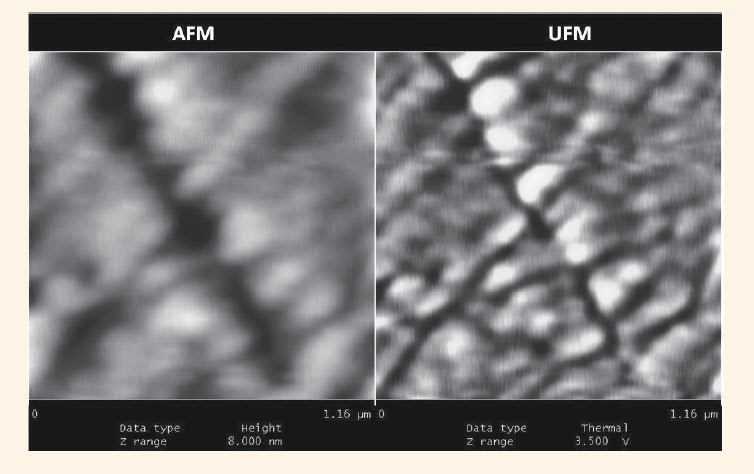
High-temperature thermoset monomers have three or more reactive sites to form bonds, unlike thermoplastic monomers, which have only two reactive sites. These extra sites enable crosslinking and network formation, as opposed to individual long chains in thermoplastics. When the reaction starts, the thermoset monomers have a low viscosity, which allows them to move about freely. Gradually, large groups of reacted monomers are formed (gel balls) in a solution of monomers and small groups of reacted monomers (oligomers). As the size of the gel balls grows, the viscosity increases, preventing the remaining monomers and oligomers from moving freely. In a cured thermoset polymer, this leads to regions of high crosslink density (gel balls) and regions that could not reach high crosslink density due to diffusion-limited motion (regions between the gel balls).
It is well known that crosslink density determines the physical properties of a polymer, with higher crosslink density resulting in higher elastic modulus (E), and higher glass transition temperature, Tg. It is expected that thermosets with regions of higher and lower crosslink density would behave like a two-phase material with one phase being stiffer (gel balls), and the other being more compliant (regions between the gel balls).
Thermoset polymers are viscoelastic materials. The two-phase nature of the material and the two-component nature of the model allow one to correlate the behavior of each phase to one of the components in the model. The gel balls being highly crosslinked and more stiff will behave more like the spring, while the less stiff between regions will behave more like the dashpot. The spring is assumed to be lossless and behave linearly with the stress, while the dashpot has a lossy behavior.
Under cyclic loading, the deformation of gel balls and the between regions will be different. Due to higher crosslink density, the gel balls are stiffer and will deform less compared to the between region. Depending on the load conditions, the polymer chains might be stretched and disentangled to different extents. Since the between region is softer than the gel balls, there is a possibility of rearrangement and alignment along the loading or other preferred direction, similar to slip in single crystalline materials. In tensile-tensile fatigue when the cyclic loading is interrupted, it is expected that at the peak stress, the material stretches, disentangling and elongating the polymer chains. Similarly, at minimum stress, the material relaxes, but not fully, owing to the viscoelastic nature of the material and the fact the material is still under some tensile stress.
PMR-15 resin is a high-temperature thermosetting polyimide used for aerospace composites where high temperature strength is required. This resin is rarely used by itself, and usually is used as the matrix material of a composite with glass or carbon fibers. In this work, PMR-15 resin was used alone so that hysteretic heating effects would not be complicated by contributions from both the resin and a fiber if a composite had been tested. To observe the changes in the behavior of hysteric heating under cyclic heating, dogbone-shaped specimens with 25.4 × 12.5 × 3 mm gage section were used. They were fatigued with a servo-hydraulic test machine with a stress ratio of 0.1, and a frequency of 3 Hz. Fatigue was stopped every 75,000 cycles for 30-60 minutes to allow the sample to return to ambient temperature. An infrared camera was used to record the sample heating behavior, and it was calibrated to have a high sensitivity about room temperature. A computercontrolled data acquisition system recorded the sample temperature.
To observe the changes in the microstructure due to fatigue, AFM and UFM measurements were performed on samples extracted from a fatigue fractured sample. The fatigue testing was interrupted every 75,000 cycles until the sample fractured. Between the interruptions, the sample was allowed to cool down to room temperature (30-60 minutes). In each of the interruptions, a clear transition in slope from a steeper initial slope to a shallower one is observed. This is indicative of a change in the heating behavior of the material. This experimental observation supports the two-phase deformation and hysteretic heating behaviors where the material effectively becomes stiffer once the polymer chains have been untangled and extended.
This work was done by J.T. Welter, E.A. Lindgren, and R. Hall of the Air Force Research Laboratory; and S. Sathish, G.P. Tandon, N. Schehl, M. Cherry, and V. Nalladega of the University of Dayton. AFRL-0213
This Brief includes a Technical Support Package (TSP).
Thermo-Elastic Nondestructive Evaluation of Fatigue Damage in PMR-15 Resin
(reference AFRL-0213) is currently available for download from the TSP library.
Don't have an account?
More From SAE Media Group
Aerospace & Defense Tech Briefs
High-Temperature Resins for Composite Materials
Aerospace & Defense Tech Briefs
Biobased Carbon Fibers and Thermosetting Resins for Use in DOD Composites Applications

Aerospace & Defense Tech Briefs
Fiber-Reinforced Thermoplastic Composites

Aerospace & Defense Tech Briefs
Molecular Engineering for Mechanically Resilient and Stretchable Electronic Polymers and Composites
Aerospace & Defense Tech Briefs
Continuous Carbon Nanofibers for Structural Composites
Aerospace & Defense Tech Briefs
Biobased Carbon Fibers and Thermosetting Resins for Use in DOD Composites Applications
Medical Design Briefs
Exploring Oligomers for Medical 3D Printing
Medical Design Briefs
Biomedical Balloons: Understanding Their Physical and Mechanical Properties
Tech Briefs
Healable Carbon Fiber Composite
Automotive Engineering
Linking Embroidery and Carbon Fiber to save Weight and Cost

Tech Briefs
Automated Tow/Tape Placement System
Aerospace & Defense Tech Briefs
‘Nanostitches’ Enable Lighter and Tougher Composite Materials
Aerospace & Defense Tech Briefs
High Temperature Graphene-Peek Adhesive
Tech Briefs
Self-Healing Aluminum Metal Matrix Composite
Tech Briefs
Process for Preparing Aerogels from Polyamides
Medical Design Briefs
3D Printable Polymer Nanocomposite Ink

Aerospace & Defense Tech Briefs
Designing Sensory and Adaptive Composite Materials
Overview
The document titled "Thermo-Elastic Nondestructive Evaluation of Fatigue Damage in PMR-15 Resin" presents research conducted by the Air Force Research Laboratory and the University of Dayton, focusing on the evaluation of fatigue damage in thermoset polyimide resins, specifically PMR-15. These resins are critical in aerospace applications, particularly in high-temperature environments such as engine shrouds, where they must endure significant thermal and mechanical stresses.
The study addresses a gap in existing literature regarding the effects of fatigue on thermosets, as most prior research has concentrated on thermoplastics. The authors investigate how cyclic loading affects the thermal properties of PMR-15 resin, utilizing nondestructive evaluation (NDE) techniques to monitor changes in heat generation during fatigue testing. This approach allows for the detection of subtle material changes associated with damage onset without compromising the integrity of the samples.
The methodology involved performing interrupted fatigue tests on four PMR-15 samples, during which temperature changes were recorded using a high-sensitivity infrared (IR) camera. The results revealed two distinct linear regions in the temperature rise during fatigue cycling. The first region exhibited a constant temperature response, while the second region showed an increasing trend, indicating progressive damage accumulation.
The findings suggest that the thermo-elastic response of PMR-15 resin can serve as an effective indicator of fatigue damage, providing a basis for developing reliable NDE techniques for monitoring the health of aerospace materials. The research emphasizes the importance of understanding the thermal behavior of thermoset polymers under cyclic loading conditions, which can lead to improved predictive maintenance strategies and enhanced safety in aerospace applications.
In conclusion, this document contributes valuable insights into the nondestructive evaluation of thermoset polyimide resins, highlighting the potential for thermo-elastic methods to assess fatigue damage. The work is supported by the U.S. Air Force and aims to advance the understanding of material performance in demanding environments, ultimately contributing to the development of safer and more reliable aerospace components.
Top Stories
NewsRF & Microwave Electronics
 Microvision Aquires Luminar, Plans Relationship Restoration, Multi-industry Push
INSIDERAerospace
 A Next Generation Helmet System for Navy Pilots
INSIDERDesign
 New Raytheon and Lockheed Martin Agreements Expand Missile Defense Production
INSIDERMaterials
 How Airbus is Using w-DED to 3D Print Larger Titanium Airplane Parts
NewsPower
 Ford Announces 48-Volt Architecture for Future Electric Truck
ArticlesAR/AI

Webcasts
Electronics & Computers
 Cooling a New Generation of Aerospace and Defense Embedded...
Automotive
 Battery Abuse Testing: Pushing to Failure
Power
 A FREE Two-Day Event Dedicated to Connected Mobility
Unmanned Systems
 Quiet, Please: NVH Improvement Opportunities in the Early Design Cycle
Automotive
 Advantages of Smart Power Distribution Unit Design for Automotive &...
Energy
 Sesame Solar's Nanogrid Tech Promises Major Gains in Drone Endurance