




High Temperature Graphene-Peek Adhesive
Compounding graphene into polymers has the potential to improve various material properties, even at very low concentrations.
Joining of composites can be a challenging issue. If adhesives are used, the joints are permanent and cannot be undone. If they need to be undone, inserts are often used and these inserts increase cost and weight. Additionally, fibers can be cut in the process leading to a part with weakened mechanical properties.
Even with these drawbacks, most components that need to be joined are threaded together, allowing for removal of the parts at a later time. However, threaded connections are costly to design and manufacture, and are often the location of fatigue failures due to their inherent stress concentrations. From an environmental and cost standpoint, there is a large waste associated with the removal of material to form the threads, even more so in sectored threads, where up to half of the machined thread is then cut away. Additionally, threaded joints often require grease to seal out environmental contamination and ensure that they can later be disassembled. This effort is aimed at replacing seldom-used threaded connections with a reusable thermoplastic adhesive.
The use of a thermoplastic makes the joining reversible, allowing any connection to be treated almost like a threaded joint, only one that uses heat instead of torque for activation. Recently, using thermoplastics as reusable adhesives has been researched by DoE for application in automobiles. However, that work is focused on thermoplastics for room temperature applications, with no work being conducted on high temperature thermoplastics such as PEEK and Polyimide. The use of localized microwave radiation to heat the thermoplastic will eliminate the need for large furnaces which consume large amounts of time and energy, and ultimately heat other parts of the system that do not need to be heated. Therefore, an investigation was begun into activating high temperature thermoplastics using microwave radiation.
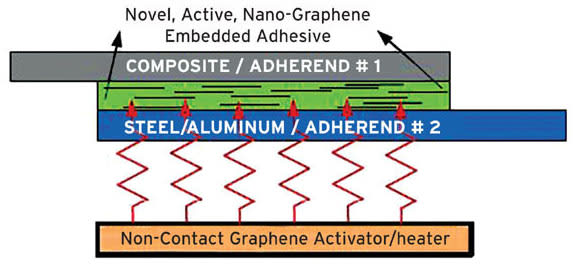
The accompanying figure shows the basic concept. Two adherends are brought together with a graphene-doped thermoplastic between them. The assembly is then subjected to microwaves which excite the graphene nanoplatelets in the adhesive generating heat and causing the adhesive to melt. When the microwave source is removed, the adhesive solidifies joining the two materials. Since the adhesive is a thermoplastic, subsequent applications of microwaves can be used to remelt the adhesive and disassemble the assembly. For adherends that block microwaves, a wave guide would be needed to direct them to the bondline.
While various carbon species can absorb microwaves, nanospecies such as carbon nanotubes and graphene have been investigated most recently because of their highly effective absorption at low weight loadings and ability to improve mechanical properties as well. Microwaves, when incident on an absorptive material, create heating by the interaction of the electromagnetic fields with the molecular and electronic structures of the molecules in the material exposed to the microwaves. The amount, and rate, of heating can be a function of microwave power, frequency, absorption, etc.
This work was done by Andrew Littlefield, Joshua A. Maurer, and Stephen F. Bartolucci for the Armament Research, Development and Engineering Center. ARL-0207
This Brief includes a Technical Support Package (TSP).
HIGH TEMPERATURE GRAPHENE-PEEK ADHESIVE
(reference ARL-0207) is currently available for download from the TSP library.
Don't have an account?
More From SAE Media Group
Aerospace & Defense Tech Briefs
‘Nanostitches’ Enable Lighter and Tougher Composite Materials
Aerospace & Defense Tech Briefs
Fiber-Reinforced Thermoplastic Composites
Tech Briefs
Automated Tow/Tape Placement System

Tech Briefs
Fiber-Metal Laminate Manufacturing Technique
Aerospace & Defense Tech Briefs
Using Thermoplastic Composites for Aerospace Applications

Tech Briefs
Thin Heat Shield for Superfast Aircraft
Aerospace & Defense Tech Briefs
High-Temperature Resins for Composite Materials
Aerospace Manufacturing and Machining INSIDER
Can This Self-Healing Composite Make Airplane and Spacecraft Components Last for Centuries?
Aerospace & Defense Tech Briefs
Thermoplastic Composites to Play Enhanced Role in Next-Generation Aerospace Applications
Aerospace & Defense Tech Briefs
Hydraulic Testing of Polymer Matrix Composite 102mm Tube Section
Aerospace & Defense Tech Briefs
Bioenvironmental Engineering Guide for Composite Materials
Aerospace & Defense Tech Briefs
Designing Sensory and Adaptive Composite Materials
Aerospace & Defense Tech Briefs
Biobased Carbon Fibers and Thermosetting Resins for Use in DOD Composites Applications
Aerospace & Defense Tech Briefs
Biobased Carbon Fibers and Thermosetting Resins for Use in DOD Composites Applications

Tech Briefs
3D-Printed Composites for High-Temperature Uses
Aerospace & Defense Tech Briefs
Beyond Boundaries: Elevating Aerospace Design with Fluorosilicones
Aerospace & Defense Tech Briefs
Aligned MWCNTs as Thermal Conductors in Adhesive Joints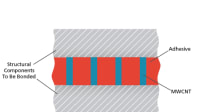
Aerospace & Defense Tech Briefs
Towards Sustainable Recycling of Epoxy-Based Polymers: Approaches and Challenges of Epoxy Biodegradation

Tech Briefs
Silicon Carbide Fiber Tows
Aerospace Manufacturing and Machining INSIDER
Thermoplastic Drive Shaft System Developed for Aerospace Applications
Aerospace & Defense Tech Briefs
Thermal Conductivities of Some Polymers and Composites
Aerospace & Defense Tech Briefs
Novel Whisker Mitigating Composite Conformal Coat Assessment
Overview
The document is a technical report titled "High Temperature Graphene-PEEK Adhesive," authored by Andrew Littlefield, Joshua A. Maurer, and Stephen F. Bartolucci, and was presented at the SAMPE Conference in May 2017. The report is associated with the U.S. Army ARDEC, specifically Benet Laboratories, and is designated with the report number ARWSB-TR-17015.
The primary focus of the report is the development and evaluation of a novel adhesive that combines graphene with PEEK (Polyether Ether Ketone), a high-performance thermoplastic known for its excellent thermal stability, chemical resistance, and mechanical properties. The integration of graphene, a material renowned for its exceptional strength and conductivity, aims to enhance the adhesive's performance, particularly in high-temperature environments.
The report outlines the methodology used in the research, including the preparation of the graphene-PEEK composite adhesive, the testing procedures, and the evaluation of its properties. Key performance metrics such as adhesion strength, thermal stability, and resistance to various environmental factors are discussed. The authors provide a detailed analysis of the results, demonstrating that the graphene-PEEK adhesive exhibits superior performance compared to traditional adhesives, particularly in applications requiring durability under extreme conditions.
Additionally, the report addresses the implications of these findings for military and industrial applications, where reliable bonding materials are critical for the performance and longevity of components exposed to harsh environments. The authors emphasize the potential for this adhesive to be utilized in various sectors, including aerospace, automotive, and electronics, where high-temperature resistance and mechanical integrity are paramount.
The document also includes administrative details such as the report date, the responsible person (Andrew Littlefield), and contact information. It is classified as unclassified and approved for public release, indicating that the findings can be shared without restrictions.
In conclusion, the "High Temperature Graphene-PEEK Adhesive" report presents significant advancements in adhesive technology, highlighting the benefits of combining graphene with PEEK to create a high-performance adhesive suitable for demanding applications. The research contributes to the ongoing exploration of advanced materials and their potential to enhance engineering solutions in various fields.
Top Stories
INSIDERDefense
 New Raytheon and Lockheed Martin Agreements Expand Missile Defense Production
NewsAutomotive
 Ford Announces 48-Volt Architecture for Future Electric Truck
INSIDERManufacturing & Prototyping
 Active Strake System Cuts Cruise Drag, Boosts Flight Efficiency
ArticlesTransportation
 Accelerating Down the Road to Autonomy
INSIDERMaterials
 How Airbus is Using w-DED to 3D Print Larger Titanium Airplane Parts
Road ReadyTransportation

Webcasts
Electronics & Computers
 Cooling a New Generation of Aerospace and Defense Embedded...
Power
 Battery Abuse Testing: Pushing to Failure
Connectivity
 A FREE Two-Day Event Dedicated to Connected Mobility
Automotive
 Quiet, Please: NVH Improvement Opportunities in the Early Design Cycle
Transportation
 Advantages of Smart Power Distribution Unit Design for Automotive &...
Aerospace
 Sesame Solar's Nanogrid Tech Promises Major Gains in Drone Endurance