




New Raytheon and Lockheed Martin Agreements Expand Missile Defense Production
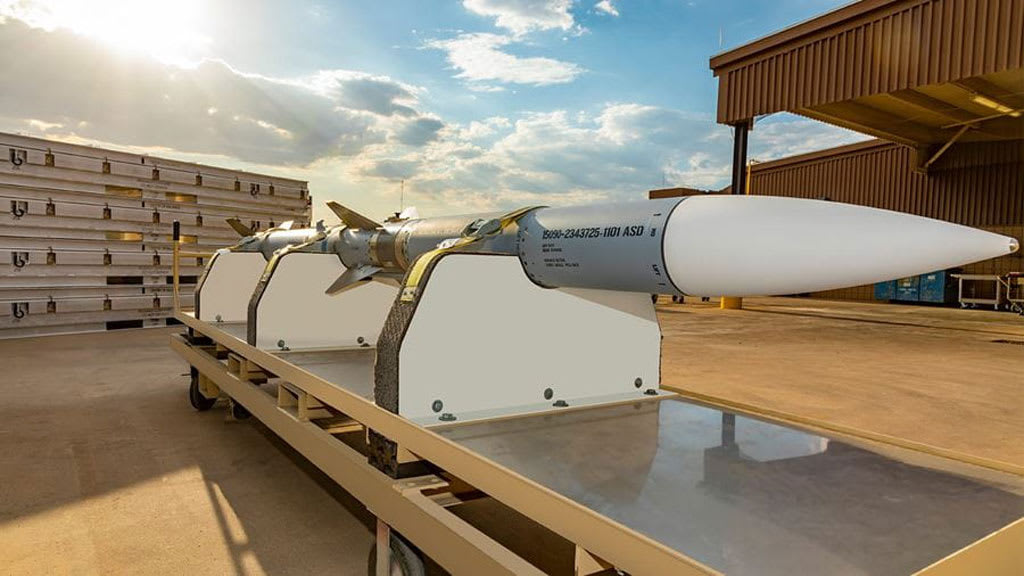
The Defense Department has announced new separate framework agreements with RTX’s Raytheon and Lockheed Martin aimed at rapidly scaling production of both offensive strike weapons and missile‑defense interceptors.
Raytheon’s Missile Production Agreements
RTX’s Raytheon finalized five new framework agreements with the Defense Department to significantly increase U.S.-based production of Tomahawk cruise missiles, AMRAAM air‑to‑air missiles, SM‑3 Block IB and IIA interceptors, and SM‑6 multi‑mission missiles. The agreements span up to seven years and leverage previous capital investments to expand manufacturing throughput at facilities in Tucson, Arizona; Huntsville, Alabama; and Andover, Massachusetts.
Under the new frameworks, Raytheon will scale annual production to over 1,000 Tomahawks, at least 1,900 AMRAAMs , and more than 500 SM‑6 missiles, while also increasing production of SM‑3 IIAs and SM‑3 IBs. Many of these munitions are projected to double or quadruple their current production rates. Raytheon executives cite the agreements as a model for government–industry collaboration under the administration’s Acquisition Transformation Strategy, ensuring faster fielding of critical systems.
The expanded production will support U.S. and allied requirements for long‑range precision strike and integrated air and missile defense. The Tomahawk has been operationally employed more than 2,300 times and flight‑tested over 550 times, while AMRAAM remains the world’s most widely deployed air‑to‑air missile, supporting both fighter aircraft and NASAMS air-defense systems.

Lockheed Martin to Quadruple THAAD Interceptor Production
In a parallel effort to bolster missile defense, Lockheed Martin signed a new Defense Department framework agreement to quadruple production of Terminal High Altitude Area Defense (THAAD) interceptors, increasing annual capacity from 96 to 400. The announcement builds on a previous agreement to accelerate PAC‑3 MSE interceptor output.
To support the increase, Lockheed Martin is breaking ground on a new Munitions Acceleration Center in Camden, Arkansas. The facility will integrate advanced manufacturing, robotics, and digital engineering to support THAAD, PAC‑3, and future missile‑defense programs. The company is also planning multibillion‑dollar investments over the next three years to modernize more than 20 facilities across Arkansas, Alabama, Florida, Massachusetts, and Texas.
Lockheed notes that THAAD’s hit‑to‑kill intercept capability — effective both inside and outside the atmosphere — has reinforced its operational value across U.S. and allied deployments. Since 2016, the company has increased deliveries of six critical munitions by more than 220 percent, with a further 245 percent increase planned to support the Pentagon’s rising missile‑defense requirements.
More From SAE Media Group
Defense INSIDER
Patriot Missile Hits Target in Test of Upgraded ICBS Radar
Aerospace & Defense Tech Briefs
Loitering Precision Strike Missile
Aerospace & Defense Tech Briefs
Integrated Electric Power Kits for Army Vehicles
Defense INSIDER
Kauai Test Facility Launches Its Largest Missile
Aerospace & Defense Tech Briefs
S-Band Radar Systems
Aerospace & Defense Tech Briefs
Surface to Surface Missile
Defense INSIDER
PAC-3 Missile Successfully Intercepts Cruise Missile Target
Aerospace & Defense Tech Briefs
Post Deployment Build-7 (PDB-7) Software

Defense INSIDER
U.S. Army Orders Next-Generation Missile Warning Systems
Aerospace & Defense Tech Briefs
UAS Interceptor System

Defense INSIDER
US, Japan Conduct First SM-3 Block IIA Intercept Test

Defense INSIDER
Army Receives First Next Generation Precision Strike Missile
Aerospace & Defense Tech Briefs
Factory-as-a-Service for Missile Production

Aerospace & Defense Tech Briefs
VPX Chassis for Missile System

Defense INSIDER
Army Develops Technology to Intercept Drones
Aerospace & Defense Tech Briefs
Missile Defense System Signal Processor
Aerospace & Defense Tech Briefs
Five Missile-Tracking Satellites Launched
Defense INSIDER
Laser-Based Aircraft Countermeasures Protect Against MANPADS
Aerospace & Defense Tech Briefs
Next Generation C-UAS Missile
Aerospace INSIDER
ATHENA Sensor Brings Generational Leap to Airborne MANPAD Protection
Aerospace & Defense Tech Briefs
AIM-120D-3 Air-to-Air Missile

Defense INSIDER
Raytheon Pairs Laser Weapon with NASAMS Air Defense System
Aerospace & Defense Tech Briefs
Next Generation Air and Missile Defense Radar
Aerospace & Defense Tech Briefs
Missile Defense System
Top Stories
INSIDERManufacturing & Prototyping
 How Airbus is Using w-DED to 3D Print Larger Titanium Airplane Parts
NewsUnmanned Systems
 Microvision Aquires Luminar, Plans Relationship Restoration, Multi-industry Push
INSIDERAerospace
 A Next Generation Helmet System for Navy Pilots
ArticlesTransportation
 CES 2026: Bosch is Ready to Bring AI to Your (Likely ICE-powered) Vehicle
Road ReadyTransportation
 2026 Nissan Sentra Review: Putting the Pieces Together
NewsTransportation

Webcasts
Automotive
 Hydrogen Engines Are Heating Up for Heavy Duty
Automotive
 Advantages of Smart Power Distribution Unit Design for Automotive...
Automotive
 Quiet, Please: NVH Improvement Opportunities in the Early Design...
Energy
 Battery Abuse Testing: Pushing to Failure
Internet of Things
 A FREE Two-Day Event Dedicated to Connected Mobility
Defense
 SiPhog Technology: Enabling GPS‑Independent Flight for Uncrewed Aerial...