




Laser-Based Aircraft Countermeasures Protect Against MANPADS
The Army expects to reach a Milestone B decision with its laser-based common infrared countermeasures, or CIRCM, defense system program later this year. The CIRCM system, under development now by both BAE and Northrup Grumman, provides a lightweight, laser-based countermeasure against man-portable air defense systems, which are missile-launched from the ground at their targets, including Army and Navy aircraft.
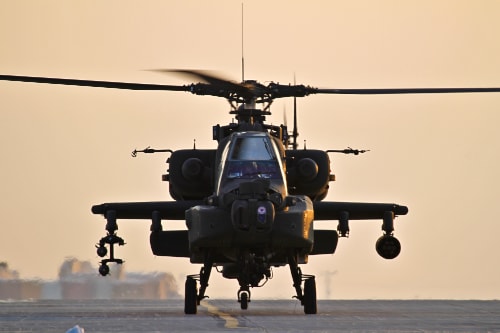
It is expected that the CIRCM system will begin fielding in Fiscal Year 2019 to both the Army and the Navy, and will be used aboard helicopters, tilt- rotor aircraft, and small fixed-wing aircraft. Included among those aircrafts are the AH-64 Apache and the UH-60 Black Hawk. Within the Department of the Navy -- a partner in the CIRCM program -- the AH-1 Cobra will receive the system, as will the MV-22 Osprey. In the future, Lee said, the Advanced Threat Infrared Countermeasures system aboard the CH-47 Chinook will be replaced with the CIRCM as well.
According to Col. Jong H. Lee, project manager for Aircraft Survivability Equipment, the primary threat CIRCM is meant to address is man-portable air- defense system, also known as MANPADS, which are in use worldwide by both nation states as well as non-state actors. The CIRCM works in conjunction with the Army's existing Common Missile Warning System aboard aircraft now. The CMWS can detect an incoming threat from a MANPADS and automatically pass relevant information about that threat to the CIRCM system.
CIRCM works in combination with the missile warning system to detect and defeat MANPADS. Missiles launched from MANPADS are typically guided by infrared capability, Lee said. The missiles guide themselves toward a target's infrared heat signature. The laser that is part of the CIRCM system takes advantage of that. Insofar, as pilot interaction is concerned, Lee said the entire system is automatic. "They only have to turn it on," Lee said. "It's meant to be fully automatic. It really makes it an extremely valuable system for the pilots and the passengers."
Lee said the CIRCM system primarily includes three components: a pointer/tracker unit, laser, and system processor unit. These three primary pieces of hardware are part of what Lee said is called the "B-Kit" portion of CIRCM. The system also includes what is being called an "A-Kit." The A-Kit portion includes the wiring and harnesses that must be installed in an aircraft before the B-KIT can be installed. Approximately 3,000 A-Kits will be purchased and installed in Army aircraft, Lee said, while 1,000 B-Kits will be purchased.
Lee said it takes "several hundred hours" to install an A-Kit into an aircraft, while it takes only a few hours to install the B-Kits in an aircraft if the A-Kits have already been installed. With this configuration, he said, it will be easy to move the B-Kit hardware - the primary system hardware - from one A-Kit-equipped aircraft to another. This means that aircraft can be easily equipped with the CIRCM system if it is needed for a mission, or the system can be removed and used elsewhere if an aircraft does not need it.
Lee said the biggest difference between CIRCM and other counter-measure systems currently in use - including the ATIRCM - is that CIRCM is so light weight. The B-Kit portion of the system weighs just 85 pounds, he said. And the Army is working with contractors to reduce the weight of the A-Kits as well. He said that both the ATIRCM - used now on the CH-47 Chinook - and the large aircraft infrared countermeasures systems, used by the Air Force, are too large for some of the aircraft the Army wants to protect with the CIRCM system. He also said the CIRCM system is designed with open systems architecture to be easily expanded, to take on more threats than what exist today. And "with a laser system, you have unlimited rounds you can dispense against threats," Lee added.
Right now, Lee said, development of CIRCM has passed a "Milestone A" decision and is in the technology maturation and risk-reduction phase, during which time the cost risks associated with technology, engineering, integration, and life cycle are reduced. During this phase, the CIRCM must also reach "technology readiness level 6." This will allow the program to successfully pass a "Milestone B" decision. When Milestone B is reached, the program will award a contract for the "engineering and manufacturing development phase" to just one contractor -- eliminating one of the current two contractors from competition. The Milestone B decision is expected to be made within this fiscal year.
Source :
More From SAE Media Group

Aerospace INSIDER
ATHENA Sensor Brings Generational Leap to Airborne MANPAD Protection
Aerospace & Defense Tech Briefs
Missile Protection System
Aerospace & Defense Tech Briefs
Multi-Spectral Targeting System
Aerospace & Defense Tech Briefs
Missile Protection System

Aerospace & Defense Tech Briefs
Loitering Precision Strike Missile
Aerospace & Defense Tech Briefs
Next Generation Air and Missile Defense Radar
Defense INSIDER
Patriot Missile Hits Target in Test of Upgraded ICBS Radar
Aerospace & Defense Tech Briefs
Precision Strike Missile Increment 1 Achieves Milestone C Approval
Defense INSIDER
Navy Proves Cold-Gas Approach in Hypersonic Launch Test
Aerospace & Defense Tech Briefs
F/A-18 Infrared Search and Rescue System


Defense INSIDER
PAC-3 Missile Successfully Intercepts Cruise Missile Target
Defense INSIDER
U.S. Army Orders Next-Generation Missile Warning Systems
Aerospace & Defense Tech Briefs
Missile Defense Battle Manager

Aerospace & Defense Tech Briefs
Next Generation C-UAS Missile

Aerospace & Defense Tech Briefs
Vehicle Active Protection System
Aerospace INSIDER
Navy Selects Lockheed Martin and Raytheon to Develop Hypersonic Missile
Aerospace & Defense Tech Briefs
Advanced Airborne Defensive Laser for Incorporation on Strike Fighter Aircraft
Defense INSIDER
Army Aviators Test Next Generation Air-to-Ground Missile
Defense INSIDER
Raytheon Pairs Laser Weapon with NASAMS Air Defense System
Defense INSIDER
Army Receives First Next Generation Precision Strike Missile
Aerospace & Defense Tech Briefs
Surface to Surface Missile


Top Stories
NewsSensors/Data Acquisition
 Microvision Aquires Luminar, Plans Relationship Restoration, Multi-industry Push
INSIDERRF & Microwave Electronics
 A Next Generation Helmet System for Navy Pilots
INSIDERWeapons Systems
 New Raytheon and Lockheed Martin Agreements Expand Missile Defense Production
NewsAutomotive
 Ford Announces 48-Volt Architecture for Future Electric Truck
INSIDERAerospace
 Active Strake System Cuts Cruise Drag, Boosts Flight Efficiency
ArticlesTransportation

Webcasts
Aerospace
 Cooling a New Generation of Aerospace and Defense Embedded...
Energy
 Battery Abuse Testing: Pushing to Failure
Power
 A FREE Two-Day Event Dedicated to Connected Mobility
Automotive
 Quiet, Please: NVH Improvement Opportunities in the Early Design Cycle
Electronics & Computers
 Advantages of Smart Power Distribution Unit Design for Automotive &...
Unmanned Systems
 Sesame Solar's Nanogrid Tech Promises Major Gains in Drone Endurance