




Air Force and Lockheed Martin Complete ARRW Hypersonic Boosted Test Flight

The U.S. Air Force and Lockheed Martin successfully conducted a hypersonic-boosted flight test of the AGM-183A Air-launched Rapid Response Weapon (ARRW) from the service’s B-52H Stratofortress. The successful flight demonstrates the weapon’s ability to reach and withstand operational hypersonic speeds, collect crucial data for use in further flight tests, and validate safe separation from the aircraft to deliver the glide body and warhead to designated targets from significant standoff distances.
“The need for hypersonic strike capabilities is critical to our nation and this successful test will help us to maintain an accelerated and rigorous timeline,” said Dave Berganini, vice president of Hypersonic and Strike Systems at Lockheed Martin Missiles and Fire Control. “Our strong partnership with the U.S. Air Force has allowed us to quickly progress hypersonic technologies for our men and women in uniform.”
“The ARRW rapid prototyping program used Section 804 authorities provided by Congress to significantly accelerate the development and test of this system, without sacrificing engineering rigor,” said Marya Bard, U.S. Air Force ARRW program director. “The tightly integrated Lockheed Martin and government team achieved speed with discipline by focusing on a common vision of providing combatant commanders a survivable rapid response strike capability as early as possible.”
Additional booster and all-up-round test flights will continue throughout 2022, before reaching Early Operational Capability (EOC) in 2023.
Hypersonic weapons provide a rapid response, time critical capability to overcome distance in contested environments using high speed, altitude and maneuverability.
Hypersonic technology has continued to present several complex engineering challenges. Going Mach 5, sometimes even faster, generates extreme levels of heat, driving the need for innovative materials, sensors and electronics to withstand such speeds throughout its journey. In addition to heat, these systems must be able to maintain consistent communication connections, as well as considerable intelligence to perform precise maneuverability techniques to overcome a wide range of advanced defense systems and extreme contested environments.
More From SAE Media Group

Aerospace & Defense Tech Briefs
Hypersonic Propulsion System Manufacturing


Aerospace Manufacturing and Machining INSIDER
DARPA Completes Key Milestone on Hypersonic Air-breathing Weapons Program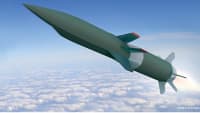
Aerospace INSIDER
How the Air Force's B-21 Raider is Advancing Across Test and Production
Aerospace & Defense Tech Briefs
Lockheed Martin Announces Latest Hypersonic Progress at Le Bourget
Defense INSIDER
Patriot Missile Hits Target in Test of Upgraded ICBS Radar
Defense INSIDER
PAC-3 Missile Successfully Intercepts Cruise Missile Target
Aerospace & Defense Tech Briefs
Raytheon, DARPA Push Forward with Hypersonic Weapon Design

Defense INSIDER
Airbus Defence and Space Produces 2,000th Target Drone
Aerospace INSIDER
A-10 Warthog to Get New Mission Computer


Aerospace INSIDER
Navy Selects Lockheed Martin and Raytheon to Develop Hypersonic Missile
Aerospace INSIDER
Hermeus Quarterhorse Joins Hypersonic High Cadence Testing Program

Aerospace INSIDER
Production Ready B-21 Bomber on Track for First Flight This Year

Aerospace & Defense Tech Briefs
BlueHalo Completes Test of Next Generation C-UAS Missile

Aerospace & Defense Tech Briefs
Tactical Combat Missiles

Aerospace & Defense Tech Briefs
Anti-Ship Missile
Aerospace INSIDER
Northrop Grumman Continues B-2 Spirit Modernization

Aerospace & Defense Tech Briefs
Next Generation C-UAS Missile
Aerospace INSIDER
Archer Delivers First Midnight eVTOL to US Air Force
Top Stories
NewsSensors/Data Acquisition
 Microvision Aquires Luminar, Plans Relationship Restoration, Multi-industry Push
INSIDERRF & Microwave Electronics
 A Next Generation Helmet System for Navy Pilots
INSIDERWeapons Systems
 New Raytheon and Lockheed Martin Agreements Expand Missile Defense Production
NewsAutomotive
 Ford Announces 48-Volt Architecture for Future Electric Truck
INSIDERAerospace
 Active Strake System Cuts Cruise Drag, Boosts Flight Efficiency
ArticlesTransportation

Webcasts
Aerospace
 Cooling a New Generation of Aerospace and Defense Embedded...
Energy
 Battery Abuse Testing: Pushing to Failure
Power
 A FREE Two-Day Event Dedicated to Connected Mobility
Automotive
 Quiet, Please: NVH Improvement Opportunities in the Early Design Cycle
Electronics & Computers
 Advantages of Smart Power Distribution Unit Design for Automotive &...
Unmanned Systems
 Sesame Solar's Nanogrid Tech Promises Major Gains in Drone Endurance