




Lockheed Martin Announces Latest Hypersonic Progress at Le Bourget

Lockheed Martin Corporation successfully flight tested the AGM-183A Air-Launched Rapid Response Weapon (ARRW) on a U.S. Air Force Boeing B-52 Stratofortress . The captive carry flight – announced during the 2019 International Paris Air Show – marks Lockheed Martin’s most recent demonstration of hypersonic technology development.
This captive carry flight – conducted out of Edwards Air Force Base in southern California – is the latest step in the U.S. Air Force's rapid prototyping effort to mature the ARRW, which just completed a preliminary design review in March. The ARRW test article was sensor-only version with no explosives. The test article gathered environmental and aircraft handling data during the flight, such as drag and vibration impacts on the ARRW and its external aircraft-mounted carriage. This type of data collection is required for all Air Force weapon systems undergoing development.
“We’re using the rapid prototyping authorities provided by Congress to quickly bring hypersonic weapon capabilities to the warfighter,” says Dr. Will Roper, assistant secretary of the Air Force for Acquisition, Technology, and Logistics. “We set out an aggressive schedule with ARRW. Getting to this flight test on time highlights the amazing work of our acquisition workforce and our partnership with Lockheed Martin and other industry partners.”
More ground and flight testing will follow over the next three years to expand ARRW’s test parameters and capabilities, eventually leading to the hypersonic weapon’s planned operational status in 2022. ARRW is currently one of two ongoing U.S. Air Force hypersonic weapons efforts. The other, the Hypersonic Conventional Strike Weapon (HCSW), is also under development by Lockheed Martin.
“This type of speed in our acquisition system is essential – it allows us to field capabilities rapidly to compete against the threats we face,” adds Roper.
“With hypersonic capabilities being a national security priority, Lockheed Martin and the U.S. Air Force are accelerating the maturation and fielding of a hypersonic weapon system,” says Frank St. John, executive vice president at Lockheed Martin Missiles and Fire Control. “Lockheed Martin is proud to partner with the U.S. Air Force on this important initiative.”
Hypersonic capabilities amplify many of the enduring attributes of airpower – speed, range, flexibility, and precision – and provide an affordable capability that will overcome distance in contested environments.
The ARRW rapid prototyping effort awarded a contract in August 2018 to Lockheed Martin Missiles and Fire Control in Orlando, Florida, for critical design review, test and production readiness support to facilitate fielded prototypes. According to Lockheed Martin, its robust experience in high-speed flight has positioned the company to be an industry leader in hypersonic technology, providing the most mature and cost-effective solutions for addressing increasing threats in the global security arena.
Lockheed Martin has played a significant role in the research, development, and demonstration of hypersonic technologies for more than 30 years. The corporation has made significant investments in key technology and capability development – including hypersonic strike capabilities and defense systems against emerging hypersonic threats – in support of the U.S. government.
William Kucinski is content editor at SAE International, Aerospace Products Group in Warrendale, Pa. Previously, he worked as a writer at the NASA Safety Center in Cleveland, Ohio and was responsible for writing the agency’s System Failure Case Studies. His interests include literally anything that has to do with space, past and present military aircraft, and propulsion technology.
Contact him regarding any article or collaboration ideas by e-mail at
More From SAE Media Group
Aerospace & Defense Tech Briefs
Northrop Grumman Will Fit Its Scramjet Combustors to Raytheon’s Hypersonic Missile
Aerospace & Defense Tech Briefs
Pratt & Whitney Receives $437M for Continued Adaptive Engine Development
Aerospace & Defense Tech Briefs
Raytheon, DARPA Push Forward with Hypersonic Weapon Design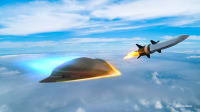
Aerospace & Defense Tech Briefs
Militaries Choose Marvin Test Solutions MTS-3060A with Enhanced Flight-Line Test Capabilities, Cybersecurity
Aerospace & Defense Tech Briefs
Lockheed Martin’s “Non-Operational” Space Fence Detects Indian Anti-Satellite Operations While Still in Test Mode
Aerospace & Defense Tech Briefs
Boeing KC-46 Program Completes Flight Testing Required for First Delivery to U.S. Air Force
Aerospace & Defense Tech Briefs
Generation Orbit’s GOLauncher1 Is Officially the Air Force’s X-60A Hypersonic Flight Research Vehicle
Aerospace & Defense Tech Briefs
Artificial Intelligence Could Reduce CV-22 Osprey Maintenance
Aerospace & Defense Tech Briefs
Ministry of Defense of Qatar Orders 28 NHIndustries NH90 Multirole Military Helicopters
Aerospace & Defense Tech Briefs
Recoated and Ready
Aerospace & Defense Tech Briefs
When It Comes to Fifth-Generation Assets, Air Force Values Virtual Training over Live Flying
Aerospace & Defense Tech Briefs
Aitech Defense Will Provide Data Interface Technology for Boeing’s Unmanned MQ-25 Refueling Platform
Aerospace & Defense Tech Briefs
The F-35 Is Getting Life-Saving Automatic Ground Collision Avoidance Systems from the F-16
Aerospace & Defense Tech Briefs
Old Bird Learns New Tricks
Automotive Engineering
NASA Picks Lockheed to Build Low-Boom X-Plane
Aerospace & Defense Tech Briefs
The Air Force’s New Unmanned Wingmate Completes Inaugural Flight
Aerospace & Defense Tech Briefs
MTSI’s Latest Project Gives Fixed-Wing Aircraft Vertical Cargo Lift Capabilities
Aerospace & Defense Tech Briefs
Raytheon, UTC Merger Will Direct $8B R&D Budget Toward Hypersonics, Cybersecurity, AI, and Next-Gen Connected Aircraft
Aerospace & Defense Tech Briefs
Curtiss-Wright Will Provide Data Technology Support for Boeing’s MQ-25 Unmanned Air Refueling Platform
Aerospace & Defense Tech Briefs
ANSYS Will Help Airbus Develop AI-Enabled Flight Controls for the FCAS Program’s Autonomous Wingmen
Aerospace & Defense Tech Briefs
BAE Systems Will Supply Flight Control and Target Identification Systems for Boeing’s Carrier-Based MQ-25
Aerospace & Defense Tech Briefs
General Atomics Moves Toward Global RPA Flight Certification for MQ-9B SkyGuardian
Aerospace & Defense Tech Briefs
Next Phase of the USAF Pilot Training Next Initiative Includes an Open Call for Innovative Solutions
Aerospace & Defense Tech Briefs
SES to Outfit Sikorsky UH-60A Black Hawk Helicopters with Unitech Composites Weapons Pylons
Aerospace & Defense Tech Briefs
Gaming Tech Helps Apache Maintainers Reduce Training Time
Aerospace & Defense Tech Briefs
Air Force Tests Fully Autonomous UAS Control System
Aerospace & Defense Tech Briefs
SAE International Establishes a New AI Standards Committee at Le Bourget
Aerospace & Defense Tech Briefs
Advanced Airborne Defensive Laser for Incorporation on Strike Fighter Aircraft
Aerospace & Defense Tech Briefs
Like a Good Neighbor, Impossible Aerospace Flew over to a Nearby Construction Fire to Help Locate Hotspots for First Responders
Top Stories
NewsSensors/Data Acquisition
 Microvision Aquires Luminar, Plans Relationship Restoration, Multi-industry Push
INSIDERRF & Microwave Electronics
 A Next Generation Helmet System for Navy Pilots
INSIDERWeapons Systems
 New Raytheon and Lockheed Martin Agreements Expand Missile Defense Production
NewsAutomotive
 Ford Announces 48-Volt Architecture for Future Electric Truck
INSIDERAerospace
 Active Strake System Cuts Cruise Drag, Boosts Flight Efficiency
ArticlesTransportation

Webcasts
Aerospace
 Cooling a New Generation of Aerospace and Defense Embedded...
Energy
 Battery Abuse Testing: Pushing to Failure
Power
 A FREE Two-Day Event Dedicated to Connected Mobility
Automotive
 Quiet, Please: NVH Improvement Opportunities in the Early Design Cycle
Electronics & Computers
 Advantages of Smart Power Distribution Unit Design for Automotive &...
Unmanned Systems
 Sesame Solar's Nanogrid Tech Promises Major Gains in Drone Endurance