




Active Strake System Cuts Cruise Drag, Boosts Flight Efficiency

For decades, aircraft have carried a fundamental compromise between their engines and wing flow interactions by using strakes. These are small fins attached at the sides of engine nacelles that generate helpful vortices during takeoff and landing that boost lift and avoid stall, but create unwanted drag during cruise flight. Now, seven William E. Boeing Department of Aeronautics & Astronautics (A&A) undergraduates have advanced a solution that improves this trade-off, achieving up to 33 percent drag reduction, on the limited tested conditions, during cruise while maintaining critical safety benefits at high angles of attack.

The team — Hugh Carbrey, Cade Homfeldt, Alexander Maldonado, Matthew Saludares, Paul Snyder, Fiona Spitzley, and Aaron Wu — worked under the mentorship of Giovanni Nino, an Affiliate Associate Professor with over 50 patents, Professor Robert Breidenthal of A&A’s Vortex Transport Lab, and Professor Alvar Saenz Otero, lead of our capstone design program. They validated the concept of an “active strake” that uses controlled air injection to dynamically adjust vortex flow based on the angle of attack to reduce drag during cruise flight.
Building on the lab's previous small-scale research in vortex control by master’s students Tobias Wittig and Lucas Weber, the capstone team scaled the concept to a half-wing model with an engine nacelle and strake. "The previous research proved concept viability on just a strake," said Fiona Spitzley, now an A&A master’s student, who handled systems engineering for the team. "We went a step farther by attaching it to a model that was representative of an actual airplane.”
RELATED: REGISTER FOR SAE INTERNATIONAL’s 2026 AEROTECH CONFERENCE (JUNE 2-4, 2026, WEST PALM BEACH, FLORIDA)
From Paper Concept to Wind Tunnel
The project began with "Iteration Zero" — a paper model assembled at the University Village Starbucks on a Friday afternoon. "We had pieces of paper, and we just cut out the first size of our elements," said Spitzley. "We looked at that and said, 'Whoa, that's really big.' So we knew to scale down the next version."
That paper model, which didn't survive the day, launched an intensive development process that produced three iterative models for the wind tunnel. Each version refined the design — smoothing the nacelle, thinning the pylon, and eventually adding channels to keep air hoses flush with the wing surface. Spitzley managed much of the 3D printing in Maple Hall’s Dabble Lab, where printer bed size constraints meant dividing the wing into sections that were later assembled with fiberglass reinforcement.
"This project demonstrates the power of combining rapid prototyping with rigorous testing," said Nino. "In just one academic quarter, these students went from paper mockup to wind tunnel validation, producing results that challenge decades of accepted aircraft design."
The smart strake translates directly to fuel savings and a reduction in carbon emissions. A 10 percent reduction in drag typically yields a 13 percent fuel savings, meaning the team's optimized 33 percent drag reduction could save approximately 650 kilograms of fuel on a typical narrow-body aircraft flying from Seattle to Los Angeles. Also, moving from a passive to an active strake showed wing stall was delayed from 17 degrees to 18 degrees.
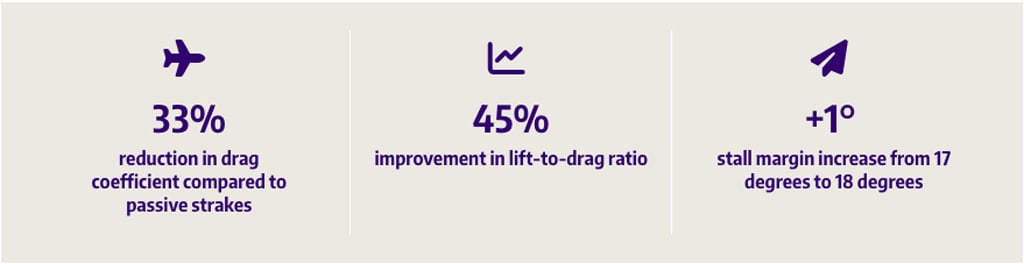
The system maintains its advantages across various flight conditions. Testing from -4 to 22 degrees angle of attack showed consistent improvements, with drag reductions exceeding 10 percent throughout the critical cruise range.
The team's "aha" moment came after their third wind tunnel test during finals week. "We processed all the data at once," Carbrey said. "You go from having just this raw data that doesn't really mean anything, and then you get the coefficients at once. Seeing that blowing a little bit of air through this fin changes the aerodynamic capabilities at all was pretty cool."
"Suddenly we saw that the difference between the passive configuration and the active configuration was pretty significant," said Spitzley. "It actually worked!"
Additional testing and refinement is next. The team’s current model increased the relative size of the strake to ensure it was big enough for wind tunnel results and it will be resized on next design iterations. The research continues with current master's student Josh Kruetz testing additional configurations such as flap positions, pneumatic injection, and strake angles building on the capstone team's foundation.
The smart strake concept addresses one of aviation's persistent efficiency challenges as industry faces constant pressure to reduce emissions and operating costs. "The industry has accepted passive strakes as a necessary compromise for 50 years," said Nino. "These students demonstrated a solution that eliminates that compromise while maintaining all the safety benefits at stall."
Cade Homfeldt presented the team's findings at the AIAA SciTech 2026 conference. Their paper, " Smart Engine Nacelle Strake ," details both the aerodynamic principles and practical implementation of their system.
This article was written by Amy Sprague for the University of Washington. For more information, contact Amy,
More From SAE Media Group

Aerospace INSIDER
NASA’s Folding Wing Reduces Drag and Increases Efficiency
Aerospace INSIDER
Optimizing Winglets for More Efficient Flight
Motion Control Tech Briefs
Inflatable Strakes for Forebody Vortex Control
Tech Briefs
Flap Edge Noise Reduction Fins
Tech Briefs
Stop-Rotor Rotary Wing Aircraft
Aerospace INSIDER
NASA Tests Engines That Reduce Drag and Fuel Burn
Aerospace & Defense Tech Briefs
Notre Dame’s New Boundary Breaking Mach 10 Quiet Wind Tunnel
Tech Briefs
Algorithms Improve Quadrotor Drone Performance
Aerospace INSIDER
Study Could Help Aircraft Avoid Dynamic Stall
Aerospace INSIDER
Slim Wing Can Reduce Aircraft Fuel Use and Emissions by 50%
Aerospace INSIDER
NASA Tests Revolutionary Shape-Changing Aircraft Flap
Aerospace & Defense Tech Briefs
Aerodynamic Modeling of a Flapping Wing Unmanned Aerial Vehicle
Aerospace INSIDER
Shape-Changing Wing Flap Reduces Drag and Noise
Aerospace INSIDER
Engineers Assess Flow Quality in Wind Tunnel Test Facility
Aerospace INSIDER
4D Composite Printing Can Improve Drone Wings
Aerospace INSIDER
Accelerating Climate-Compatible Aircraft Design with AI

Tech Briefs
Winglet with Injected Flow
Aerospace INSIDER
Electra Starts Proving Blown Lift eSTOL Technology
Aerospace INSIDER
New DARPA X-Plane Will Have No Moving Control Surfaces
Aerospace INSIDER
Airbus Starts Testing Airplane Wing That Changes Shape In-Flight
Test & Measurement INSIDER
NASA Tests Shape-Changing Wing for Next-Generation Aviation
Aerospace INSIDER
Quarterhorse Hypersonic Test Aircraft Completes First Flight
Aerospace INSIDER
Embraer Subsidiary Shows First Full-Scale eVTOL Prototype
Aerospace INSIDER
Ducted Fans for Aircraft Propulsion
Tech Briefs
Bio-Inspired Wing Design for Small Drones

Top Stories
NewsRF & Microwave Electronics
 Microvision Aquires Luminar, Plans Relationship Restoration, Multi-industry Push
INSIDERAerospace
 A Next Generation Helmet System for Navy Pilots
INSIDERDesign
 New Raytheon and Lockheed Martin Agreements Expand Missile Defense Production
INSIDERMaterials
 How Airbus is Using w-DED to 3D Print Larger Titanium Airplane Parts
NewsPower
 Ford Announces 48-Volt Architecture for Future Electric Truck
ArticlesAR/AI

Webcasts
Aerospace
 Cooling a New Generation of Aerospace and Defense Embedded...
Automotive
 Battery Abuse Testing: Pushing to Failure
Transportation
 A FREE Two-Day Event Dedicated to Connected Mobility
Unmanned Systems
 Quiet, Please: NVH Improvement Opportunities in the Early Design Cycle
Transportation
 Advantages of Smart Power Distribution Unit Design for Automotive &...
Energy
 Sesame Solar's Nanogrid Tech Promises Major Gains in Drone Endurance