




Shape-Changing Wing Flap Reduces Drag and Noise
A milestone for the Adaptive Compliant Trailing Edge (ACTE) project at NASA's Armstrong Flight Research Center occurred with the delivery of two revolutionary experimental flaps designed and built by FlexSys of Ann Arbor, MI, for installation on the Gulfstream G-III Aerodynamics Research Test Bed aircraft. Researchers are replacing the airplane’s 19-foot-long aluminum flaps with advanced, shape-changing assemblies that form continuous bendable surfaces.
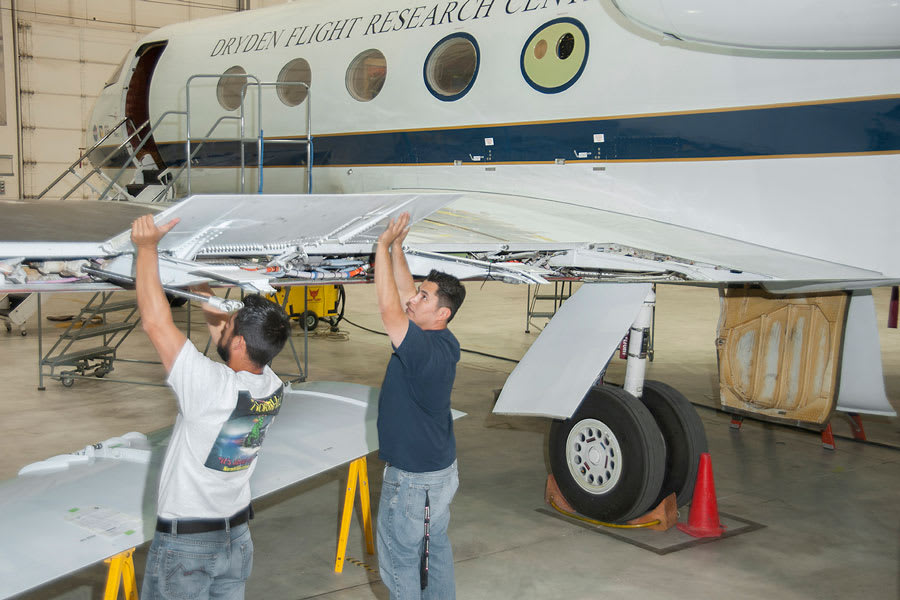
Technicians have begun scanning the G-III with a special laser system to create a computer-generated 3D model of the airplane. The flap assemblies will also be scanned so that project engineers can conduct virtual fit checks before actually installing the new flaps. This will reduce the risk of damaging either the airplane or its new control surfaces.
The ACTE experimental flight research project is a joint effort between NASA and the U.S. Air Force Research Laboratory to design aircraft technology that will reduce drag, wing weight, and aircraft noise. The effort is part of NASA's Environmentally Responsible Aviation (ERA) project that explores technologies to reduce aviation’s impact on the environment.
More From SAE Media Group
Aerospace INSIDER
NASA Tests Revolutionary Shape-Changing Aircraft Flap
Aerospace INSIDER
NASA Flight-Tests Flexible, Twistable Wing Flaps
Aerospace INSIDER
New DARPA X-Plane Will Have No Moving Control Surfaces

Aerospace INSIDER
Air Force Develops Morphing Aileron for Aircraft Wing
Tech Briefs
Improved Fixed-Wing Gust Load Alleviation Device


NASA Spinoff
From Shark Searches to Space Tours
Tech Briefs
Flap Device for Airframe Noise Reduction
Aerospace INSIDER
NASA Tests Green Aviation Technology
Aerospace & Defense Tech Briefs
Air Force Receives First Joby eVTOL
Motion Design INSIDER
Tailless Jet Flies Free with Novel Control Technique
Aerospace INSIDER
NASA Unveils Radically New Airplane Wing

Tech Briefs
Novel Control Method in Tailless Aircraft

Aerospace INSIDER
Delta Air Lines, JetZero to Design Commercial Blended Wing Body Airliner
Tech Briefs
Fixed-Wing Angle eVTOL
Aerospace INSIDER
NASA Alloy Could Fold Wings in Flight
Aerospace INSIDER
NASA Shines Lasers on Future Aircraft Concept
Aerospace INSIDER
X-59 Supersonic Aircraft Cleared for Final Assembly
Air Force Research Laboratory Technology Horizons
Blended Wing Body Aircraft
Aerospace INSIDER
NASA Tests Aircraft Wing Coatings that Slough Bug Guts
Aerospace INSIDER
Archer Aviation Completes Midnight eVTOL Transition Flight Milestone

Aerospace INSIDER
Air Force Receives First eVTOL Six Months Ahead of Schedule
Top Stories
INSIDERManufacturing & Prototyping
 How Airbus is Using w-DED to 3D Print Larger Titanium Airplane Parts
INSIDERManned Systems
 FAA to Replace Aging Network of Ground-Based Radars
NewsTransportation
 CES 2026: Bosch is Ready to Bring AI to Your (Likely ICE-powered) Vehicle
NewsSoftware
 Accelerating Down the Road to Autonomy
EditorialDesign
 DarkSky One Wants to Make the World a Darker Place
INSIDERMaterials
 Can This Self-Healing Composite Make Airplane and Spacecraft Components Last...
Webcasts
Defense
 How Sift's Unified Observability Platform Accelerates Drone Innovation
Automotive
 E/E Architecture Redefined: Building Smarter, Safer, and Scalable...
Power
 Hydrogen Engines Are Heating Up for Heavy Duty
Electronics & Computers
 Advantages of Smart Power Distribution Unit Design for Automotive...
Unmanned Systems
 Quiet, Please: NVH Improvement Opportunities in the Early Design...
