




NASA Tests Revolutionary Shape-Changing Aircraft Flap
NASA's green aviation project is one step closer to developing technology that could make future airliners quieter and more fuel‑efficient with the successful flight test of a wing surface that can change shape in flight. Researchers replaced an airplane’s conventional aluminum flaps with advanced, shape‑changing assemblies that form seamless bendable and twistable surfaces. Flight testing will determine whether flexible trailing‑edge wing flaps are a viable approach to improve aerodynamic efficiency and reduce noise generated during takeoffs and landings.
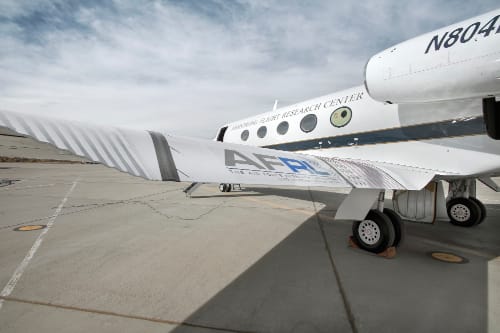
The Adaptive Compliant Trailing Edge (ACTE) project is a joint effort between NASA and the U.S. Air Force Research Laboratory (AFRL), using flaps designed and built by FlexSys of Ann Arbor, MI. FlexSys developed a variable geometry airfoil system called FlexFoil that can be retrofitted to existing airplane wings or integrated into brand new airframes.
During the initial ACTE flight, the experimental control surfaces were locked at a specified setting. Different flap settings will be employed on subsequent flights to collect a variety of data demonstrating the capability of the flexible wings to withstand a real flight environment. The flaps have the potential to be retrofitted to existing airplane wings or integrated into new airframes.
More From SAE Media Group

Test & Measurement INSIDER
NASA Tests Shape-Changing Wing for Next-Generation Aviation
Aerospace INSIDER
NASA Tests Aircraft Wing Coatings that Slough Bug Guts
Tech Briefs
Improved Fixed-Wing Gust Load Alleviation Device
Aerospace INSIDER
New DARPA X-Plane Will Have No Moving Control Surfaces
Aerospace INSIDER
Delta Air Lines, JetZero to Design Commercial Blended Wing Body Airliner
Tech Briefs
Flap Device for Airframe Noise Reduction
Aerospace INSIDER
NASA Tests Green Aviation Technology
Aerospace INSIDER
NASA Flight-Tests Flexible, Twistable Wing Flaps
Tech Briefs
Aircraft Vertical Takeoff and Landing
Tech Briefs
Fixed-Wing Angle eVTOL
Aerospace INSIDER
Archer Aviation Completes Midnight eVTOL Transition Flight Milestone
Aerospace INSIDER
Electra Starts Proving Blown Lift eSTOL Technology
Aerospace INSIDER
Archer Achieves First Untethered Flight with Midnight eVTOL
Tech Briefs
Bio-Inspired Wing Design for Small Drones
Tech Briefs
Multirotor Aircraft Noise Reduction
Aerospace INSIDER
Airbus Reveals Blended Wing Aircraft Demonstrator
Aerospace INSIDER
Hermeus Rolls Out First Quarterhorse Hypersonic Test Aircraft
Aerospace INSIDER
Air Force to Inspect KC-135 Fleet for Non-Conforming Tail Pins
Tech Briefs
Winglet with Injected Flow
Aerospace INSIDER
Airbus Starts Testing Airplane Wing That Changes Shape In-Flight

Tech Briefs
Novel Control Method in Tailless Aircraft
Motion Design INSIDER
Tailless Jet Flies Free with Novel Control Technique


Aerospace & Defense Tech Briefs
Rear Fuselage Packer
Aerospace INSIDER
Lilium Starts Production of eVTOL Jet Batteries
Aerospace INSIDER
A Next Generation Helmet System for Navy Pilots
Top Stories
NewsSensors/Data Acquisition
 Microvision Aquires Luminar, Plans Relationship Restoration, Multi-industry Push
INSIDERRF & Microwave Electronics
 A Next Generation Helmet System for Navy Pilots
INSIDERWeapons Systems
 New Raytheon and Lockheed Martin Agreements Expand Missile Defense Production
NewsAutomotive
 Ford Announces 48-Volt Architecture for Future Electric Truck
INSIDERAerospace
 Active Strake System Cuts Cruise Drag, Boosts Flight Efficiency
ArticlesTransportation

Webcasts
Aerospace
 Cooling a New Generation of Aerospace and Defense Embedded...
Energy
 Battery Abuse Testing: Pushing to Failure
Power
 A FREE Two-Day Event Dedicated to Connected Mobility
Automotive
 Quiet, Please: NVH Improvement Opportunities in the Early Design Cycle
Electronics & Computers
 Advantages of Smart Power Distribution Unit Design for Automotive &...
Unmanned Systems
 Sesame Solar's Nanogrid Tech Promises Major Gains in Drone Endurance