




Missile Defense Battle Manager
Northrop Grumman Corporation
Falls Church, VA
703-280-2900
www.northropgrumman.com
The Northrop Grumman Corporation-developed Integrated Air and Missile Defense (IAMD) Battle Command System (IBCS) successfully demonstrated its ability to scale up and network across long distances during a recent U.S. Army-led test. The evaluation was conducted by U.S. Army soldiers over a five-week period with air and missile defense assets located at sites in New Mexico, Texas and Alabama.

As part of SCOE 4.0, the multi-node distributed test examined IBCS’ scalability, resilience and performance under stressing threat conditions. The open-architecture IBCS networked more than 20 nodes across White Sands Missile Range, New Mexico; Fort Bliss, Texas; and Redstone Arsenal, Alabama. Integrated to operate as a single system, the test involved nine IBCS engagement operations centers and 12 IBCS integrated fire control network relays, along with Sentinel short range air defense radars and Patriot radars, Patriot Advance Capability Two (PAC-2), PAC-3 and PAC-3 Missile Segment Enhancement interceptors.
The test required IBCS to virtually form an IAMD task force to defend four critical assets while tracking ‘red’ and ‘blue’ fighter aircraft, cruise missiles and tactical ballistic missiles. Multiple two-hour scenarios were run to check IBCS abilities, including: providing and managing a network to maintain voice, data and video connectivity; performing friend-or-foe identification of air objects and forming the single integrated air picture; and planning, executing and monitoring simulated threat engagements. The test also included dynamically adding and removing nodes to confirm IBCS’ ability to self-configure as a mobile ad hoc network.
The IBCS-enabled enterprise system provides significant benefits over standalone, proprietary systems that merely ‘talk’ with each other. With IBCS, air and missile defense commanders can orchestrate forces over extensive distances using whatever means of communications that are available. Today, commanders are restricted by the proprietary and limited networks tied to the individual closed systems.
IBCS continues to validate the advantages of an open-systems, net-centric, enterprise approach to air and missile defense for getting capabilities to the warfighter that make a pivotal difference on the battlefield. Previous SCOE trials proved IBCS’ value for building a significantly more accurate integrated air picture and its effectiveness for countering electronic attacks.
The system has already demonstrated its ability to take out live targets, having conducted a successful intercept on its inaugural flight test and a more difficult “engage-on-remote” on its second flight test. During its third flight test, IBCS simultaneously intercepted two types of threats with two different interceptor types by providing command-and-control for sensors and weapons never designed to work with each other. Two more successful flight tests in support of the Indirect Fire Protection Capability were conducted with Sidewinder and Longbow Hellfire missiles. Both missiles were integrated into the system within a few short months.
IBCS is the central component of the Army’s future IAMD construct. The program is managed by the Army Program Executive Office for Missiles and Space, Redstone Arsenal, Alabama.
For Free Info Visit Here .
More From SAE Media Group
Aerospace & Defense Tech Briefs
Next Generation Air and Missile Defense Radar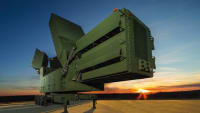
Aerospace & Defense Tech Briefs
Battle Command System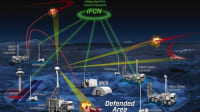
Aerospace & Defense Tech Briefs
Missile Defense System
Aerospace & Defense Tech Briefs
Five Missile-Tracking Satellites Launched
Aerospace & Defense Tech Briefs
Next Generation C-UAS Missile
Aerospace & Defense Tech Briefs
Missile Protection System
Aerospace & Defense Tech Briefs
Aircraft Protection Systems
Aerospace & Defense Tech Briefs
Loitering Precision Strike Missile
Aerospace & Defense Tech Briefs
Post Deployment Build-7 (PDB-7) Software
Aerospace & Defense Tech Briefs
Missile Defense System Signal Processor
Aerospace & Defense Tech Briefs
Advanced Airborne Defensive Laser for Incorporation on Strike Fighter Aircraft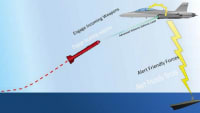
Aerospace & Defense Tech Briefs
VPX Chassis for Missile System
Aerospace & Defense Tech Briefs
AIM-120D-3 Air-to-Air Missile
Aerospace & Defense Tech Briefs
Surface to Surface Missile
Defense INSIDER
Patriot Missile Hits Target in Test of Upgraded ICBS Radar
Aerospace & Defense Tech Briefs
Autonomous Multi-Sensor Maritime Awareness System
Aerospace & Defense Tech Briefs
Long-Range Anti-Ship Missile Flight Test
Aerospace & Defense Tech Briefs
Land Combat Missile
Aerospace & Defense Tech Briefs
Active Protection System
Aerospace & Defense Tech Briefs
The Ballistic Missile Defense System: An Integrated Approach to Global Defense
Aerospace & Defense Tech Briefs
Navy Lasers, Railgun, and Hypervelocity Projectile: Background and Issues for Congress
Aerospace & Defense Tech Briefs
Tactical Combat Missiles
Aerospace & Defense Tech Briefs
High-Speed Data Cables for Fighter Aircraft
Aerospace & Defense Tech Briefs
Integrated Remote Weapons Systems
Aerospace & Defense Tech Briefs
Integrated Short-Range Air Defense
Aerospace & Defense Tech Briefs
Electro-Optical Missile System
Aerospace & Defense Tech Briefs
Lockheed Martin’s “Non-Operational” Space Fence Detects Indian Anti-Satellite Operations While Still in Test Mode
Aerospace & Defense Tech Briefs
A New Approach to Counter-UAS Technology
Aerospace & Defense Tech Briefs
Electronic Warfare System
Top Stories
NewsSensors/Data Acquisition
 Microvision Aquires Luminar, Plans Relationship Restoration, Multi-industry Push
INSIDERRF & Microwave Electronics
 A Next Generation Helmet System for Navy Pilots
INSIDERWeapons Systems
 New Raytheon and Lockheed Martin Agreements Expand Missile Defense Production
NewsAutomotive
 Ford Announces 48-Volt Architecture for Future Electric Truck
INSIDERAerospace
 Active Strake System Cuts Cruise Drag, Boosts Flight Efficiency
ArticlesTransportation

Webcasts
Aerospace
 Cooling a New Generation of Aerospace and Defense Embedded...
Energy
 Battery Abuse Testing: Pushing to Failure
Power
 A FREE Two-Day Event Dedicated to Connected Mobility
Automotive
 Quiet, Please: NVH Improvement Opportunities in the Early Design Cycle
Electronics & Computers
 Advantages of Smart Power Distribution Unit Design for Automotive &...
Unmanned Systems
 Sesame Solar's Nanogrid Tech Promises Major Gains in Drone Endurance