




Raytheon Pairs Laser Weapon with NASAMS Air Defense System
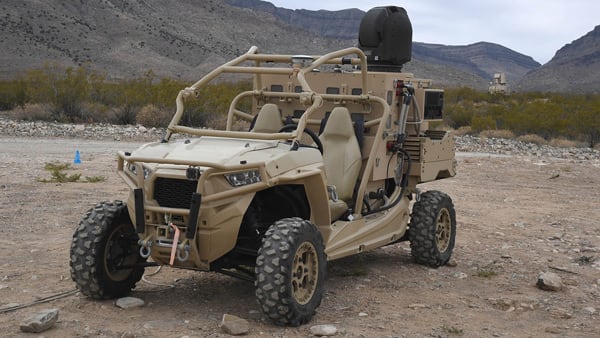
One of the advanced technologies Raytheon Intelligence & Space (RI&S) is promoting at this year's AUSA Annual Meeting and exhibition is their High-Energy Laser Weapon Systems (HELWS) program. Since Raytheon deployed its first HELWS in 2019, the systems have completed approximately 400 kills, logged more than 25,000 operational hours, and successfully defeated multiple 60mm mortar bombs.
Earlier this year, RI&S, a Raytheon Technologies business, demonstrated that their High Energy Laser Weapon System can pair with the National Advanced Surface-to-Air Missile System (NASAMS), to stop unmanned aircraft threats. During the live-fire exercise, the HELWS received cues from the NASAMS Fire Distribution Center and used automated target cueing and a full spectrum of electro-optical/infrared sensors to track, identify and quickly take down drones at tactically relevant distances. The HELWS took down nine Group 1 and Group 2 drones over the White Sands Missile Range.
“Drone threats are particularly dangerous in any environment – from soccer stadiums to battlefields – because they’re not easy to spot and take down,” said Annabel Flores, president of Electronic Warfare Systems for RI&S. “We’re showing the world that our defensive laser weapons can plug into existing air defenses to find and drop drones in the blink of an eye.”
Representatives from multiple U.S. military and civilian agencies, as well as international ministries of defense, attended the demonstration at the White Sands Missile Range to see how the HELWS is readily interoperable with existing command and control systems. The NASAMS medium-range air defense solution, co-developed by Raytheon Missiles & Defense and Kongsberg Defence & Aerospace, consists of the Sentinel radar, Fire Distribution Center, and a suite of effectors. The demonstration showcased the ability to integrate a counter-unmanned aircraft systems solution with NASAMS, adding to its interoperability and medium-range air defense capabilities for a layered defense.
By adding NASAMS to the list of sensors, effectors, and command and control systems the HELWS already works with, Raytheon Technologies can provide end users maximum flexibility to engage unmanned aircraft threats as part of an integrated air defense.
RI&S’ laser weapon systems, built in McKinney, Texas, work on land, in the air and at sea, providing 360-degree coverage that can protect bases, airports, stadiums and other high-value military or civilian assets. Open architecture, scalable power, and ruggedized design easily adapt to the demands of the mission. As RI&S experts will illustrate for attendees who visit their booth (#2304) at AUSA, HELWS can be used as a standalone system or rapidly installed on a variety of platforms.
More From SAE Media Group

Aerospace & Defense Tech Briefs
H4 Palletized Laser Weapon
Defense INSIDER
Army Awards Combat Laser Weapon System Contract
Aerospace & Defense Tech Briefs
Advanced Airborne Defensive Laser for Incorporation on Strike Fighter Aircraft
Aerospace & Defense Tech Briefs
Navy Lasers, Railgun, and Hypervelocity Projectile: Background and Issues for Congress

Aerospace & Defense Tech Briefs
Aircraft Protection Systems
Aerospace & Defense Tech Briefs
Missile Protection System
Aerospace & Defense Tech Briefs
Next Generation C-UAS Missile
Defense INSIDER
Conference to Focus on Counter-Drone Technology

Aerospace Manufacturing and Machining INSIDER
Raytheon to Develop Counter UAS Sensors, Effectors for US Army
Aerospace & Defense Tech Briefs
Missile Protection System


Aerospace & Defense Tech Briefs
TRML-4D Radar for Ukrainian Air Defense
Aerospace & Defense Tech Briefs
Integrated Electric Power Kits for Army Vehicles
Defense INSIDER
Army Receives First Next Generation Precision Strike Missile
Aerospace Manufacturing and Machining INSIDER
Counter UAS Systems Tested Against Swarms of 50 Drones in Latest Yuma Exercise
Aerospace & Defense Tech Briefs
British Army Completes First Test of Drone Killing Radio Frequency Weapon
Defense INSIDER
Patriot Missile Hits Target in Test of Upgraded ICBS Radar
Defense INSIDER
Army Developing Lasers That Pierce Fog, Dust to Destroy Targets
Aerospace & Defense Tech Briefs
GOKBERK C-UAS Testing
Defense INSIDER
Armed Forces Are Developing Laser Weapons
Aerospace & Defense Tech Briefs
Fighter Jet Armaments
Aerospace & Defense Tech Briefs
Counter-UAS Technology
Aerospace & Defense Tech Briefs
Autonomous Air Defense Production
Aerospace & Defense Tech Briefs
S-Band Radar Systems
Aerospace & Defense Tech Briefs
Radar System
Top Stories
NewsAutomotive
 Microvision Aquires Luminar, Plans Relationship Restoration, Multi-industry Push
INSIDERDesign
 A Next Generation Helmet System for Navy Pilots
INSIDERWeapons Systems
 New Raytheon and Lockheed Martin Agreements Expand Missile Defense Production
NewsPower
 Ford Announces 48-Volt Architecture for Future Electric Truck
INSIDERAerospace
 Active Strake System Cuts Cruise Drag, Boosts Flight Efficiency
ArticlesTransportation

Webcasts
Aerospace
 Cooling a New Generation of Aerospace and Defense Embedded...
Test & Measurement
 Battery Abuse Testing: Pushing to Failure
Internet of Things
 A FREE Two-Day Event Dedicated to Connected Mobility
Transportation
 Quiet, Please: NVH Improvement Opportunities in the Early Design Cycle
Electronics & Computers
 Advantages of Smart Power Distribution Unit Design for Automotive &...
Aerospace
 Sesame Solar's Nanogrid Tech Promises Major Gains in Drone Endurance