




Armed Forces Are Developing Laser Weapons
Responding to lawmakers' questions about how close the Army is to developing offensive and defensive directed-energy weapons, Mary J. Miller responded: "I believe we're very close." Miller, deputy assistant secretary of the Army for Research and Technology, testified before the House Armed Services Committee's Subcommittee on Emerging Threats and Capabilities recently regarding the Army's Science and Technology (S&T) Program for fiscal year 2017.

The Army's S&T effort is committed to pursuing high-energy lasers, she said. That effort has been used in an analysis of alternatives for the Indirect Fire Protection Capability program of record. That effort has now been "aligned to transition into a program of record in the fiscal 2023 timeframe," she said. It's already planned and funded.
It will take that long because it's being done in a "step-wise demonstration of capability," she explained. "We have to make sure the lasers work and do the full set of scopes against the threats we project. And those threats include the counter-rockets, counter-artillery and counter-mortar as well as [Unmanned Aerial Vehicle] and cruise missile threats."
Miller explained that the Army wants to understand the lasers' full capabilities "before we offer it to a soldier," because operators need to trust what lasers can do. "Lasers have been promised for a long time, but they've never held up and delivered what was asked for, so the operators are rightfully skeptical," she pointed out. That's why the Army is taking lasers out into operational environments and testing them. In the meantime, "there will be steps along the way where we spin off lesser capable laser systems that can do good things on smaller platforms. Those will come out soon," she concluded.
Dr. David Walker, deputy assistant secretary of the Air Force for Science, Technology and Engineering, Office of the Assistant Secretary of the Air Force for Acquisition, agreed with Miller's logic for step-wise rollouts. "We too have spun off lesser-capable laser systems," he said, following Miller's remarks.
The Air Force is flying every day with lasers under its transport aircraft, using them as infrared countermeasure system," so we too spun off lesser-capable laser systems and as we get larger power outputs and better thermal management out of smaller package lasers, we will build those powers into defensive to offensive capability as well," Walker said.
Walker also said the Air Force is working with Special Operations Command to develop an offensive laser that will be fitted to AFSOC AC-130 gunships. Part of that technology, he said, includes "beam-steering and power and thermal management." The Navy's science representative described similar laser programs for ships, subs and Marines.
More From SAE Media Group
Aerospace & Defense Tech Briefs
Navy Lasers, Railgun, and Hypervelocity Projectile: Background and Issues for Congress
Aerospace & Defense Tech Briefs
Missile Protection System
Aerospace INSIDER
ATHENA Sensor Brings Generational Leap to Airborne MANPAD Protection
Aerospace INSIDER
Air Force Performs First Test of Microwave Counter Drone Weapon THOR

Aerospace & Defense Tech Briefs
H4 Palletized Laser Weapon
Aerospace & Defense Tech Briefs
Advanced Airborne Defensive Laser for Incorporation on Strike Fighter Aircraft
Aerospace INSIDER
Navy Selects Lockheed Martin and Raytheon to Develop Hypersonic Missile

Aerospace INSIDER
Air Force Pilots Control XQ-58s from Fighter Jets
Aerospace & Defense Tech Briefs
F/A-18 Infrared Search and Rescue System

Defense INSIDER
Raytheon Pairs Laser Weapon with NASAMS Air Defense System
Aerospace & Defense Tech Briefs
Surface to Surface Missile
Defense INSIDER
Anduril Becomes Third US Supplier of Solid Rocket Motors
Aerospace & Defense Tech Briefs
Precision Strike Missile Increment 1 Achieves Milestone C Approval


Aerospace & Defense Tech Briefs
Tactical Combat Missiles

Aerospace Manufacturing and Machining INSIDER
Counter UAS Systems Tested Against Swarms of 50 Drones in Latest Yuma Exercise
Aerospace INSIDER
New Drones and Software Selected for DoD's Replicator 1.2
Aerospace INSIDER
Barracuda: Anduril's New Software-Defined Autonomous Air Vehicles
Aerospace & Defense Tech Briefs
Integrated Short-Range Air Defense
Defense INSIDER
Kauai Test Facility Launches Its Largest Missile
Aerospace INSIDER
Navy Completes 73-Hour Nonstop Flight of Solar-Powered UAS

Aerospace & Defense Tech Briefs
A New Record for Optical Power Beaming
Aerospace & Defense Tech Briefs
Lasers Destroy Drones as Additive Manufacturing Builds Them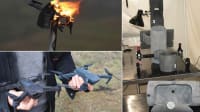
Top Stories
INSIDERManufacturing & Prototyping
 How Airbus is Using w-DED to 3D Print Larger Titanium Airplane Parts
NewsAutomotive
 Microvision Aquires Luminar, Plans Relationship Restoration, Multi-industry Push
INSIDERAerospace
 A Next Generation Helmet System for Navy Pilots
INSIDERDesign
 New Raytheon and Lockheed Martin Agreements Expand Missile Defense Production
ArticlesAR/AI
 CES 2026: Bosch is Ready to Bring AI to Your (Likely ICE-powered) Vehicle
Road ReadyDesign

Webcasts
Semiconductors & ICs
 Advantages of Smart Power Distribution Unit Design for Automotive...
Unmanned Systems
 Quiet, Please: NVH Improvement Opportunities in the Early Design...
Electronics & Computers
 Cooling a New Generation of Aerospace and Defense Embedded...
Power
 Battery Abuse Testing: Pushing to Failure
AR/AI
 A FREE Two-Day Event Dedicated to Connected Mobility
