




2026 Nissan Sentra Review: Putting the Pieces Together
Getting back to basics doesn’t mean the result is, well, basic.
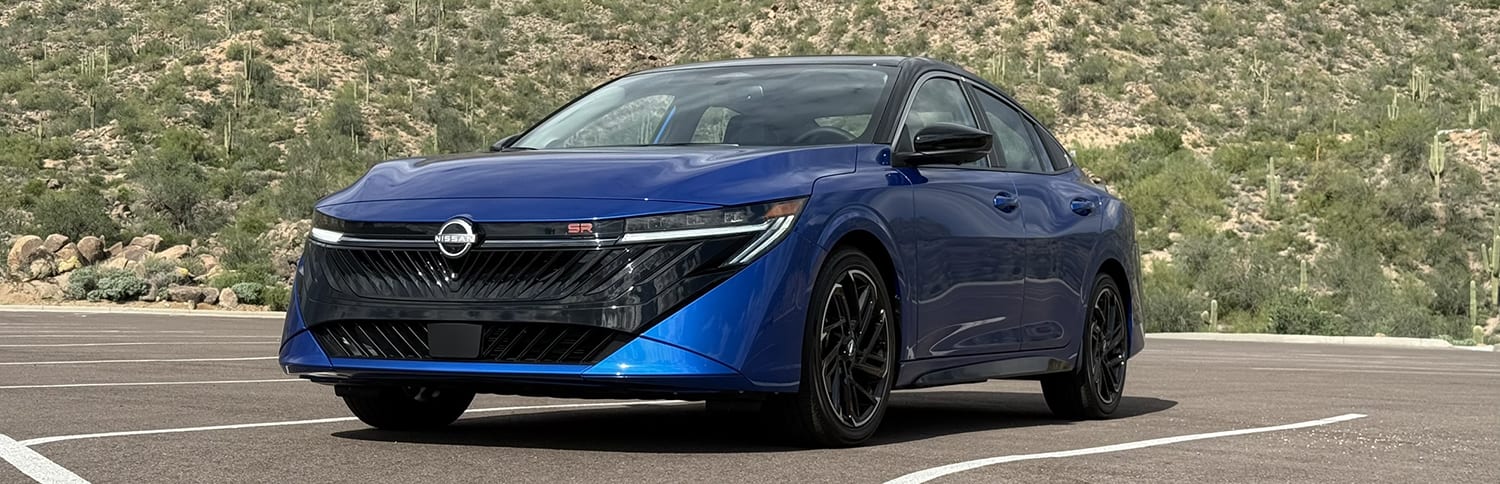
The Nissan Sentra has provided straightforward behavior and performance for sedan shoppers in the U.S. for over forty years. For 2026, Nissan took the solid 2025 model and made enough mechanical tweaks and visual changes to call it an all-new vehicle. Initially, this might sound like a bit of a stretch, but given how the advancements add up to an improved drive experience in a better-looking vehicle, we’ll let it slide.
Available in four grades – S, SV, SR and SL that range from $22,400 to $27,990, before destination fees and packages – the 2026 Sentra puts on airs like it’s a simple vehicle, hiding some of its advanced technology to keep the interior clean and clear, from the driver’s screen to the steering wheel buttons. Wireless device charging and wireless Apple CarPlay/Android Auto minimize wire clutter. The standard 12.3-in NissanConnect infotainment touchscreen hides its options in a selection of tiles, and it has a single round volume button that makes it easy to turn down quickly.

Looks-wise, the 2026 Sentra gets a new hood shaped by a new design philosophy that continues into the interior with a new instrument panel, new materials and new technologies. The redesigned front end ups the elegant-ish look while providing space to hide sensors required for standard ADAS features (AEB with Pedestrian Detection, FCW, BSW and Rear Cross Traffic Alert) and the optional ProPilot Assist on upper trims. Enhanced LED headlamps now offer 70% better light distribution and the rear has been slightly redesigned to offer a 50-mm (2-in) wider opening at the bottom of the trunk. The trim levels are also changed from last year.
In the end, the new Sentra isn’t an in-your-face update, but it comes together in a way Nissan wants: an entry-level vehicle that performs above its weight in a way that’s natural and seamless for the driver.
All-new? Altogether not important
Nissan calls the 2026 Sentra all-new, but in reality, it’s a slew of incremental updates and changes from 2025. Nissan representatives told SAE Media during a recent test drive in Arizona that the method here was like cooking a favorite recipe but adding a bit more spice this time. Much of the hardware ingredients – chassis components, engine, transmission – remain the same from last year’s Sentra, but they’ve been tuned differently to account for customer requests for more power and for the new body structure.
The 2026 Sentra uses Nissan’s third-generation MR engine that has been under Sentra hoods since the previous generation. The 2.0-L naturally aspirated MR20DD produces an uninspiring-but-workable 149 hp (111 kW) and 146 lb-ft. The suspension still uses independent struts with coil springs in front and an independent multi-link setup in the rear. The Xtronic CVT is also carried over, now retuned for more linear power delivery.
Nissan finalized its performance tweaks at its test track and on public roads in the U.S. after getting the initial specs from Japan, where engineers were only able to test on the track, Nissan told SAE Media in Arizona. Nissan tuned the Sentra in the U.S. using “customer scenes” in California and Arizona, including Phoenix, for the U.S. customer. This version of the Sentra will also be sold in Canada, Mexico and Latin America. A sister model, the Sylphy, will be sold in China and was locally tuned specifically for that market.

Nissan’s on-road tests in North America led to a chassis that was tuned to take into account the changed body structure and to give to the sedan a more confident feel by slowing down the body roll rate – not necessarily the actual body roll itself from an angle perspective, but from a rate perspective – a smidge so that when the car enters a curve, the body's not moving as quickly and the driver feels it less. To provide more power, Nissan engineers adjusted the gas pedal’s tip-in setting to provide more throttle opening, which increased G rise and G peak and resulted in a quicker response when you tip in.
You can feel these changes on the road. Acceleration remains less-than blazing, but you don’t need a Sentra to win a drag race to remain competent and controlled. The way Nissan improved the CVT didn’t completely eliminate the rubber band feeling inherent to this technology, but the new Sentra does have a more direct response to each pedal press and body roll was notably improved. The Sentra looks far better now, too. The striking two-tone orange color, officially called “Energetic Ember/Super Black,” is a winner and the interior materials don’t feel like a low-cost compromise. For anyone looking to prove that you don’t need to spend a ton of money or follow the CUV/SUV trend to get a solid new vehicle in 2025, test-driving a new Sentra is highly recommended.
More From SAE Media Group
Automotive Engineering
5 More HP for 2026 Kia Sportage: First Drive
Automotive Engineering
2019 Kia Forte Gets 'Smart' CVT
Automotive Engineering
Volvo Concept Estate Shows Clues for New XC90
Automotive Engineering
Toyota Stretches SUV Line-Up with World Debut of Grand Highlander
Automotive Engineering
Honda Enters Burgeoning Subcompact SUV Fray
Automotive Engineering
2021 Toyota Supra 2.0
Automotive Engineering
2016 Mazda MX-5 Stays True to Its Roots
Automotive Engineering
Nissan Tries to Re-Create Murano Buzz Through Design
Automotive Engineering
Mazda Enters Subcompact Crossover Segment with 2016 CX-3
Automotive Engineering
2016 Optima Gets Upgraded UVO
Automotive Engineering
Audi's New Compact Q2 Blends 3-Cylinder Efficiency, Agile Chassis
Automotive Engineering
2019 Subaru Ascent Premium
Automotive Engineering
2024 Lexus GX Ready for Off-Road Adventure with New Platform, E-KDSS
Off-Highway Engineering
Cat 745 Articulated Truck Boasts Next-Gen Cab, New Machine-Control Features
Automotive Engineering
Nissan's Maxima Has Flowing Sports Car Lines, Upgraded 3.5-L V6 and CVT
Automotive Engineering
A Rebel’s Guide to Chassis Engineering
Automotive Engineering
Redesigned 2017 Infiniti Q60 Gets New Engine
Automotive Engineering
Camry's Mid-Cycle "Refresh" More Than Just Front and Rear Panels
Automotive Engineering
2016 Explorer Gains More Powerful Four-Cylinder, Platinum Opulence
Automotive Engineering
2015 Chrysler 300 Gets Upgrades
Automotive Engineering
Subaru Carefully Reworks Outback on New Platform
Automotive Engineering
Suppliers Struggling to Keep Pace with Faster Product Cycles, Says IHS
Automotive Engineering
Chevy, Honda Join U.S. Subcompact Crossover Market
Automotive Engineering
Mitsubishi Puts NVH in 2016 Outlander's Crosshairs
Automotive Engineering
Ford Refines Interior, Exterior on 2025 Explorer
Automotive Engineering
Hyundai Reveals More Conservatively Styled 2015 Sonata
Automotive Engineering
Honda’s All-New Global 2016 Civic Targets Mercedes Refinement
Automotive Engineering
New Angle on Mercedes-Benz’ S-Class Coupe
Automotive Engineering
Hyundai Updates Its Tucson Compact Crossover
Automotive Engineering
Infiniti Concept Conjures a New-Tech Q45
Top Stories
INSIDERManufacturing & Prototyping
 How Airbus is Using w-DED to 3D Print Larger Titanium Airplane Parts
INSIDERManned Systems
 FAA to Replace Aging Network of Ground-Based Radars
NewsTransportation
 CES 2026: Bosch is Ready to Bring AI to Your (Likely ICE-powered) Vehicle
NewsSoftware
 Accelerating Down the Road to Autonomy
EditorialDesign
 DarkSky One Wants to Make the World a Darker Place
INSIDERMaterials
 Can This Self-Healing Composite Make Airplane and Spacecraft Components Last...
Webcasts
Defense
 How Sift's Unified Observability Platform Accelerates Drone Innovation
Automotive
 E/E Architecture Redefined: Building Smarter, Safer, and Scalable...
Power
 Hydrogen Engines Are Heating Up for Heavy Duty
Electronics & Computers
 Advantages of Smart Power Distribution Unit Design for Automotive...
Unmanned Systems
 Quiet, Please: NVH Improvement Opportunities in the Early Design...
