




Volvo Concept Estate Shows Clues for New XC90

News that Volvo would be adopting Apple’s CarPlay graphical interface system, demonstrated in the company’s latest concept at the 2014 Geneva Motor Show, gained almost as much attention as the concept car itself. Named simply the Concept Estate, the design study is the third show concept from Volvo in the last year. But unlike its predecessors, it presented more than a rendition of the car’s exterior, partly so that it could demonstrate the touchscreen system that will incorporate CarPlay and show how it’s integrated with the dash panel.
Just as the Concept Coupe shared the Volvo booth at the 2013 Frankfurt Motor Show last fall with Volvo’s 1960s coupe, the P1800, the Concept Estate shared the Geneva booth with a P1800ES, the elegant station wagon derivative of the P1800 that clearly influenced the design of the concept.
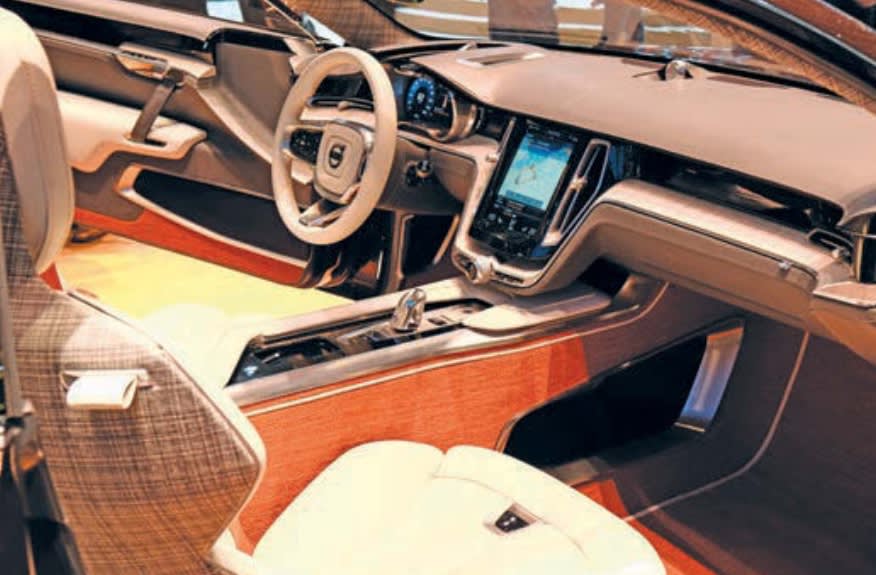
The show car shares its three-door, four-seat layout and thrust forward design of the front grille, some of which were also carried by the C30 model that ceased production last year. The design themes of the two earlier concepts are seen again in the Concept Estate through the hood shape, grille design, and headlights that feature T-shaped daytime running light guides.
Volvo points to echoes of the rear of the 1800ES in the Concept Estate, although the all-glass tailgate of the original is not part of the Concept Estate design, which features a glass roof. As Volvo has been keen to emphasize, the design features of the three recent concepts give an idea of how the forthcoming XC90 SUV replacement, due to be launched later this year, and other subsequent models will look.
Volvo’s Scalable Product Architecture was introduced last year as the basis for all future large- and medium-sized Volvos. The construction follows a familiar pattern to many other modern cars in using different grade steels strategically in the architecture to provide high structural integrity.
According to Volvo, the new in-car touchscreen control system will be introduced on the new XC90 and follow in other succeeding models. The core of the system is a large touchscreen in the center stack, similar to a tablet screen. The system is designed to replace the majority of the conventional dashboard switchgear, incorporating familiar operating gestures such as pinching and swiping with new functions designed specifically for automotive use.
The only conventional switchgear remaining is that for volume, play/pause, hazard warning lights, and heated screens. Like other existing systems, from the Volkswagen Group for instance, the display interacts with the screen immediately ahead of the driver that incorporates a digital instrument display.
Volvo likens the large central display to a stack of “tiles,” one each for navigation, media, and telephone, with navigation at the top. Above these is a thin band for flagging up notifications. The digital climate controls are set below the tiles. When touched, the tile expands while the others are compressed, opening up the options for that function.
Volvo has used the same suppliers for all three concept models including Pirelli, Uniwheels, and Axalta Coating Systems for tires, wheels, and exterior paint, respectively. Inside, 3M, Autoliv, Valeo, Orrefors, and Kongsberg are among the suppliers.
More From SAE Media Group
Automotive Engineering
2026 Nissan Sentra Review: Putting the Pieces Together
Automotive Engineering
5 More HP for 2026 Kia Sportage: First Drive
Automotive Engineering
New Angle on Mercedes-Benz’ S-Class Coupe
Automotive Engineering
2016 Mazda MX-5 Stays True to Its Roots
Automotive Engineering
Toyota Stretches SUV Line-Up with World Debut of Grand Highlander
Automotive Engineering
Chevrolet Ups the Performance Ante with MY2015 Corvette Z06
Automotive Engineering
Mercedes’ New GLC Represents a Sportier Focus
Automotive Engineering
2016 Optima Gets Upgraded UVO
Automotive Engineering
EXP 10 Speed 6 Could Preview Sportier Two Seater
Automotive Engineering
Designing for Downforce
Automotive Engineering
Audi's New Compact Q2 Blends 3-Cylinder Efficiency, Agile Chassis
Automotive Engineering
Opel Designs a New Astra
Automotive Engineering
Mercedes Boosts Off-Road Prowess of 2019 G-Wagen
Automotive Engineering
2021 Toyota Supra 2.0
Automotive Engineering
2019 Kia Forte Gets 'Smart' CVT
Automotive Engineering
Nissan Tries to Re-Create Murano Buzz Through Design
Automotive Engineering
2025 Ford Bronco Sport Proves Sasquatch Fits on Smaller SUV
Automotive Engineering
Infiniti Creates 'Executive Boardroom' for 2015 Model
Automotive Engineering
Jaguar’s Making of a Sports Sedan
Automotive Engineering
2023 Cadillac Lyriq Executive Chief Engineer: New EV Her ‘North Star’
Automotive Engineering
2024 Lexus GX Ready for Off-Road Adventure with New Platform, E-KDSS
Automotive Engineering
Lexus Previews 2018 LC 500 Luxury Coupe
Automotive Engineering
Mercedes-Benz Melds SUV and Coupe Styling for GLE Coupe
Automotive Engineering
McLaren Debuts New Entry-Level Sports Series
Automotive Engineering
2016 Explorer Gains More Powerful Four-Cylinder, Platinum Opulence
Automotive Engineering
GT Concept Reveals Opel/Vauxhall’s Sports Car Template

Automotive Engineering
A Rebel’s Guide to Chassis Engineering
Automotive Engineering
Ford Refines Interior, Exterior on 2025 Explorer
Automotive Engineering
How Land Rover Took the Lid off the Evoque
Top Stories
NewsSensors/Data Acquisition
 Microvision Aquires Luminar, Plans Relationship Restoration, Multi-industry Push
INSIDERRF & Microwave Electronics
 A Next Generation Helmet System for Navy Pilots
INSIDERWeapons Systems
 New Raytheon and Lockheed Martin Agreements Expand Missile Defense Production
NewsAutomotive
 Ford Announces 48-Volt Architecture for Future Electric Truck
INSIDERAerospace
 Active Strake System Cuts Cruise Drag, Boosts Flight Efficiency
ArticlesTransportation

Webcasts
Aerospace
 Cooling a New Generation of Aerospace and Defense Embedded...
Energy
 Battery Abuse Testing: Pushing to Failure
Power
 A FREE Two-Day Event Dedicated to Connected Mobility
Automotive
 Quiet, Please: NVH Improvement Opportunities in the Early Design Cycle
Electronics & Computers
 Advantages of Smart Power Distribution Unit Design for Automotive &...
Unmanned Systems
 Sesame Solar's Nanogrid Tech Promises Major Gains in Drone Endurance