




Designing for Downforce
Airflow is paramount for performance vehicles, which require aerodynamic enhancements to promote high-speed stability and greater cornering capability.
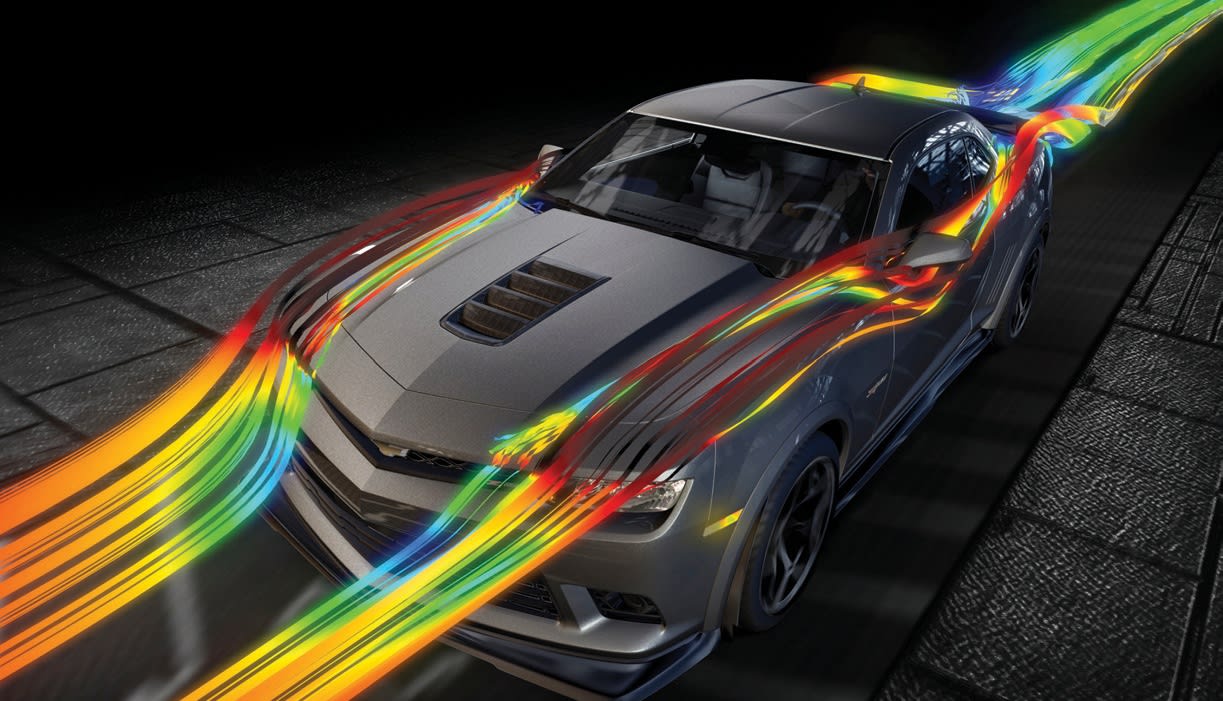
Aerodynamics currently is a hot topic for the transportation sector, from passenger vehicles all the way to Class 8 trucks. Along with advanced powertrain technologies and light-weight materials, aerodynamics is an area receiving considerable engineering attention due to its potential for improving vehicle fuel efficiency — a major goal as stricter regulations loom for cars and light-duty trucks as well as medium- and heavy-duty vehicles.
But for cars that easily surpass the 100-mph (161-km/h) mark and feel as at home on the racetrack as on the road, airflow takes on added significance. Their speed potential must be complemented with the appropriate aerodynamic solutions to keep such cars safely and firmly planted to the driving surface at high speeds.

Following are details of two recently announced performance vehicles — the Ferrari 458 Speciale and the Chevrolet Camaro Z/28 — that place particular emphasis on design for downforce.
Active aerodynamics for special Ferrari
Ferrari revealed at the 2013 Frankfurt Motor Show a new special-series sports car, the 458 Speciale, to join stable mates 458 Italia and 458 Spider. Derived from the 458 Italia, the new berlinetta (i.e., sporty coupe) embodies an even-greater focus on performance and boasts an abundance of advanced technologies not just in the powertrain and chassis, but also in the finer details of its body.
“The engine, in which we have put a lot of Formula One technology, is not the only news in this car,” Ferrari Chairman Luca di Montezemolo said at the Frankfurt reveal. “We have a very innovative, patented active aerodynamics. This is Ferrari technology and is completely new on the market.”
Mobile aerodynamic solutions at the front and rear of the car ensure that different aerodynamic configurations can be adopted in cornering, where maximum downforce is required, and on straightaways, where drag must be minimized. The 458 Speciale has a downforce (Cl) value of 0.53, along with a 0.35 Cd.

At the front of the car are two vertical flaps in the center and a horizontal flap below them. The company explains that at relatively low speeds, the vertical flaps are closed, channeling air into the radiators for engine cooling; but at speeds in excess of 170 km/h (106 mph), the flaps open to reduce the volume of air flowing into the radiators, thereby cutting drag. Above 220 km/h (137 mph), the horizontal flap lowers to balance downforce between the front and rear axles, leading to a 20% shift in overall downforce toward the rear, Ferrari claims.
Turning vanes at either side of the front bumper are designed to slow the airflow and increase downforce, shifting the aerodynamic balance 4% over the front, according to Ferrari. Aerodynamic fins ahead of the rear wheels increase downforce in a similar fashion as the front turning vanes.
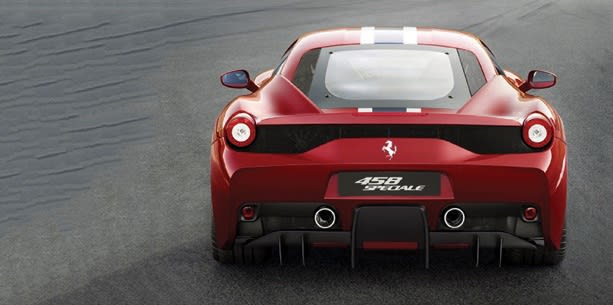
Ferrari engineers developed a rear spoiler with a larger surface area and more pronounced shape, which improves underbody efficiency and also increases downforce by 7 points. And by repositioning the tailpipes, engineers could design a new diffuser that optimizes the extraction capacity of the underbody, increasing Cl by 6.5 points.
Flaps at the rear of the 458 Speciale have two configurations: raised for higher downforce and lowered to minimize drag. Sensors and a specific algorithm allow the flaps to be lowered by as much as a 17° angle, thereby stalling the diffuser and reducing Cd by 3 points, the automaker claims.
The Ferrari Style Center collaborated with Pininfarina on the car’s racing-inspired styling. Most of the body panels have been redesigned without modifying the passenger cell or the signature design features of the 458 Italia. Glass thickness has been reduced to cut weight, and the rear windscreen is now a Lexan (from SABIC Innovative Plastics) polycarbonate panel. The composite bumpers were redesigned, and the front hood features two deep air outlets to channel away the air exiting the radiator.
Aero-focused Camaro Z/28
The new Camaro Z/28 is the fastest factory-produced Camaro ever on a track, posting a lap time at Nürburgring that was 4 s faster than the Camaro ZL1’s and beating published times for the Porsche 911 Carrera S and the Lamborghini Murcielago LP640, according to General Motors.

To accomplish such a feat, GM engineers had to focus on more than just what was under the hood; they had to modify numerous exterior elements compared to the Camaro SS to improve downforce. These modifications help press the Z/28 to the ground with 440 lb (1.96 kN) more force at 150 mph (241 km/h) than the SS model, which generates slight lift at that speed.
“Most production cars are designed with some lift at speed in order to slip through the air for greater fuel economy, but the all-new Camaro Z/28’s track-oriented purpose dictated an entirely different take on airflow management,” said Tom Froling, Lead Development Engineer–Aerodynamics. “Its carefully tailored aerodynamics package generates downforce for greater handling stability at speed, and the grilles are optimized to meet stringent cooling flow and brake-cooling requirements.”
The Z/28 shares several racing-inspired aero features from various Camaro and Corvette racecars, Froling noted. A front splitter that provides downforce at the front of the car is designed to withstand 250 lb (1.11 kN) of force at its tip. The splitter is matched with an aero closeout panel under the front of the engine compartment, along with molded-in aero features forward of the front wheels.
To meet downforce requirements for Z/28, the rear spoiler used for Camaro SS was modified with a “wickerbill” — a small, vertical tab at the edge of the spoiler. The “minor” change adds about 28 counts of drag, improving rear lift performance by 70 counts, according to GM.
A functional carbon-fiber hood extractor — similar to the one featured on the Camaro ZL1 — not only increases engine cooling but also provides a path for air channeled through the grille to exit out the hood and over the car. GM notes that without the vent, the air would be pushed out the bottom of the engine compartment, possibly generating lift.

The Z/28 underbody incorporates a belly pan that helps reduce front lift and also contributes to drivetrain cooling. Modified NACA duct profiles draw air into the underbody tunnel area to provide extra cooling for components affected by the engine’s exhaust thermal energy. Unique wheelhouse liners with closeouts also assist with airflow.
The fog lamps, air dam, and upper grille found on the front fascia of the Camaro SS are replaced with covers, an air duct support bracket, an airflow-optimized upper grille for enhanced cooling, and a modified fascia lower inlet that helps funnel air from the splitter/lower grille through ducts to the brake rotors and calipers.
Engineers employed CFD, reduced-scale rolling wind-tunnel testing, full-scale clay models, and full-size prototypes tested in several wind tunnels, including GM’s facility in Warren, MI, for the aerodynamic development of the new Z/28.
More From SAE Media Group
Automotive Engineering
Chevrolet Ups the Performance Ante with MY2015 Corvette Z06
Autonomous Vehicle Engineering
Predicting the Road to Efficiency
Automotive Engineering
BMW, Honda and Yamaha Form Connected Motorcycle Consortium
Autonomous Vehicle Engineering
Prepping Cities for Vehicle Autonomy
Off-Highway Engineering
Peloton Develops a Level 4 Automated Platooning System, but Keeps the Driver in Charge
Automotive Engineering
5 More HP for 2026 Kia Sportage: First Drive
Automotive Engineering
2015 GT350 Mustang Aimed at Track-Day Dominance
Automotive Engineering
2021 Toyota Supra 2.0
Automotive Engineering
2026 Nissan Sentra Review: Putting the Pieces Together
Automotive Engineering
Advanced Aerodynamics Features Applied to Mustang
Automotive Engineering
Shanghai’s Human Horizons Unveils a 5G-V2X-Enabled Electric, Luxury SUV
Automotive Engineering
GM Readies Comprehensive New Vehicle-Software Platform
Automotive Engineering
2016 Mazda MX-5 Stays True to Its Roots
Automotive Engineering
McLaren CEO Fast-Forwarding Technology-Centric McLaren Automotive
Automotive Engineering
Volvo Concept Estate Shows Clues for New XC90
Off-Highway Engineering
MOBI Rolls out the First Blockchain-Enabled Vehicle Identity (VID) Mobility Standard
Automotive Engineering
As V2I Evolves, Costs, Maintenance Concerns Emerge
Automotive Engineering
Automotive Cybersecurity Needs Serious Work
Automotive Engineering
Nissan Tries to Re-Create Murano Buzz Through Design
Automotive Engineering
Autonomous Transit Bus Nears Its First Year of Operation
Automotive Engineering
NAIAS 2022: Seventh-Generation of Ford Mustang Is Highest Performer Yet
Automotive Engineering
V2X Communications Face Many Challenges Before Deployment

Automotive Engineering
Can Ads Help in Vehicle-To-Vehicle Rollout?
Autonomous Vehicle Engineering
Purpose, Perceptions for Driver-Assist Tech Solidify
Automotive Engineering
Toyota Stretches SUV Line-Up with World Debut of Grand Highlander
Automotive Engineering
Faster, Lighter: Lotus Reveals Its Quickest Road Car Yet
Automotive Engineering
Mercedes-Benz CL63 AMG Becomes S63 AMG for 2015
Automotive Engineering
EXP 10 Speed 6 Could Preview Sportier Two Seater
Automotive Engineering
Lexus Previews 2018 LC 500 Luxury Coupe
Top Stories
INSIDERManufacturing & Prototyping
 How Airbus is Using w-DED to 3D Print Larger Titanium Airplane Parts
INSIDERManned Systems
 FAA to Replace Aging Network of Ground-Based Radars
NewsTransportation
 CES 2026: Bosch is Ready to Bring AI to Your (Likely ICE-powered) Vehicle
NewsSoftware
 Accelerating Down the Road to Autonomy
EditorialDesign
 DarkSky One Wants to Make the World a Darker Place
INSIDERMaterials
 Can This Self-Healing Composite Make Airplane and Spacecraft Components Last...
Webcasts
Defense
 How Sift's Unified Observability Platform Accelerates Drone Innovation
Automotive
 E/E Architecture Redefined: Building Smarter, Safer, and Scalable...
Power
 Hydrogen Engines Are Heating Up for Heavy Duty
Electronics & Computers
 Advantages of Smart Power Distribution Unit Design for Automotive...
Unmanned Systems
 Quiet, Please: NVH Improvement Opportunities in the Early Design...
