




Advanced Aerodynamics Features Applied to Mustang

Spending twice as much in aerodynamics development compared to previous Mustangs resulted in innovations such as front-wheel aero curtains and active grille shutters. Showing how important aerodynamic CFD is to the engineering process, Carl Widmann, Aerodynamics Engineering Manager for Ford, noted that major advances in Ford’s CFD capabilities let them test the effect of design changes and give feedback to the studio in less than 48 h. More time means more design options are explored.
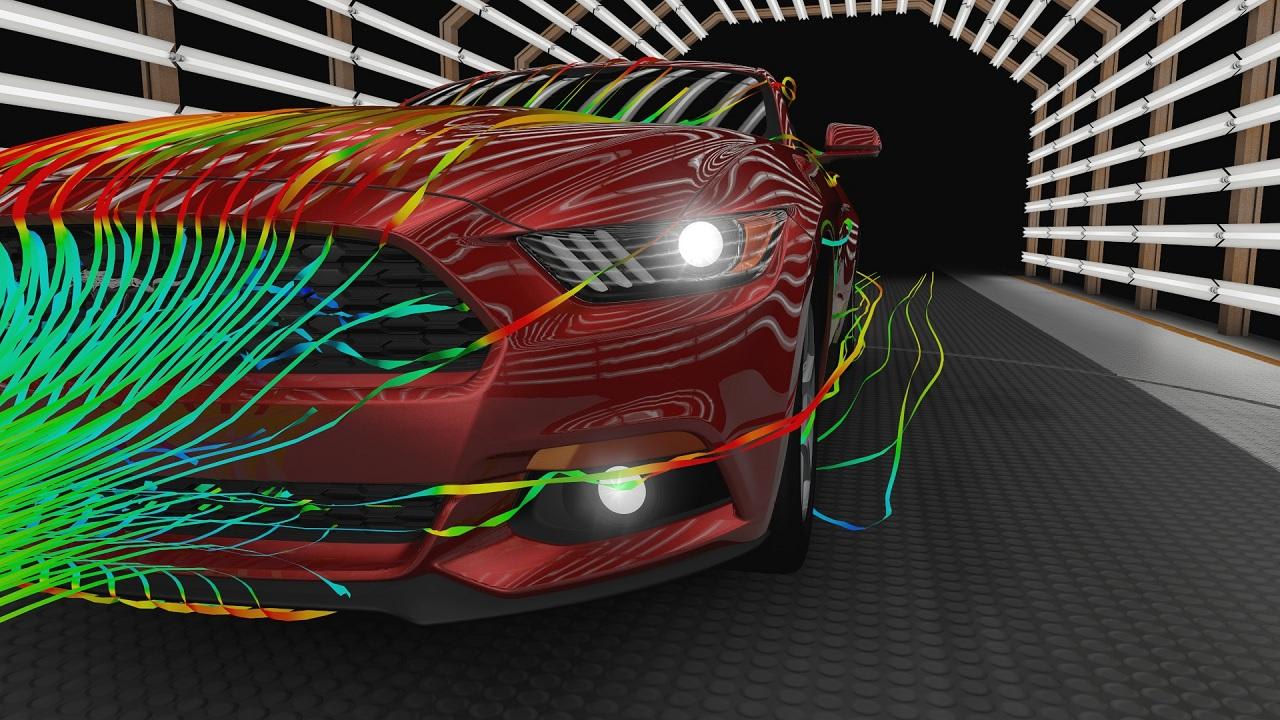
Rotating wheels are a major source of aerodynamic drag. They can account for 30% of total drag, or more, depending on how streamlined the rest of the car is. This is because the wheels themselves are not streamlined; they rotate within the wheel housings, and the airflow spreads from the underbody and wheel well and so it hits the wheels on a yaw angle. These three factors interact, causing turbulence and drag.
One solution is to enclose the wheels with a skirt, a design feature dismissed by Ford for a performance sports car such as the Mustang. Instead, the development team adopted air curtains. These are vertical slots in the outer edge of the front fascia. These channel air from the front of the car to openings in the wheel wells, directing it across the outer surface of the wheel and tire. Mustang joins the likes of BMW with this design feature.
This feature also helps cool the brakes, according to Kemal Curic, Mustang Exterior Design Manager. Ford addresses drag from the rear wheels by using small blades attached to the front of the rear wheel housing.
Another feature Curic pointed to was the shark-nose front end that helps cut the air, separate it, and attach the airflow to the body, again for efficiency. New Mustangs are equipped with splitters and air dams below the front fascia that help to minimize air under the car. Integrated rear deck spoilers are slightly different for different models.
For Mustangs outfitted with the 2.3-L EcoBoost gasoline direct-injection, turbocharged engine active grille shutters will further reduce drag at high speeds. The shutters can completely close off the grille, sending air over and around the car instead of through the engine compartment. Other engine options will get static grilles.
All together, Ford claims the overall drag force is reduced by 3%, without providing a specific overall drag coefficient (Cd) at present.
The top speed is 155 mph (249 km/h), slated for the V8, 420-hp (313-kW) Mustang GT. At such speeds, vehicle dynamics and handling matter as much as efficiency. New Mustangs are equipped with splitters and air dams below the front fascia that help to minimize air under the car. The Mustang GT version (alone) also features a pair of vents in the hood that also contribute to front-end downforce.
More From SAE Media Group
Automotive Engineering
2021 Toyota Supra 2.0
Automotive Engineering
2015 GT350 Mustang Aimed at Track-Day Dominance
Automotive Engineering
Designing for Downforce
Automotive Engineering
Chevrolet Ups the Performance Ante with MY2015 Corvette Z06
Automotive Engineering
NAIAS 2022: Seventh-Generation of Ford Mustang Is Highest Performer Yet
Automotive Engineering
Ford Debuts Mustang Convertible and Revised Focus
Automotive Engineering
Wraith Offers Rolls-Royce’s Most Dynamic Driving Experience
Automotive Engineering
Lutz and Fisker Introduce New Viper-Powered Force 1 Supercar
Automotive Engineering
Koenigsegg Returns to U.S. Market with Carbon-Fiber 'Hypercar'
Automotive Engineering
Nissan Tries to Re-Create Murano Buzz Through Design
Automotive Engineering
Challenger GT AWD Concept Debuts at 2015 SEMA Show
Automotive Engineering
Faster, Lighter: Lotus Reveals Its Quickest Road Car Yet
Automotive Engineering
Making over the World’s Leading Hybrid
Automotive Engineering
5 More HP for 2026 Kia Sportage: First Drive
Automotive Engineering
2016 Explorer Gains More Powerful Four-Cylinder, Platinum Opulence
Automotive Engineering
McLaren Faces the Electrified and Autonomous Future
Automotive Engineering
2016 Camaro: GM Unleashes Its Lighter, Faster Mustang Competitor
Automotive Engineering
EXP 10 Speed 6 Could Preview Sportier Two Seater
Automotive Engineering
Mazda Trickles out More New MX-5 Details
Automotive Engineering
Mercedes-Benz CL63 AMG Becomes S63 AMG for 2015
Automotive Engineering
2019 Chevrolet Silverado 2.7L
Off-Highway Engineering
Western Star Adds ‘Weight Sensitive’ 47X to Vocational Lineup
Automotive Engineering
Ford GT Prototypes "Run Naked" in Public-Road Testing Phase
Automotive Engineering
Mercedes Boosts Off-Road Prowess of 2019 G-Wagen
Automotive Engineering
Jaguar’s Making of a Sports Sedan
Automotive Engineering
McLaren Debuts New Entry-Level Sports Series
Automotive Engineering
Hyundai Brings Brave New Tech to 2020 Sonata
Automotive Engineering
Lexus Previews 2018 LC 500 Luxury Coupe
Automotive Engineering
Nissan Titan Warrior Concept Previews a Raptor Competitor
Automotive Engineering
Peugeot Seeks International Appeal with Quartz Concept
Top Stories
INSIDERManufacturing & Prototyping
 How Airbus is Using w-DED to 3D Print Larger Titanium Airplane Parts
INSIDERManned Systems
 FAA to Replace Aging Network of Ground-Based Radars
NewsTransportation
 CES 2026: Bosch is Ready to Bring AI to Your (Likely ICE-powered) Vehicle
NewsSoftware
 Accelerating Down the Road to Autonomy
EditorialDesign
 DarkSky One Wants to Make the World a Darker Place
INSIDERMaterials
 Can This Self-Healing Composite Make Airplane and Spacecraft Components Last...
Webcasts
Defense
 How Sift's Unified Observability Platform Accelerates Drone Innovation
Automotive
 E/E Architecture Redefined: Building Smarter, Safer, and Scalable...
Power
 Hydrogen Engines Are Heating Up for Heavy Duty
Electronics & Computers
 Advantages of Smart Power Distribution Unit Design for Automotive...
Unmanned Systems
 Quiet, Please: NVH Improvement Opportunities in the Early Design...
