




Hyundai Brings Brave New Tech to 2020 Sonata
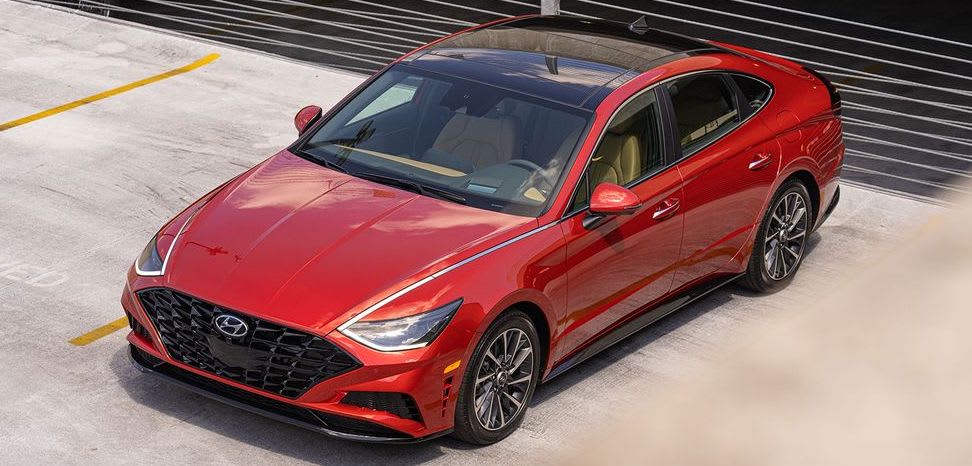
Amid a steadily contracting sedan universe, Hyundai has dug in its heels and thoroughly redesigned and engineered its Sonata for 2020. The eighth-generation model sports a shapely (to our eyes) exterior form slightly reminiscent of Audi’s A7. It’s underpinned by a new platform shared with its 2021 Kia Optima cousin that will serve multiple FWD/AWD passenger cars and crossovers, according to senior U.S. product-planning manager, Mike Evanoff.
New technology applications include a “Digital Key” that allows Sonata drivers to unlock and start their cars via their smart phones, Hyundai’s first continuously-variable valve duration system in the new 1.6-L turbo engine, and a solar array that extends driving range in a new hybrid propulsion option.
Hyundai Group R&D boss Albert Biermann and global design chief SangYup Lee conspired to lengthen Sonata’s wheelbase by 1.4 in/35.5 mm (now 111.8 in/2840 mm) and reduce overhangs (20 mm in front) while significantly lowering the front structure to optimize driver sightlines. Cowl and shock-tower height are reduced by 8 mm (.31 in); roof height is 30 mm (nearly 1.2 in) lower, and the leading edge of the hood is 45-mm (1.7-in) below that of the previous Sonata. It’s designed to pass “ped-pro” (pedestrian impact) tests.
“We [design team] had to fight for every millimeter!” noted Kevin Kang, the senior creative manager. “Reducing shock-tower height was a game-changer for us.”
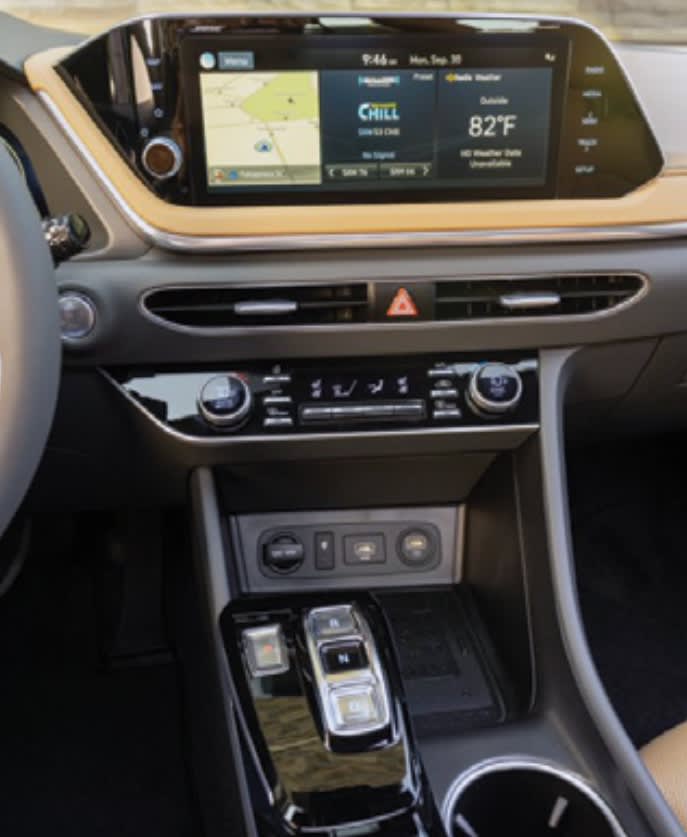
Sonata’s cabin is spacious even for this gangly 6-ft 3-in-tall editor, though it loses 0.2 in/5 mm of rear seat headroom (but makes up for it with a variable-density foam in the seat cushions). Kang’s team obsessively integrated the door armrests with storage space. The human-machine interfaces are an effective blend of digital and mechanical controls that optimize driver convenience, appearance, and center-console space utilization. There’s a 10.3-in infotainment screen in the dashboard (styled to resemble a drone aircraft, Kang said); the touchscreen’s left side is angled toward the driver to more cleanly package the gauge cluster. A head-up display with exceptional acuity shows navigation commands when the navi is activated.
The “Digital Key” system uses near-field communication (NFC) to detect when the phone is within four centimeters of the car’s door handle. It can be programmed for use with up to four phones. The system slips into a wireless charger/NFC reader and allows full access to vehicle functions and interior adjustments. By comparison, Tesla’s phone-app feature in the Model 3 uses Bluetooth to open the car and adjust settings when the driver gets within about 30 ft (9.14 m) of the vehicle.
The new Sonata/Optima steel-intensive structure increases use of high-strength alloys, including hot-stamped side rails. According to Evanoff, engineers achieved a 127-lb (57.6-kg) overall curb weight reduction, comparing 2020-vs.- 2019 base models. Load-path energy management and IIHS small-front-offset crash performance were developmental priorities, he said. Other body-related details include touch-capacitive door handles; a lower-drag grill and reshaped rear spoiler that help achieve .27-Cd aerodynamics (vs. .26 Cd for the 2020 Toyota Camry and .27 Cd for Honda Accord). The underbody systems are designed to manage airflow under the car and through the engine compartment, and front-door glazing is now 5-mm (0.196-in) thick to better attenuate cabin NVH.
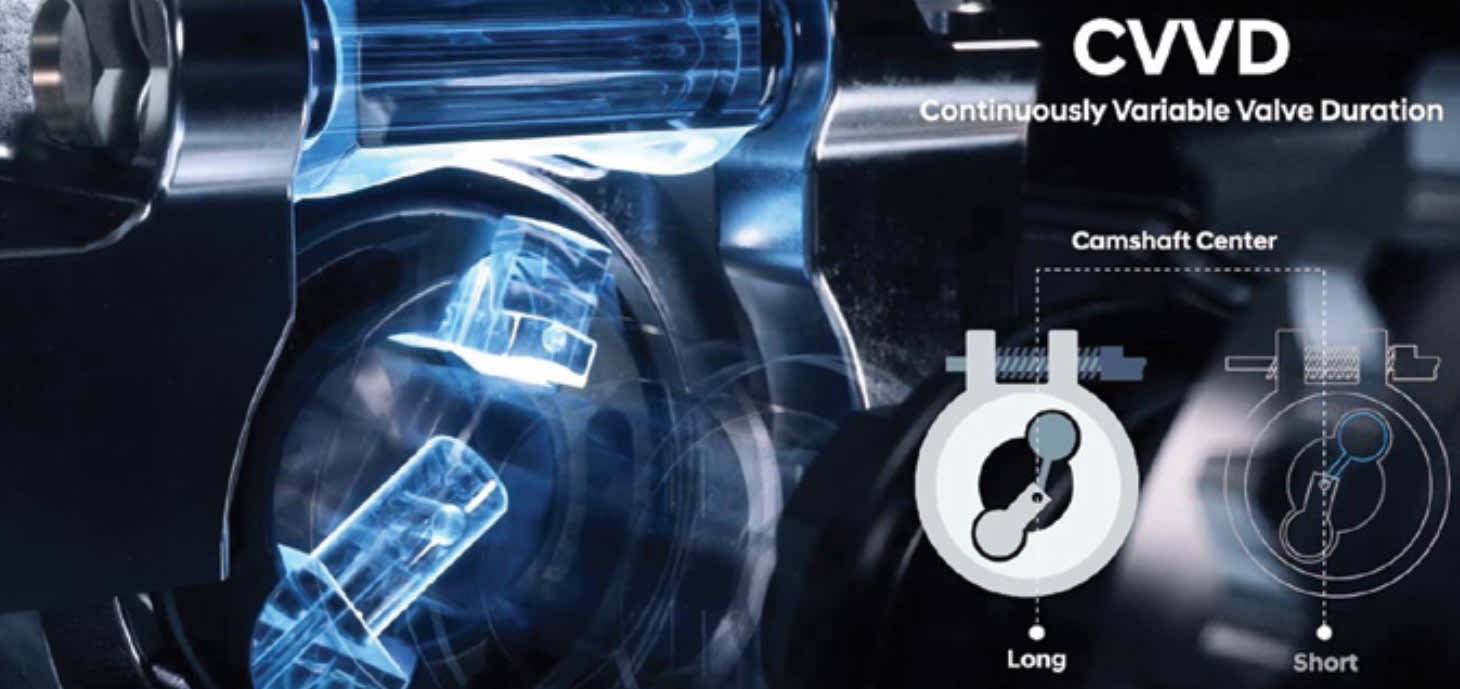
Hyundai propulsion engineers pushed new boundaries with the optional ‘SmartStream’ 1.6-L turbocharged/CVVD unit and the solar-blended 2.0-L hybrid (a naturally aspirated 2.5-L is the base engine), both mated with an 8-speed automatic, and a 2.0-L hybrid-electric powertrain. The big-news CVVD is controlled by a fairly complex set of dedicated hardware fitted within the top of the DOHC cylinder head. By varying the length of time the valves remain open and closed, Hyundai claims CVVD is capable of Atkinson-, Miller-, and Otto- cycle operation. This gives engineers another “lever” to optimize current and future ICE combustion strategies in both boosted and non-boosted applications.
The new CVVD turbo engine delivers SAE-rated 180 hp (134 kW) at 6,000 rpm and 195 lb-ft (264 Nm) at 1,500 rpm. Brake-specific fuel consumption (BSFC) across the rpm range is 5% better than the previous turbo engine, according to Hyundai.
But wait, there’s more: the hybrid model combines a new 2.0-L Atkinson-cycle SmartStream engine with a 38-kW electric machine and 6-speed automatic, for total output of 192 hp (143 kW). The Sonata Hybrid is the first application of Hyundai’s solar-panel roof, designed to recharge the car’s battery and mitigate discharge. Hyundai claims the solar-panel roof can extend the hybrid’s range by 800 miles (nearly 1,290 km) per year, if the solar array operates for six hours per day.
More From SAE Media Group
Automotive Engineering
Toyota Stretches SUV Line-Up with World Debut of Grand Highlander
Automotive Engineering
Making over the World’s Leading Hybrid
Automotive Engineering
2021 Toyota Supra 2.0
Automotive Engineering
2016 Malibu Sheds 300 lb, Adds New Hybrid System
Tech Briefs
Making EVs Accessible for All
Automotive Engineering
2016 Optima Gets Upgraded UVO
Automotive Engineering
2019 Subaru Ascent Premium
Automotive Engineering
Q80 Inspiration Concept Previews Future Top-Range Infiniti, New Engine Family
Automotive Engineering
Aisin Opens New North American Tech Center, Will Add Engineers
Automotive Engineering
2016 Explorer Gains More Powerful Four-Cylinder, Platinum Opulence
Automotive Engineering
Chevrolet Ups the Performance Ante with MY2015 Corvette Z06
Automotive Engineering
5 More HP for 2026 Kia Sportage: First Drive
Automotive Engineering
Audi Shows Design, Fuel-Cell Directions
Automotive Engineering
SsangYong Takes on European Challenge with Tivoli

Automotive Engineering
Road-Efficient Mud Machine
Automotive Engineering
Ford Unveils 2021 Mustang Mach-E Electric Vehicle
Automotive Engineering
Cadillac’s 2016 CT6 Is a Body-Engineering Benchmark
Automotive Engineering
China Luxury Market Requirements Drive New Lincoln Continental Design, Engineering
Automotive Engineering
Lexus Sharpens Best-Selling RX for 2016
Off-Highway Engineering
Yanmar CE Adds to Growing Compact Track Loader Segment

Automotive Engineering
ZF's CEO Talks About Lightweight Vehicle Applications
Automotive Engineering
Suppliers Struggling to Keep Pace with Faster Product Cycles, Says IHS
Automotive Engineering
Acura TLX Is Honda’s New Body-Build Benchmark
Automotive Engineering
2015 F-150: Ford Drops an Aluminum Blockbuster
Automotive Engineering
2026 Toyota RAV4 Review: All Hybrid, All the Time
Automotive Engineering
2026 Nissan Sentra Review: Putting the Pieces Together
Automotive Engineering
Kia's 2017 Niro Hybrid CUV Targets Sub-90 G/km CO2 Emissions
Automotive Engineering
Aluminum: Toward 50% Body Content
Top Stories
INSIDERManufacturing & Prototyping
 How Airbus is Using w-DED to 3D Print Larger Titanium Airplane Parts
INSIDERManned Systems
 FAA to Replace Aging Network of Ground-Based Radars
NewsTransportation
 CES 2026: Bosch is Ready to Bring AI to Your (Likely ICE-powered) Vehicle
NewsSoftware
 Accelerating Down the Road to Autonomy
EditorialDesign
 DarkSky One Wants to Make the World a Darker Place
INSIDERMaterials
 Can This Self-Healing Composite Make Airplane and Spacecraft Components Last...
Webcasts
Defense
 How Sift's Unified Observability Platform Accelerates Drone Innovation
Automotive
 E/E Architecture Redefined: Building Smarter, Safer, and Scalable...
Power
 Hydrogen Engines Are Heating Up for Heavy Duty
Electronics & Computers
 Advantages of Smart Power Distribution Unit Design for Automotive...
Unmanned Systems
 Quiet, Please: NVH Improvement Opportunities in the Early Design...
