




2026 Toyota RAV4 Review: All Hybrid, All the Time

Toyota’s big claim for its new sixth-generation 2026 RAV4 is that the SUV is now“ 100% electrified.” That’s true, as Obi-wan once said, from a certain point of view. As it recently did with the Camry, the automaker has now eliminated an ICE-only powertrain from the list of options, giving drivers the choice between a gas-electric hybrid or a plug-in hybrid (PHEV).
The hybrids use Toyota’s fifth-generation hybrid system, which uses a 2.5-L 4-cylinder aluminum Atkinson cycle engine that produces 163 lb-ft and up to 226 hp (169 kW) in FWD configuration, 236 hp (176 kW) in AWD. Seven trim levels – LE, XLE Premium (which Toyota expects to be the volume trim), Limited, SE, XSE and Woodland – can be had with the hybrid powertrain, while the driving-focused GR Sport version can only be had as a PHEV. The plug-in option is available on the SE, XSE and Woodland. These new RAV4s use Toyota’s sixth-generation PHEV system, which produces 324 hp (242 kW) and up to 172 lb-ft So, yes, the entire line-up is electric, but most are also gas-powered.
Earlier this year, Toyota told us that “electrified” powertrains — EVs, PHEVs and hybrids — made up over 43% of Toyota’s total U.S. sales volume in 2024. Eliminating the gas-only engine option means this number will continue to climb, but Toyota doesn’t want to give its customers the chance to miss something they are accustomed to.
Change it, but keep it the same
Customers are used to model year changes and, outwardly, the RAV4 has upped the chunkiness for 2026. The exterior’s new, angular design is echoed in the more rectangular, more functional interior. It’s a strong look that makes the new RAV4 look larger, even though the wheelbase remains unchanged at 105.9 in (269 cm) while the overall length has grown by up to an inch, from 180.9 in (460 cm) last year to 182 in (462 cm) in the Woodland trim (all other 2026 RAV4 models are 181 in). Width remains the same at 73 in. (185 cm), but the Woodland again stands out at 74 in. (188 cm). Ground clearance numbers range from 8.0 to 8.6 in (20-22 cm) for the 2025 RAV4, but this year maxes out at 8.5 in.(22 cm) for the Woodland trim and 8.1 in (21 cm) for all other grades.
“The [current RAV4] had lots of technology in it, and it really expanded the awareness and acceptance from a wide range of customers. This time, we eliminated the gasoline engine and we made sure we didn't compromise or lose any of the performance that the gasoline engines had, despite changing to hybrid and plug-in hybrid,” RAV4 chief engineer Yoshinori Futonagane told SAE Media during test drives for the new RAV4 in Arizona.
“One of the places for improvement on the fifth-generation hybrid was noise,” he said (through an interpreter). “We've increased the rigidity of the powertrain unit itself to suppress the source of sound and noise and used acoustic glass in the front windows, passenger windows and front windshield, effectively using sound absorption materials to create a comfortable environment for the driver, even more than the current generation.”
To improve handling, the team increased rigidity throughout the vehicle, including the suspension mounting points, the opening around the rear hatch, and the steering mount. “Finding effective points to increase rigidity was a big part of these improvements,” Futonagane said. The team also rethought the hydraulic system layout for the brake actuator, improving brake caliper response time in the millisecond range, Futonagane said. The brakes still work off of oil pressure as they did in the previous RAV4, but they can now get additional assistance from the motor, which can act like an electric, limited-slip differential for better traction control and much improved Hill Descent Control on the off-road-focused Woodland trim. On a short, relatively undemanding off-road course (for a true off-road vehicle), the Woodland made it easy to drive down unpaved trails without any extra driver training.
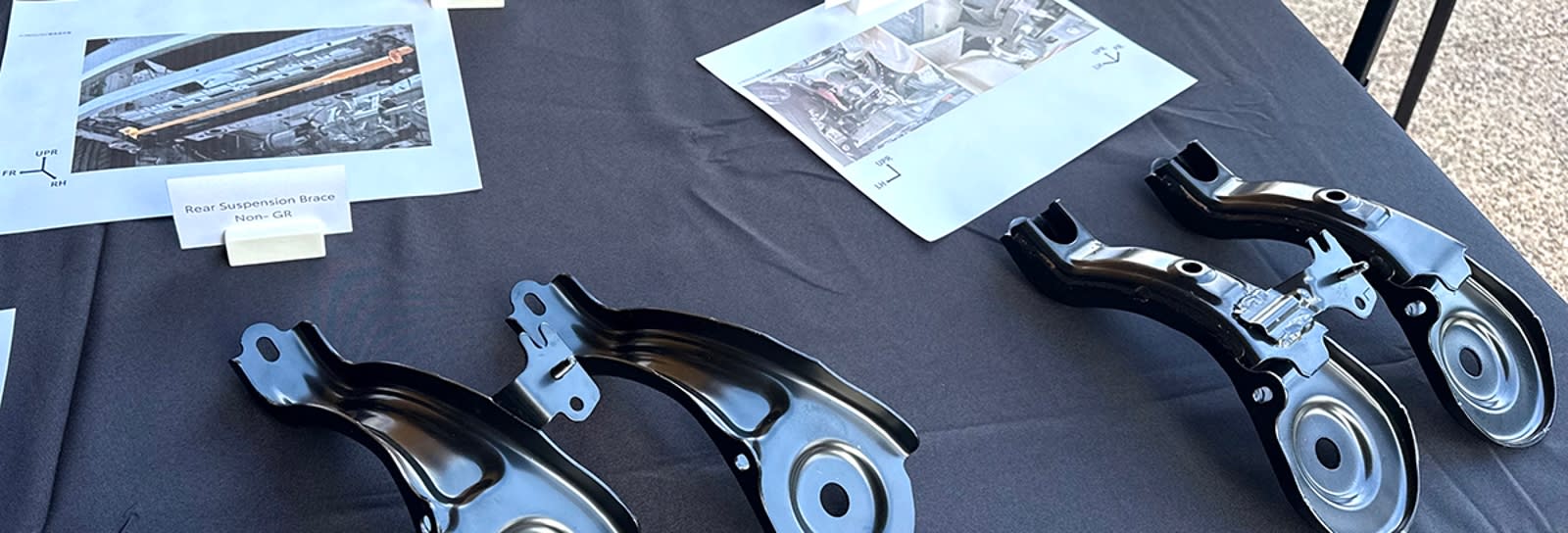
On the other end of the SUV spectrum, the RAV4 GR Sport is the first-ever GR-Sport RAV4 model and comes with PHEV and AWD standard. The peppy trim has plenty of visual differentiators – badges and logos sprinkled throughout, an exclusive Matrix front end, an optional rear wing spoiler – but there are important changes in the powertrain as well. A dedicated suspension brings the ride height 15 mm (0.6 in) lower. An improved rear suspension brace increases body rigidity. And the wheels are offset to be 20-mm (0.8 in) wider than on the other RAV4s. All these changes are intended to make the GR Sport model feel more intuitive on the road. Towing is not recommended for the RAV4 GR Sport.
A PHEV that isn’t Prime

The new RAV4 PHEV - the company dropped the Prime designator for this model year – can be had with standard Level 2 AC charging, with a 50-kW DC fast-charging port, or both. Four of the RAV4’s seven grades will have a PHEV option, in two different charging configurations. The SE and GR Sport trims have a 7 kW J1772 port on the passenger side, while the XSE and Woodland trims have a CCS1 DC fast-charging port on the driver side capable of 11 kW AC or up to 50 kW DC. Futonagane said having both options came from the RAV4 being a global model. He said Toyota knows that AC charging will be the default for most buyers, but engineers wanted to give drivers who appreciate the PHEV performance boost a way to recharge quickly.
“For people who want to continue to enjoy the maximum EV performance of the car, offering a DC charger gives them the option to extend that as quickly as possible,” Futonagane said, adding that the extra cost of adding the DC port only makes sense for certain customers. “You can imagine the Limited and some of the XSEs, those are the customers who are willing to pay the extra to maintain maximum performance at more opportunities,” he said. “But this is a challenge. To be honest, we're investigating and seeing how the feedback is on keeping both types.”The PHEV’s 22.7 kWh battery can be charged from 10 to 80% in approximately 35 minutes using fast charging, or in 3.5 houToyota learned some new software tricks as it developed the new RAV4. Specificaly, this is the first model to incorporate the use of Arene OS, Toyota’s comprehensive software development solution. Futonagane said development of the multimedia and electrical systems were finished in less time with help from Arene, which was developed by Toyota’s Woven project.
“All the ECUs which were independently doing their own job, we've clumped into similar job roles,” he said. “Before, we had to physically install that in a physical vehicle to test it. Now we can create a virtual environment within a computer and also the evaluation environment
On the road

All these changes result in a better, but not wildly different RAV4. The highlighted trims, Woodland and GR Sport, stand out because they offer something new, but this remains an excellent SUV designed for the masses. The driving improvements, especially turn-ins, felt tighter in the GR Sport, but I can’t help but think Toyota is leaving some acceleration on the table. Even with all of the talk of electrification, all trims of the RAV4 accelerate – some better, some worse – like an ICE model. This is disappointingly true even when EV mode is engaged. The oomph that thrills EV drivers from other brands is missing here, to Toyota’s detriment. Acceleration is unexcitingly competent when the four-cylinder is pushed, but the rest of the drive is comfortable and relatively quiet. Some unwanted road noise creeps in through the window seals, but nothing major.
In the end, the RAV4 remains a people-mover worth considering. It’s got the looks and performance to keep families happy, and it can come with some nice bonuses. As mentioned, the off-roading capabilities of the Woodland trim certainly stand out, especially if you’re the type of outdoors person who wants a safe ride to the hiking trailhead, not a driver looking to rock crawl all day. And around 50 miles or electric range in the PHEV models mean you’re unlikely to need to gas up much unless it’s time to head off to that distant hike you’ve been meaning to get to.
More From SAE Media Group
Automotive Engineering
Toyota Stretches SUV Line-Up with World Debut of Grand Highlander
Automotive Engineering
2026 Nissan Leaf First Drive: Fun and More Efficient
Automotive Engineering
Toyota’s Multi-Pathway Future on Full Display
Automotive Engineering
2026 Toyota BZ: Improved, but Still Not a WheeeeeEV
Automotive Engineering
Volvo XC90 Line-Up Keeps Hybrid Futures Safe
Automotive Engineering
2025 Kia Carnival MPV Hybrid Brings Unplugged PHEV Power
Automotive Engineering
ICE and Hybrid-Electric Propulsion Show Staying Power
Automotive Engineering
Ford Engineers a Tech Barrage with 2020 Lincoln Aviator
Automotive Engineering
SAE WCX 2022: ICE Won’t Melt amid Shift to EVs
Automotive Engineering
EV Confidence
Automotive Engineering
2019 S60 and V60 Volvo’s Newest Chips in the Transformation Game
Automotive Engineering
High-Performance Hybrid Headlines Lexus’s Re-Engineered RX Lineup
Automotive Engineering
2025 Ram 1500 REV Driving Range Would Jump to Head of Class
Automotive Engineering
Lincoln Corsair Leverages Global Architecture to Differentiate Latest C-Segment Luxury SUV
Automotive Engineering
Ford Engineers Charged with a Blank EV Slate for the All-New 2021 Mustang Mach-E
Automotive Engineering
2025 Cadillac Optiq EV Arrives with Standard Dual Motors
Automotive Engineering
Nissan Leaf Gets Updates – and Stays the Same – Where It Matters Most
Automotive Engineering
Driving the New Nissan Leaf Prototype
Off-Highway Engineering
Bollinger’s Electric Truck Enters Design Validation Phase
Automotive Engineering
CES: VinFast Previews Wild Concept Truck
Automotive Engineering
2025 BMW M5 First Drive: Stuffed like Schnitzel with PHEV Tech
Automotive Engineering
New BMW 5 Series Adds PHEV, Touring, XDrive M5
Automotive Engineering
Q&A: VW Engineering Chief on Wireless Charging at DC Speeds
Automotive Engineering
The Fiat 500e Is Back
Automotive Engineering
GM’s Hummer EV Is Still like Nothing Else
Automotive Engineering
New Lexus SUVs: GX for Show, TX for Dough?
Automotive Engineering
BMW Takes Multi-Modal Route to Manufacturing
Automotive Engineering
Lighter Volvo XC90 Is Engineered for "Premium Cool"
Automotive Engineering
2024 Honda Prologue Is a Cautious Invitation to Drive Electric
Automotive Engineering
TRD Spells Capability for Toyota’s Latest Tundra
Top Stories
INSIDERManufacturing & Prototyping
 How Airbus is Using w-DED to 3D Print Larger Titanium Airplane Parts
INSIDERManned Systems
 FAA to Replace Aging Network of Ground-Based Radars
NewsTransportation
 CES 2026: Bosch is Ready to Bring AI to Your (Likely ICE-powered) Vehicle
NewsSoftware
 Accelerating Down the Road to Autonomy
EditorialDesign
 DarkSky One Wants to Make the World a Darker Place
INSIDERMaterials
 Can This Self-Healing Composite Make Airplane and Spacecraft Components Last...
Webcasts
Defense
 How Sift's Unified Observability Platform Accelerates Drone Innovation
Automotive
 E/E Architecture Redefined: Building Smarter, Safer, and Scalable...
Power
 Hydrogen Engines Are Heating Up for Heavy Duty
Electronics & Computers
 Advantages of Smart Power Distribution Unit Design for Automotive...
Unmanned Systems
 Quiet, Please: NVH Improvement Opportunities in the Early Design...
Power

Similar Stories
What We’re DrivingPower

ArticlesTransportation

NewsTransportation
 All-New 2015 Chrysler 200 Debuts in Detroit
NewsManufacturing & Prototyping
 Several World Firsts Highlight Volvo XC90 (Video)
ArticlesPower
 Toyota’s Multi-Pathway Future on Full Display
