




2026 Nissan Leaf First Drive: Fun and More Efficient
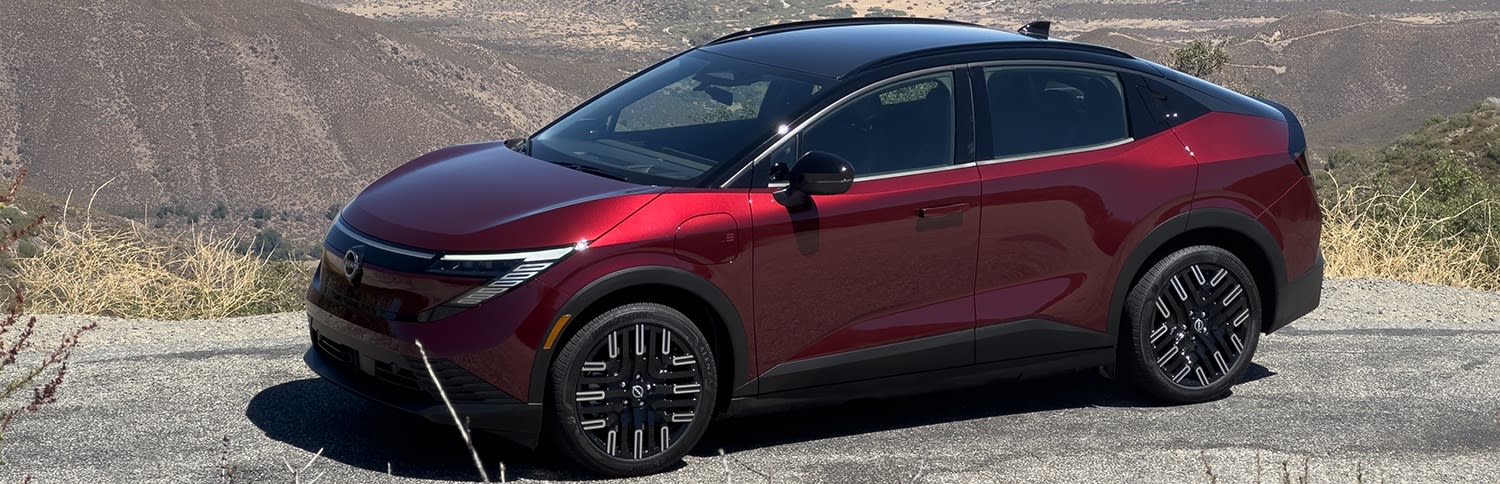
By law, you have to mention that at one time, the Nissan Leaf (actually, LEAF, which stands for Leading Environmentally-friendly Affordable Family car) was the number one selling EV in the world until the Tesla Model 3 arrived on the market. The first-generation Leaf was a game-changer. The second-generation Leaf felt like Nissan was falling behind competitors. Also, it was boring.
The latest Leaf not only gets a major design overhaul, but the powertrain and battery are updated to make the Leaf a proper EV that competes with other electric crossovers. But the big news for many is its starting price. It's a big move for Nissan, but that price point does come with caveats.
Starting at under $30,000 ($29,990 plus $1,495 destination) for the S+ the Leaf continues to be a bargain, except now it can claim that inexpensive crown without too many compromises. The SV+ will come in at $34,230 (plus $1,495 destination), while the top trim level Plat+ hits $38,990 (plus the destination fee). For the drive program, Nissan gave us the top-grade version to drive around San Diego. It ships with LED taillights, 19-inch wheels, a Dimming panoramic roof, and V2L interior ports. All nice amenities, but the foundation of the vehicle is what makes this generation Leaf an important vehicle in the EV sector and for Nissan.
Liquid beats air
The largest update to the Leaf is thermal management. A completely redesigned and liquid-cooled system should squash any concerns that the new Leaf would suffer the fate of the air-cooled EVs.
Like the now-unavailable-in-the-US Ariya, the Leaf is built on Nissan's Common Module Family (CMF) architecture. For the battery, the new platform includes a proper thermal management system. This integrated system ties the HVAC, motor, battery, charger system, and radiator together into a single thermal structure. The system keeps the battery, motors, and onboard charger cooled or heated to optimum operating temperatures while keeping passengers comfortable. For example, on a cold day, excess heat from the vehicle can be used to warm the cabin.
Nissan has also added a battery heater and the option to manually optimize the battery for charging. Unfortunately, while standard on all other trim levels, the feature is unavailable on the entry-level S+. The lack of a battery heater on that trim and its lack of integrated Google navigation (standard on the rest of the Leaf lineup) means that there's also no battery conditioning via route planning, mostly because the trim level does not offer route planning.
Still, the S+ trim level does offer up to 303 miles of range from a 75kWh pack, thanks in part to the efficiency gains available from the new thermal management system.
Additional gains come from the 3-in-1 powertrain that combines the motor, inverter, and reducer into a single unit. The single unit reduces weight and production costs for Nissan. Throw in a 0.26 Cd, and Nissan seems to have understood the assignment. Make an inexpensive EV that has up to 300 miles of range.
Stick around for fun

These are not words you expect to see together, but the Nissan Leaf is fun to drive. It's not overly quick. A rather boring metric for EVs now, considering how easy it is relatively speaking to make an EV go from zero to 60 in under five seconds. Instead, the 214 horsepower, 262 lb ft of torque comes together in a vehicle that's delightful to pilot. The steering makes that especially true. It's tighter than you would expect from a vehicle in this segment and delivers a much-needed upgrade over the second-generation Leaf. The motor has just enough power to keep it interesting. Any more would actually spoil the experience. The Leaf is still a heavy EV. The new multi-link independent rear suspension and upgraded rack electronic steering do their best to reign it in. There are moments where you feel that heft coming in and out of turns. Body roll does rear its head but the chassis does keep it mostly under control. Throwing more power would throw the entire experience out of whack and create a ton of understeer.
Sometimes, less is more, and that's true with the driving dynamics of the 2026 Leaf.
Stop and whoa
There is one weird issue. Like the Ariya, the Leaf does not have one-pedal driving. A weird omission from the company that essentially popularized the feature. It does have four levels of regenerative braking available from the paddles on the steering column. Those work as advertised. Then there's a deeper level of regen available from the e-Step button on the dash. This is almost one-pedal driving but not quite. More alarming is that Nissan took a page out of Mercedes-Benz's book, and while in e-Step mode, the brake pedal moves to match the level of braking being applied by the vehicle. It's odd. Brake pedal location and the anticipation that the pedal will always be located in the same space is paramount to safety. Moving the pedal, even just a little bit could create confusion among drivers.
Inside

Nissan has excised a majority of the piano black seen in its lineup for the Leaf. Yes, it's still there, but it's overshadowed by an interior that mixes quality hard materials with a fabric dash. The gear buttons are easy to find and while the steering wheel is where Nissan put most of the piano black material, it's not cluttered and makes for quick muscle memory adaptation. The capacitive touch climate controls reside under the 14.3-inch infotainment display. The infotainment system with integrated Google works well and supports wireless CarPlay and Android Auto on all trim levels.
Again, we did not have access to the S+ trim level which has a smaller display and lacks Google integration. Fortunately, it does support wireless CarPlay and Android Auto, so I expect most drivers will just plug in their phones and not worry all that much about lacking access to Google features natively.
The front seats are comfortable while the rear seats are best used by individuals shorter than six-feet tall. The driver and front passenger should have no trouble on a road trip. The folks in the back will be happier if they are children.
NACS and J1772 together
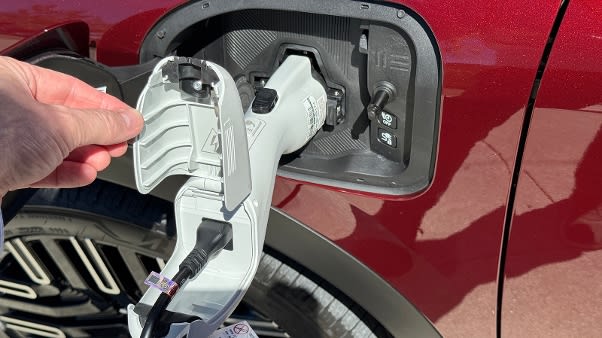
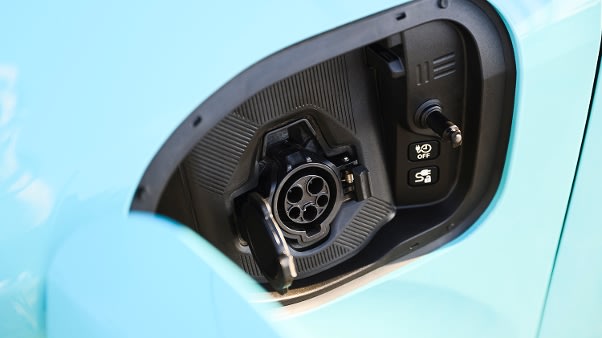
The industry move to NACS (SAE J3400) came at an interesting time in the development of the Leaf. To keep up with the EV world while not walking away from CCS, Nissan has added both ports to the vehicle.
The NACS port on the passenger side is for DC fast charging. While the AC J1772 port on the driver side is strictly an AC affar. Nissan said that most people that charge at home have invested in J1772 and it wanted to keep the port for those people. It makes sense if the person's previous EV wasn't a Tesla. Some of the issues around this decision is that the NACS port does not support AC charging. So Tesla destination charging stations are a no-go.
What you get in return is a J1772 port that supports V2L via an optional AC adapter available from the automaker.
Stay on target
Nissan wants to be relevant. At least it wants to be relevant again in the EV world. The Ariya didn't seem to click with the US market in a way the automaker had hoped. Now it's putting its EV bets on the Leaf. What it's delivered is a truly remarkable comeback that does something that many automakers seem to have forgotten: not everyone can afford a $60,000 EV.
For those people, the Leaf is here right now. It'll be followed by the Slate truck and Ford's yet-to-be-unveiled inexpensive truck. The Chevy Bolt is also coming back. The Leaf, though, is ready to go. The Leaf is first, again.
More From SAE Media Group
Automotive Engineering
2026 Toyota BZ: Improved, but Still Not a WheeeeeEV
Automotive Engineering
Audi Unveils Production Version of First-Ever EV: E-Tron
Automotive Engineering
2018 Nissan Leaf SV
Off-Highway Engineering
Ford Expands EV Lineup with E-Transit Cargo Van
Automotive Engineering
Driving the New Nissan Leaf Prototype
Automotive Engineering
Nissan Leaf Gets Updates – and Stays the Same – Where It Matters Most
Automotive Engineering
The EV Tech of BMW’s Neue-Klasse IX3
Automotive Engineering
2026 Toyota RAV4 Review: All Hybrid, All the Time
Automotive Engineering
BMW Engineers for the EV-Transition Reality
Off-Highway Engineering
Quantron Launches 12-M Battery-Electric Bus; Fuel-Cell Variant to Follow
Off-Highway Engineering
BEV Truck Manufacturers Charge Ahead at 2022 NTEA Show
Automotive Engineering
2025 Hyundai Ioniq 5 Brings All the Right Updates
Automotive Engineering
LEAF Turns to the 2020s
Automotive Engineering
The Fiat 500e Is Back
Automotive Engineering
SAE Completes Next Step to Standardize Tesla-Developed EV Charging Connector
Off-Highway Engineering
Volkswagen ID.Buzz All-electric Vans Combine Iconic Styling With Modern Technology
Automotive Engineering
Welcome to the Automotive Engineering Podcast
Automotive Engineering
ZF Meets Changing EV Market with Suite of Improved Components
Automotive Engineering
2023 Cadillac Lyriq Executive Chief Engineer: New EV Her ‘North Star’
Automotive Engineering
Automaker Coalition Plans High-Power Charging Network to Rival Tesla's
Off-Highway Engineering
Bollinger’s Electric Truck Enters Design Validation Phase
Automotive Engineering
The Lesson of J3400: Move Fast and Fix Things
Automotive Engineering
All-Electric Nissan Ariya Handles Ultra-Cold Temps on Pole to Pole Trek
Automotive Engineering
First Drive: Lucid's Gravity Electric SUV
Automotive Engineering
2025 Cadillac Optiq EV Arrives with Standard Dual Motors
Automotive Engineering
Williams Debuts New Flexible Platform for BEVs and FCVs
Automotive Engineering
2019 E-Tron SUV: Audi Goes Electric
Off-Highway Engineering
Daimler Launches New EV Truck Brand for U.S. Market
Off-Highway Engineering
Medium-Duty Electric Trucks Multiply to Meet Demand
Off-Highway Engineering
Bollinger Expanding Planned EV Lineup with the Deliver-E Commercial Van
Top Stories
INSIDERManufacturing & Prototyping
 How Airbus is Using w-DED to 3D Print Larger Titanium Airplane Parts
INSIDERManned Systems
 FAA to Replace Aging Network of Ground-Based Radars
NewsTransportation
 CES 2026: Bosch is Ready to Bring AI to Your (Likely ICE-powered) Vehicle
NewsSoftware
 Accelerating Down the Road to Autonomy
EditorialDesign
 DarkSky One Wants to Make the World a Darker Place
INSIDERMaterials
 Can This Self-Healing Composite Make Airplane and Spacecraft Components Last...
Webcasts
Defense
 How Sift's Unified Observability Platform Accelerates Drone Innovation
Automotive
 E/E Architecture Redefined: Building Smarter, Safer, and Scalable...
Power
 Hydrogen Engines Are Heating Up for Heavy Duty
Electronics & Computers
 Advantages of Smart Power Distribution Unit Design for Automotive...
Unmanned Systems
 Quiet, Please: NVH Improvement Opportunities in the Early Design...
