




First Drive: Lucid's Gravity Electric SUV
The automaker has established a vibe.
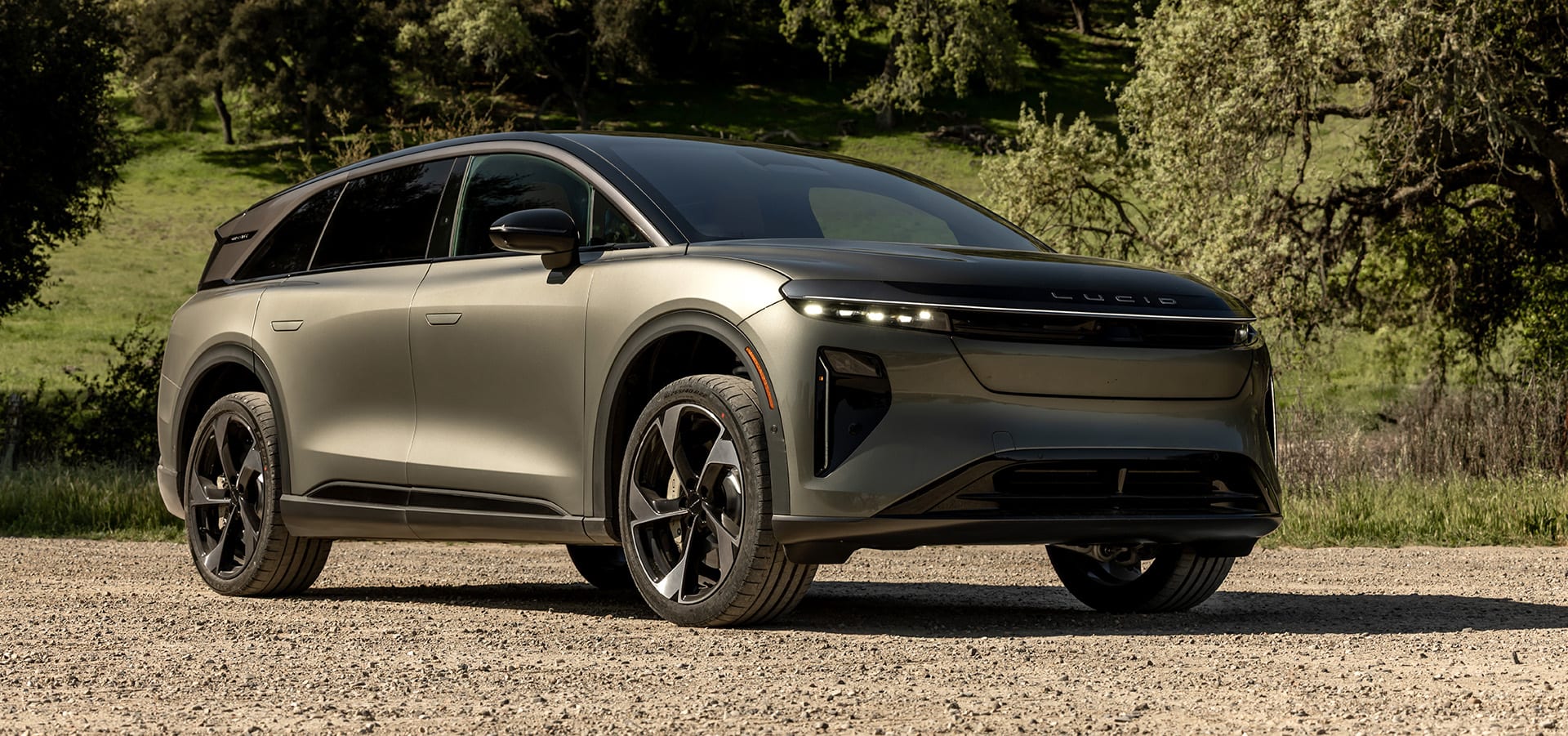
It's not unusual for vehicles from the same automaker to have a completely different feel on the road. Behind the wheel, the Chevy Corvette and Chevy Malibu might as well be from different planets. But there is something to be said about an automaker that creates a driving dynamic and establishes that across its lineup. Even if the lineup is only two vehicles.
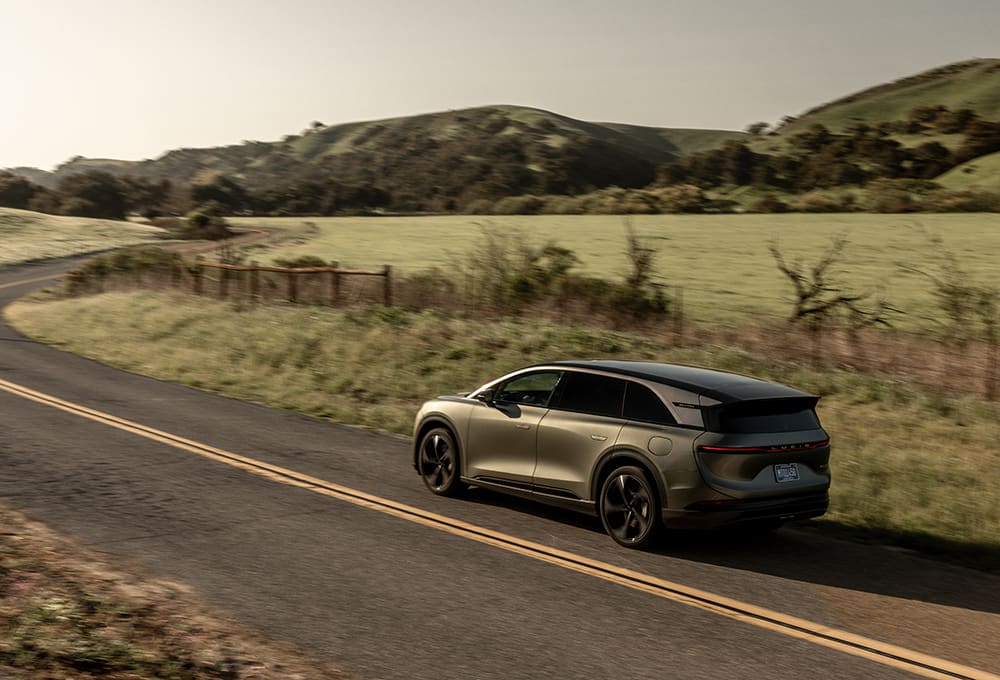
Lucid's electric sedan, the Air, has garnered praise among the automotive press for its smooth yet taut driving dynamics. It's a luxury sports sedan. Quick around curves while pampering the driver and passengers. The SUV Lucid Gravity, the second vehicle from the startup, continues the automaker's ability to deliver performance driving in an opulent package. Lucid pulls this off in a well-packaged vehicle that that builds on what the automaker learned from its sedan.
Efficiency is the Brand
At the core of the Gravity is the updated motor. Emad Dlala, Lucid's senior vice president of powertrain, told SAE Media that the new motors have received significant improvements in reducing drive unit noise by doubling the isolation and skewing the internal rotor., which has a new rotor architecture than what's found on the Lucid Air. This includes Lucid using what it learned from the high-performance Sapphire trim level to improve thermal performance by adjusting the winding of the stator. The automaker even swapped out the magnets, for again, better thermal performance and higher efficiency.
All this thermal efficiency is great for an EV, but it's doubly important for the Gravity. SUV's are expected to be able to tow. The optional towing package will support up to 8,000 pounds.Thermal efficiency in conjunction with a new charging system and next-generation battery pack also increases the NACS-enabled 3-row SUV's charge rate. Lucid says at a compatible 800-volt or higher charging station, the vehicle will charge at up to 400kW. At a Tesla 500-volt charging station, it will charge at up to 225kW. Lucid – like Hyundai – is using the rear motor to step down the vehicle to charge at lower-voltage charging stations like those offered by Tesla.
Connected to a 1,000-volt charger, the Gravity's native up to 926-volt platform (depending on battery pack and other trim level factors) will add 200 miles of range in about 11 minutes. That's from a vehicle with up to 450 miles (724 km) of EPA-estimated range. The charging speed is helped by a flattened charging curve. Dlala told SAE that the automaker increased the temperature bandwidth significantly. Optimized charging ambient temperature can be about 50 degrees Fahrenheit. Most vehicles require about 70 degrees Fahrenheit to hit peak charging.
That move to J3400 and support for Tesla Supercharging stations wasn't without its issues. Dlala said that development of the vehicle was about 60 to 70 percent complete when Ford announced support for NACS. Questions about charging port location and whether or not to add a separate box to boost volage to support the slower Tesla chargers came into play. Then it came down to adjusting the rear motor. "The rear drive unit is the high-power drive unit. It can also do higher power boosting because of that. So it's a capable 500 kW traction peak, it does 200 kW plus continuous. So it's able to do 200 kW -plus boosting. And we made a decision to just change the charge board, make this compatible." In a little over a year, the team was able to put that into production.
Lucid wondered if Tesla would be able to upgrade its Supercharger network to the 1,000-volt v4 charging stations before the Gravity came to market. "They have so many legacy key V3 (charging stations) in key locations. We don't think they're gonna upgrade them anytime soon," Dlala said. For upgrades, Tesla would have to pull those locations off the grid, which would be a huge setback for Tesla and its customers.
Packaging for Activities
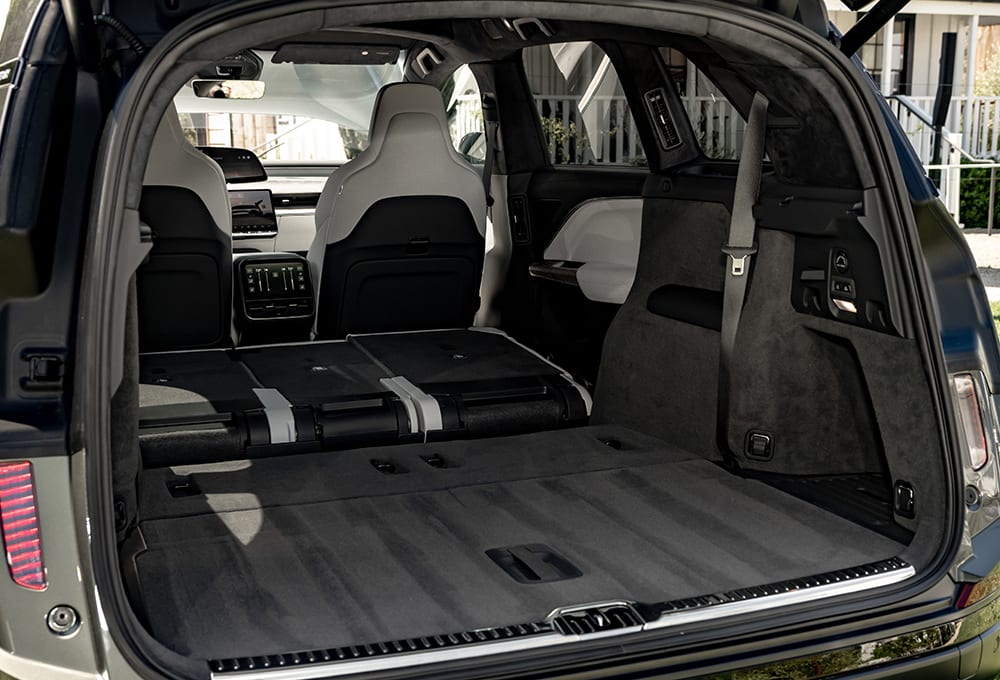
The Gravity is available as a five- or seven-seater and has 120 cubic feet (3398 L) and 114.3 cubic feet (3236 L) behind the first row (and including the frunk), respectively. The sleek design actually resembles a cross between an SUV and a wagon (in the best way). The design language of the Air is clearly visible. It's just larger with an impressive amount of room. Unless you're taller than six-foot two-inches and you want to sit in the third row. There is leg room, but your head may bump the roof. The rest of the seats are comfortable and stylish and the second row fold-out tables (similar to what you see on an airplane) add function without reducing room.
The innovative clamshell opening of the back and frunk make adding cargo to the vehicle a breeze. The front can be outfitted with an optional cushion for seating while tailgating or just relaxing. The rear has an impressively low load height which should make adding heavy objects to the cargo area easier. It also helps that the ride height can be adjusted from 5.2 inches (132 mm) to 9.3 inches (236 mm). For context, the Mercedes G550 has a ride height of 9.5 inches (241 mm).
At the end of the day, the Gravity drives like a Lucid. It's smooth yet aggressive for its size. You can't completely erase the heft of the 123 kWh capacity battery pack and the higher center of gravity, but Lucid's chassis engineers have done a great job reducing its effect on road performance.
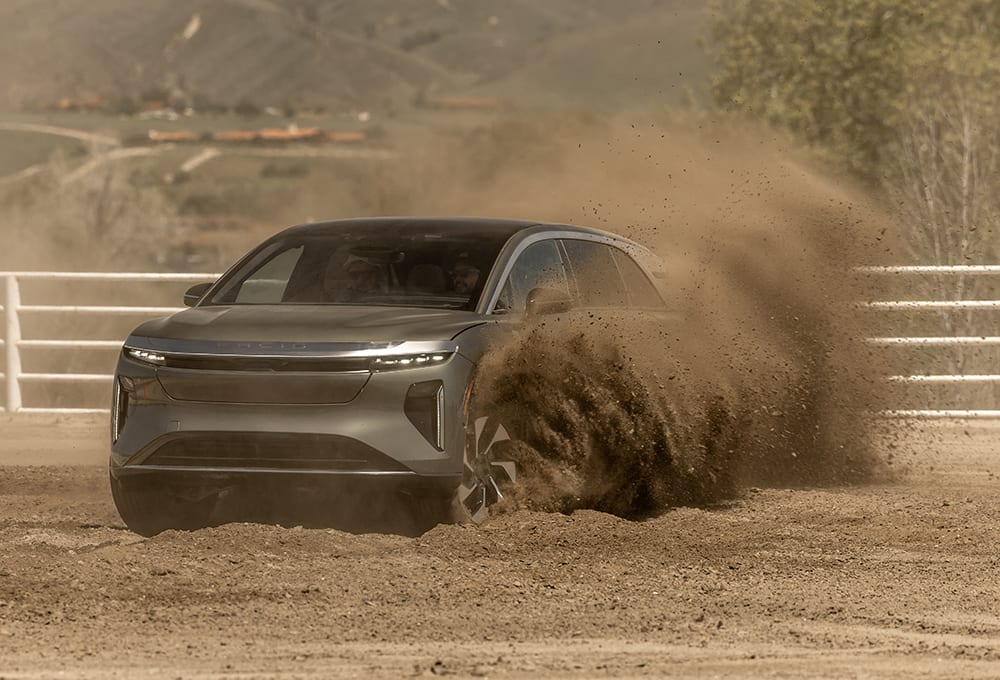
With 828 horsepower (618 kW) and 909 foot-pounds (1232 Nm) of torque, the Gravity was capable of impressive acceleration at any speed. It's unlikely most buyers will ever use all that power, but it's there if needed, with a zero to 60 mph time of 3.4 seconds.
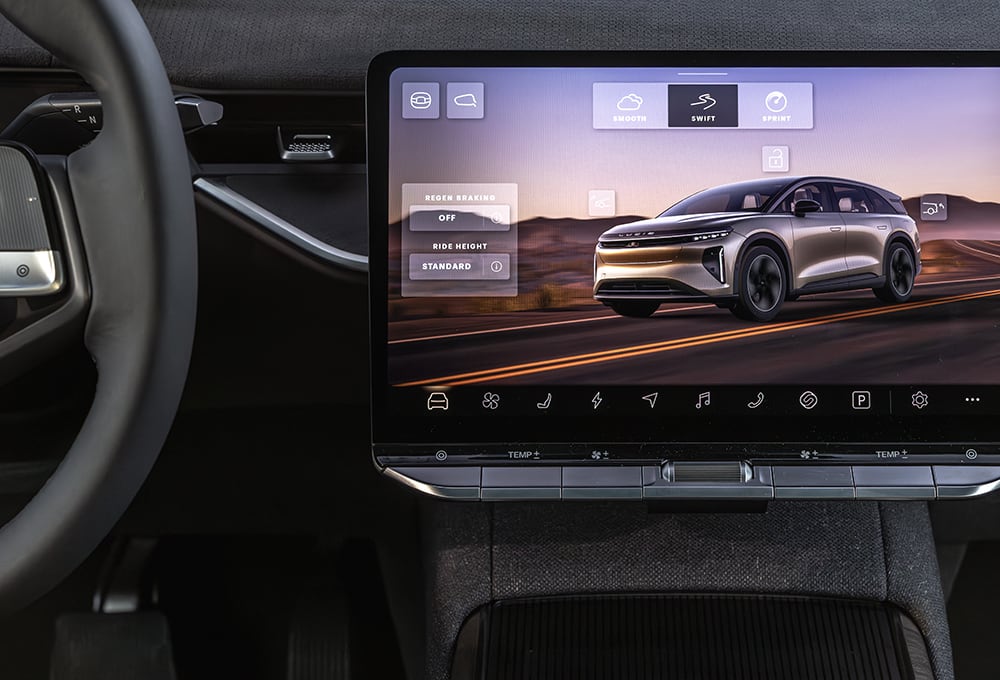
The steering was tight in sprint mode without being over twitchy. In comfort mode, the lighter steering and malleable suspension reminded us that at its core, Lucid is still a luxury brand aiming its sights at the high-end German automakers.
Tow and terrain modes will be available later this year. We had a chance to try a development build of the terrain mode and found ourselves drifting a luxury electric SUV on an off-road course with ease, something you don't usually experience. It'll be great for tricky dirt roads, but this is not an off-roader in the vein of the Bronco or Wrangler.
The latest infotainment system, Lucid UX 3.0, builds on the upgrades found in the latest Air sedans. The dual touchscreens highlight the most used features, while digging into the system can offer up additional fine-tuning and information about the vehicle. It's best to dive into those settings while parked.
Overall, the Lucid Gravity continues the Lucid tradition of impressive engineering coupled with luxury refinements and a whole lot of cargo space. But now, you can bring along six of your friends.
More From SAE Media Group
Automotive Engineering
Lucid Unveils Gravity Electric SUV with More Than 440 Miles of Range
Automotive Engineering
BMW Engineers for the EV-Transition Reality
Automotive Engineering
The EV Tech of BMW’s Neue-Klasse IX3
Automotive Engineering
GM’s Hummer EV Is Still like Nothing Else
Automotive Engineering
Ford Details All-Electric F-150 Lightning
Automotive Engineering
2018 Nissan Leaf SV
Automotive Engineering
2025 Lucid Air Review: Unnecessarily Fast, Astonishingly Efficient
Automotive Engineering
GM Energy Introduces Vehicle-To-Home Charging Solution
Automotive Engineering
Nissan Leaf Gets Updates – and Stays the Same – Where It Matters Most
Automotive Engineering
The Fiat 500e Is Back
Automotive Engineering
Cadillac to Launch 2023 Lyriq EV Months Earlier Than Planned
Automotive Engineering
Audi Unveils Production Version of First-Ever EV: E-Tron
Automotive Engineering
2025 Hyundai Ioniq 5 Brings All the Right Updates
Automotive Engineering
Cadillac Lyriq Spearheads GM’s EV Assault
Automotive Engineering
Mahindra Launches E2o ElectriCity Car in the UK
Off-Highway Engineering
Ford Expands EV Lineup with E-Transit Cargo Van
Automotive Engineering
Honda Ready with First North American Crossover EV
Off-Highway Engineering
Blue Arc Amps up for EV Production
Automotive Engineering
Ford Engineers Charged with a Blank EV Slate for the All-New 2021 Mustang Mach-E
Automotive Engineering
2026 Toyota BZ: Improved, but Still Not a WheeeeeEV
Automotive Engineering
Lotus Breaks out with New Eletre Electric SUV
Automotive Engineering
Cadillac Counts on 2025 Escalade IQ for EV Sizzle
Automotive Engineering
All-Electric Nissan Ariya Handles Ultra-Cold Temps on Pole to Pole Trek
Automotive Engineering
Change? Sure, Sometimes.
Automotive Engineering
Slate Unveils Bare-Bones EV Mini Truck
Automotive Engineering
Volvo’s Polestar Powerhouse Plug-In Hybrid
Automotive Engineering
BEV Streamliner Tops 350 Mph for U.S. Speed Record
Off-Highway Engineering
Daimler Launches New EV Truck Brand for U.S. Market
Automotive Engineering
Volvo’s Electric High-Wire Act
Automotive Engineering
Mercedes Unveils Tech-Heavy Electric G-Class
Top Stories
NewsRF & Microwave Electronics
 Microvision Aquires Luminar, Plans Relationship Restoration, Multi-industry Push
INSIDERAerospace
 A Next Generation Helmet System for Navy Pilots
INSIDERDesign
 New Raytheon and Lockheed Martin Agreements Expand Missile Defense Production
INSIDERMaterials
 How Airbus is Using w-DED to 3D Print Larger Titanium Airplane Parts
NewsPower
 Ford Announces 48-Volt Architecture for Future Electric Truck
ArticlesAR/AI

Webcasts
Electronics & Computers
 Cooling a New Generation of Aerospace and Defense Embedded...
Automotive
 Battery Abuse Testing: Pushing to Failure
Power
 A FREE Two-Day Event Dedicated to Connected Mobility
Unmanned Systems
 Quiet, Please: NVH Improvement Opportunities in the Early Design Cycle
Automotive
 Advantages of Smart Power Distribution Unit Design for Automotive &...
Energy
 Sesame Solar's Nanogrid Tech Promises Major Gains in Drone Endurance