




2016 Malibu Sheds 300 lb, Adds New Hybrid System
More wheelbase, style, fuel economy, and comfort aim to move GM’s volume midsize sedan from the sidelines to the fast lane.
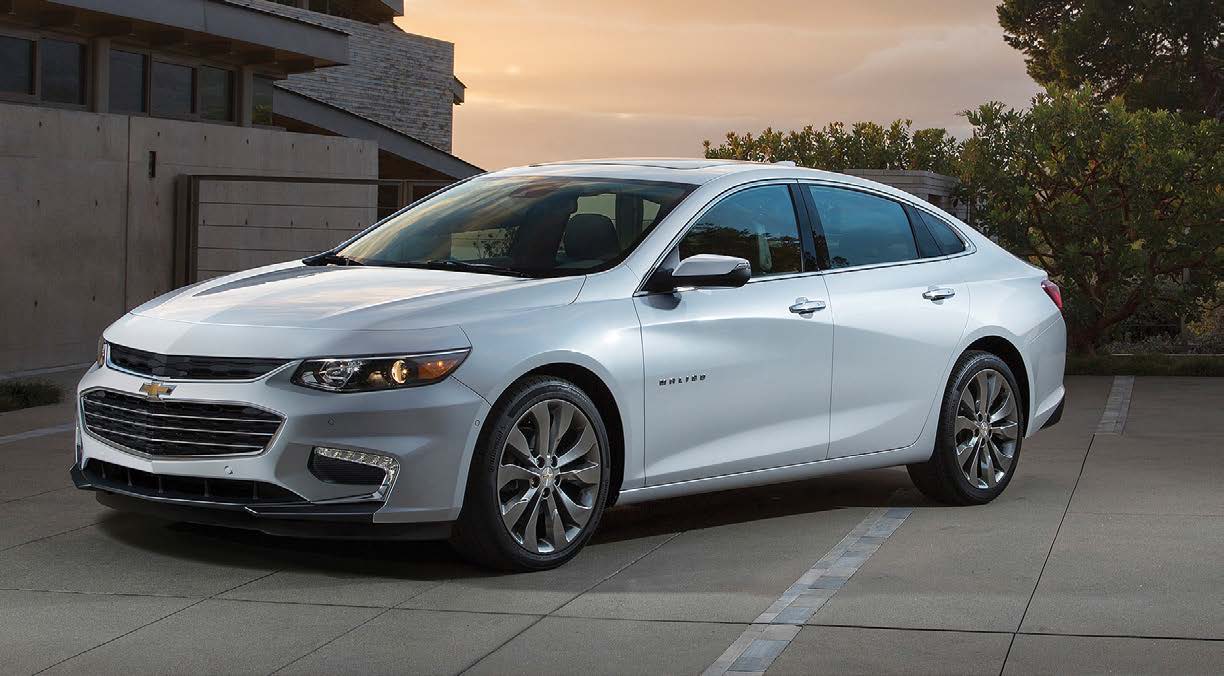
Entering its ninth generation, the 2016 Chevrolet Malibu zoomed through its development cycle faster than any General Motors vehicle in recent memory. It gains a new platform and powertrains—including an all-new dedicated strong-hybrid model with some EV-only capability — aimed at putting the nameplate at the head of North America’s most competitive segment.
“This was a fast program — about three years,” Chief Engineer Jesse Ortega told Automotive Engineering. “We’ve got at last count 17 competitors for Malibu, in a hot segment that represents 14% of the industry.” The car’s design was the province of the team, under Chevrolet Executive Design Director John Cafaro, that delivered the current Impala, while the car’s new Epsilon II architecture has its roots in Russelsheim.
The Malibu Hybrid model shares elements of its electrified-drive system with the 2016 Volt. It carries a U.S. EPA rating of 47 mpg combined (48 mpg city/45 mpg highway). Its numbers exceed those of hybrid versions of the 2015 Ford Fusion, Hyundai Sonata, Kia Optima, and Toyota Camry, and equal to that of the Honda Accord Hybrid. Ortega said the strong-hybrid drivetrain was designed into the vehicle structure from the onset.
Enabling “great interior and exterior styling, with best-in-class interior comfort,” particularly more — 1.5 in (38 mm) rear leg room, were the program’s main targets, Ortega said. The cramped rear seat area was the main complaint of current Malibu owners, GM engineers said. It was one reason why sales fell 6% from those of the seventh-generation car.
Target: 3375 pounds
The new Malibu’s fastback, six-window greenhouse “makes a contemporary statement,” noted Jaymer Starbody, Lead Exterior Designer. He explained that the new model’s bolder proportions are the result of “pushing tires and sheetmetal out to the corners,“ lowering the shock towers within the body structure to reduce cowl height by 19 mm (0.74 in), and stretching the wheelbase 3.6 in (91 mm) and overall length by 2.3 in (58 mm). The car’s 73-in (1854-mm) overall width is carried over from the previous generation Malibu.
Starbody claims a 0.29 Cd for the new Malibu’s aerodynamics, aided by active grille shutters on LS and LT trim levels.
At the top of Ortega’s must-do list was delivering “significant” mass reduction with the larger car — and to make Malibu the lightest hybrid model in the midsize segment. “Our target was to get it within the 3375-lb (1530-kg) test weight class, which we did, while achieving NHTSA 5-star (crash ratings),” he said.
Ortega describes his body engineers’ FEA focus as “intense,” which ultimately led to a 300-lb (136-kg) overall curb weight reduction versus the 2015 model. About 120 lb (54 kg) of that — more than 33% of the total weight savings — comes from the switch to the more mass-efficient platform. Epsilon II brings a higher percentage of high- and ultra-high-strength steels with reduced wall thickness on some components. The Malibu’s clamshell hood is its only major exterior closure in aluminum alloy and saves 5.6 lb (2.5 kg) versus the previous steel hood.
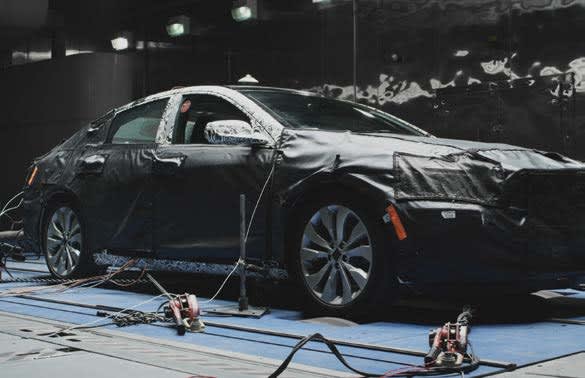
According to GM structural engineer Amir Sewani, the FEA work also resulted in significant parts consolidation and reduced bill of materials.
Inside the body shell, Ortega’s team hunted for excess ounces throughout the interior. The optional leather seats are collectively 40.6 lb (18.4 kg) lighter than those in the current model. About 1.5 lb (0.7 kg) was saved with new trunk-liner material and another 1.1 lb (0.5 kg) was lost with new, proprietary interior carpet material that also is claimed to be more durable than that used previously.
A new center console uses a one-piece structural shell that sheds 1.75 lb (0.8 kg) over the incumbent Malibu. New power window regulators collectively save 4.2 lb (1.9 kg) — a 34% reduction over the 2015 car. Another 2.2 lb (1 kg) was eliminated by simplifying the IP and its cross-car structure. The new center stack is a cleaner, simplified design that makes it easier to read and use the HVAC and infotainment controls. There’s also space to store mobile devices and inductive charging for phones on some trim levels.
Hybrid platform engineering
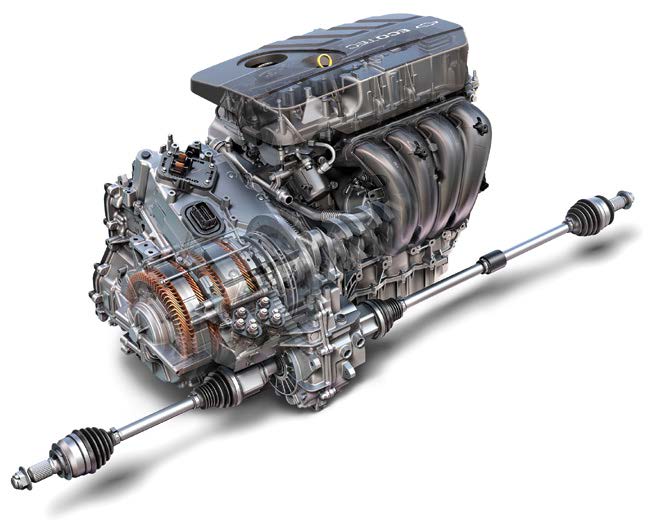
The biggest news on the propulsion front is Malibu’s all-new, GM developed two-motor hybrid drive system that enables some EV-only driving. It also marks Chevrolet’s first application of exhaust gas heat recovery (EGHR) that uses exhaust heat from the new 1.8-L, long-stroke, direct-injection four-cylinder ICE (internal combustion engine) to warm the engine and cabin at cold starts.
“The new hybrid drive is an example of ‘platform engineering’ with this and our new Voltec-2 unit used in the 2016 Volt,” noted Darryl Wilson, the Hybrid Chief Engineer. He said the two systems were developed in parallel and share their DC inverter and power electronics, including Delphi Viper IGBTs.
The drive unit uses two electric machines coupled to a planetary gearset to give “the functionality of a CVT,” Wilson said, “but it won’t feel like a CVT — or like a Volt.” The second motor enables downspeeding of the combustion engine and allows it to run close to or at its peak BSFC (brake specific fuel consumption).
A 1.5-kW·h battery pack, its 80 lithium-ion cells supplied by Hitachi, provides electric power and enables EV-only propulsion at up to 55 mph (89 km/h). The ICE automatically engages at higher speeds and loads when necessary to provide additional power. Total system power is rated at 182 hp (136 kW).
There are also two other all-new Ecotec engines for the non-hybrid models. The standard long-stroke 1.5-L turbo inline four from GM’s new Small Gas Engine family is fitted with stop-start. It is 86 lb (39 kg) lighter than the outgoing model’s standard 2.5-L unit and is claimed to deliver 160 hp (119 kW) at 5600 rpm and 184 lb·ft (250 N·m) at 2000-4000 rpm. (All outputs are estimated, pending completion of SAE testing when this article was written.) The base engine delivers an estimated 37 mpg highway with the 6T45 six-speed automatic. An optional 2.0-L turbo with square 86-mm (3.46-in) bore and stroke, is estimated to deliver 250 hp (186 kW) at 5300 rpm and 258 lb·ft (350 N·m) at 1700 rpm. The 2.0 L will power the Aisin-designed AWF8F45 — GM’s first eight-speed automatic for FWD applications.
In the realm of connectivity, infotainment, and electronic safety, Malibu’s suite of new technology features includes available OnStar 4G LTE, and Chevrolet MyLink with a 7-in or 8-in diagonal color touch screens. There’s also an all-new Teen Driver feature, which allows parents to view their kids’ driving statistics such as maximum speed and warning alerts.
New available active safety features include a front pedestrian alert that uses a forward-looking camera and has brake intervention; lane-keep assist with lane departure warning; front and rear park assist; and adaptive cruise with front automatic braking.
More From SAE Media Group
Automotive Engineering
Toyota Stretches SUV Line-Up with World Debut of Grand Highlander
Automotive Engineering
Kia's 2017 Niro Hybrid CUV Targets Sub-90 G/km CO2 Emissions
Automotive Engineering
Hyundai Brings Brave New Tech to 2020 Sonata
Automotive Engineering
5 More HP for 2026 Kia Sportage: First Drive
Automotive Engineering
Audi Shows Design, Fuel-Cell Directions
Automotive Engineering
Lexus Unveils Concept Flagship Crossover
Automotive Engineering
2023 Cadillac Lyriq Executive Chief Engineer: New EV Her ‘North Star’
Automotive Engineering
Mercedes Board Member Demonstrates Upgrades for New C-Class
Automotive Engineering
Mercedes-Benz Debuts 'Car of the Future' at CES
Automotive Engineering
New XC90 Burnishes Volvo's Safety Credentials
Automotive Engineering
2019 Kia Forte Gets 'Smart' CVT
Automotive Engineering
2024 Lexus GX Ready for Off-Road Adventure with New Platform, E-KDSS
Automotive Engineering
2021 Toyota Supra 2.0
Automotive Engineering
2016 Mazda MX-5 Stays True to Its Roots
Automotive Engineering
2026 Nissan Sentra Review: Putting the Pieces Together

Automotive Engineering
Lexus RC F Coupe Provides V8 Excitement
Automotive Engineering
New Honda Fit Introduced with "Earth Dreams" Engine, CVT, New Body Construction
Automotive Engineering
2016 Optima Gets Upgraded UVO
Off-Highway Engineering
Western Star Adds ‘Weight Sensitive’ 47X to Vocational Lineup
Automotive Engineering
2019 Chevrolet Silverado 2.7L
Automotive Engineering
GM's Production 2017 Bolt EV to Offer +200-Mi Range at $30K Price
Automotive Engineering
McLaren Debuts New Entry-Level Sports Series
Automotive Engineering
2015 Chrysler 300 Gets Upgrades
Automotive Engineering
New Ford S-Max to Get Class-Leading Driver Assistance Features
Automotive Engineering
Toyota Gives a Look at Its Re-Engineered 2016 Prius
Automotive Engineering
Fiat 124 Spider Returns After More Than 30 Years
Automotive Engineering
Jaguar’s Making of a Sports Sedan
Automotive Engineering
2016 Chevrolet Cruze Is Larger, Longer, and Sheds 250 Lb
Automotive Engineering
Infiniti Concept Conjures a New-Tech Q45
Top Stories
NewsSensors/Data Acquisition
 Microvision Aquires Luminar, Plans Relationship Restoration, Multi-industry Push
INSIDERRF & Microwave Electronics
 A Next Generation Helmet System for Navy Pilots
INSIDERWeapons Systems
 New Raytheon and Lockheed Martin Agreements Expand Missile Defense Production
NewsAutomotive
 Ford Announces 48-Volt Architecture for Future Electric Truck
INSIDERAerospace
 Active Strake System Cuts Cruise Drag, Boosts Flight Efficiency
ArticlesTransportation

Webcasts
Aerospace
 Cooling a New Generation of Aerospace and Defense Embedded...
Energy
 Battery Abuse Testing: Pushing to Failure
Power
 A FREE Two-Day Event Dedicated to Connected Mobility
Automotive
 Quiet, Please: NVH Improvement Opportunities in the Early Design Cycle
Electronics & Computers
 Advantages of Smart Power Distribution Unit Design for Automotive &...
Unmanned Systems
 Sesame Solar's Nanogrid Tech Promises Major Gains in Drone Endurance