




GM's Production 2017 Bolt EV to Offer +200-Mi Range at $30K Price
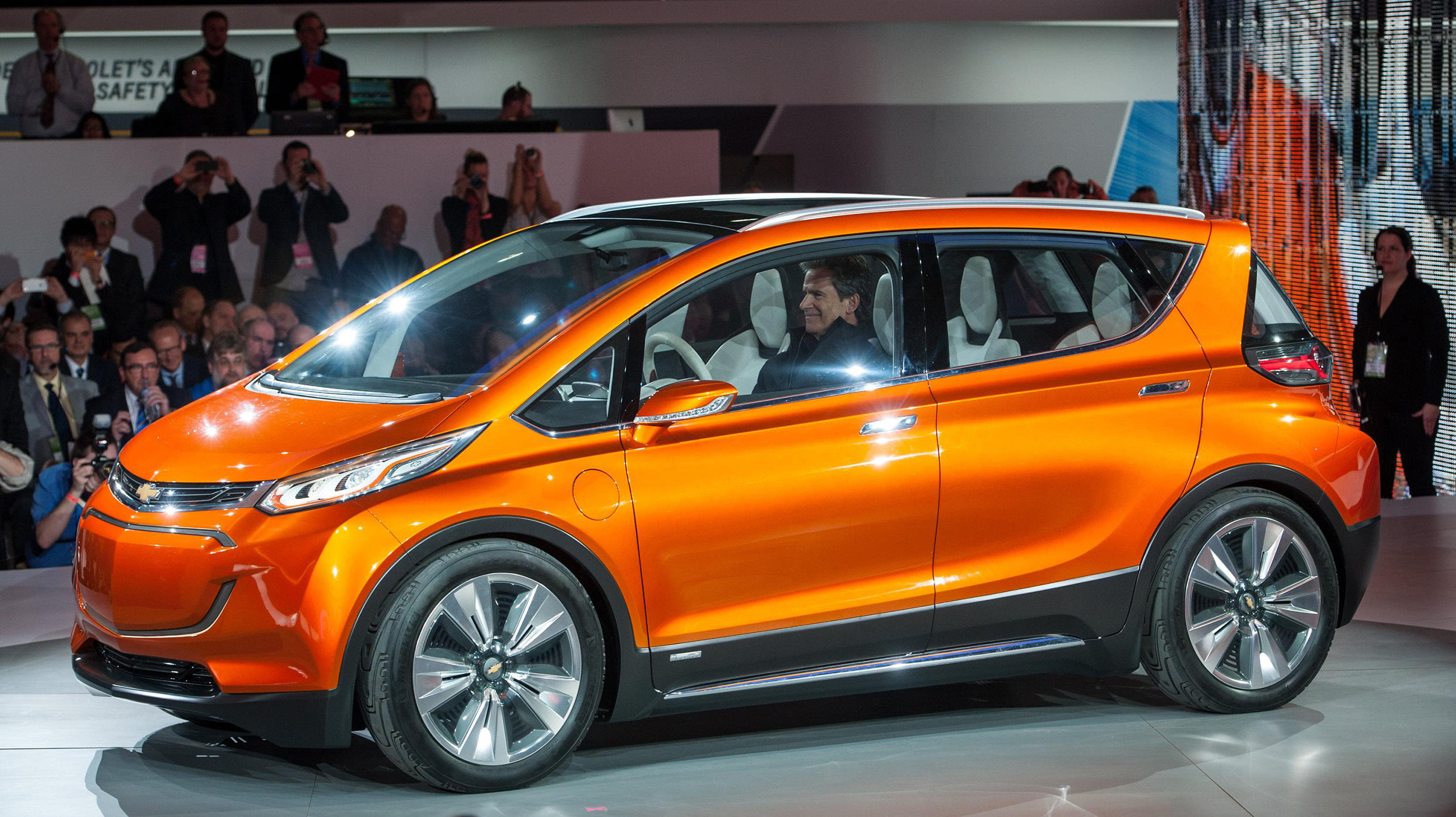
The race to develop and volume-produce a battery-electric vehicle that is capable of at least 200 mi (322 km) driving range and is priced at $30,000 (after incentives) has intensified, with General Motors confirming on February 12 that it will produce its Chevrolet Bolt EV. Unveiled as a concept at the 2015 North American International Auto Show, the Bolt EV will be built at GM’s Orion Assembly plant north of Detroit.

The five-door electric is expected to arrive as a 2017 model, according to suppliers familiar with the project’s timeline, although GM has not officially stated the car’s start-of-production timing. “We’re applying our EV expertise to take electrification further,” said GM CEO Mary Barra during the NAIAS. The Bolt will be sold in all 50 U.S. states as well as many global markets.
The car’s liquid-cooled lithium-ion battery technology "is in the progression of what we’ve revealed about the 2016 Volt battery,” according to Pete Savagian, GM’s General Director of Electrification Systems, who spoke briefly with Automotive Engineering during the Bolt’s Detroit show debut. While he provided no further details about the Bolt’s energy-storage and propulsion systems, it’s worth noting that the new Gen-2 Volt uses prismatic-pouch-type cells with a NMC/LMO (Nickel Manganese Cobalt/Lithium Manganese Oxide) chemistry. This enabled a 20% improvement in volumetric energy density. The 2016 Volt’s cells are supplied by LG Chem (see GM Unveils More Efficient 2016 Volt Powertrain); no word yet on the Bolt’s battery-cell supplier.
The concept’s exterior form, with its short front and rear overhangs, is “very close” to the production car but the concept interior “is being extensively reworked for production,” said a GM engineering source who asked to remain anonymous. GM engineers are putting a major effort into reducing mass in the Bolt’s structure to offset the battery weight; the concept was said to weigh 3543 lb (1607 kg). The production car will use a mixed-materials strategy consisting mainly of high-strength steel and aluminum alloys, with magnesium and (perhaps) carbon fiber used in specific areas.

If GM actually brings the Bolt to market at $30,000 by 2017, it could be the first EV manufacturer to achieve the feat of combining such a relatively low MSRP with at least 200-mi electric operating range. Tesla CEO Elon Musk has stated that his company’s upcoming Model 3, designed for similar range, will enter the market in the 2017 time frame at $35,000 after incentives, Musk said.
By comparison the 2015 Ford Focus EV’s base price is also about $30,000 but its 23 kW·h liquid-cooled lithium-ion battery pack delivers a range of 76 mi (122 km) according to the U.S. EPA. Two B-segment EVs priced about $12,000 higher, the BMW i3 and Mercedes B-Class Electric Drive, carry window stickers showing driving ranges of 81 and 85 mi (130 and 137 km), respectively. The BMW’s battery pack is rated at 22 kW·h, while the Mercedes’ pack is rated at 36 kW·h. The Mercedes is capable of delivering slightly more than 100 mi (161 km) range in ideal thermal conditions.
Bolt’s powertrain controller will allow drivers to select operating modes based on preferred driving styles in various operating conditions such as commuting and steady-state cruising. In the concept vehicle, the modes adjust accelerator pedal mapping, vehicle ride height, and suspension tuning. The car also is expected to be capable of dc fast charging.
The concept also featured a dedicated app that enables various functions, including self-parking, to be accessed via smartphone.
To support Bolt production, GM has invested $200 million in the Orion Assembly and nearby Pontiac (MI) stamping plant, with $160 million going to Orion for tooling and equipment and $40 million to Pontiac for dies. The Orion plant is powered by natural gas that is piped in from two nearby landfills. It also uses a 350-kW solar-panel array to generate electricity for use in the plant; excess off-peak energy is sold back to the local power grid.
More From SAE Media Group
Automotive Engineering
Audi A3 Sportback E-Tron Swells VW’s Plug-In Hybrid Choices
Automotive Engineering
GM and LG Corp. Partnering for 2017 Bolt EV May Create New Development Model
Automotive Engineering
Engineering ‘Electron Guzzlers’
Automotive Engineering
2023 Cadillac Lyriq Executive Chief Engineer: New EV Her ‘North Star’
Automotive Engineering
2016 Malibu Sheds 300 lb, Adds New Hybrid System
Off-Highway Engineering
A Bevy of Battery and Fuel-Cell Electric Truck Reveals
Off-Highway Engineering
ACT Expo 2022: Production ECascadia Ready for 230 Miles of ‘Typical Range’



Battery & Electrification Technology
Ultracapacitor Solutions to Address Energy-Storage Needs of Vehicles
Automotive Engineering
Lexus Unveils Concept Flagship Crossover
Off-Highway Engineering
Western Star Adds ‘Weight Sensitive’ 47X to Vocational Lineup
Automotive Engineering
New Zapp Electric Scooter Just 200 Pounds, 200 Components

Automotive Engineering
ICE and Hybrid-Electric Propulsion Show Staying Power
NASA Spinoff
NASA ‘RAMPT’ Up 3D Printed Engine Size
Automotive Engineering
5 More HP for 2026 Kia Sportage: First Drive
Off-Highway Engineering
Mack Trucks Begins Production of LR Electric
Automotive Engineering
Aston Martin Concept Is Part Crossover, Part GT
Automotive Engineering
Mercedes-Benz Debuts 'Car of the Future' at CES
Automotive Engineering
Audi Shows Design, Fuel-Cell Directions
Off-Highway Engineering
Mellor Bus Stresses Lightweight Construction for New Midsized Battery-Electric Buses
Off-Highway Engineering
REE’s P7 Brings Advanced Suspension Control to Medium-Duty Trucks
Automotive Engineering
All-Electric Nissan Ariya Handles Ultra-Cold Temps on Pole to Pole Trek
Automotive Engineering
2024 Lexus GX Ready for Off-Road Adventure with New Platform, E-KDSS
Tech Briefs
Making EVs Accessible for All
Automotive Engineering
GM’s Barra: Electric Vehicles Are Still the Future
Automotive Engineering
Toyota Stretches SUV Line-Up with World Debut of Grand Highlander
Tech Briefs
Are In-Wheel Motor Systems Catching On?
Top Stories
INSIDERManufacturing & Prototyping
 How Airbus is Using w-DED to 3D Print Larger Titanium Airplane Parts
INSIDERManned Systems
 FAA to Replace Aging Network of Ground-Based Radars
NewsTransportation
 CES 2026: Bosch is Ready to Bring AI to Your (Likely ICE-powered) Vehicle
NewsSoftware
 Accelerating Down the Road to Autonomy
EditorialDesign
 DarkSky One Wants to Make the World a Darker Place
INSIDERMaterials
 Can This Self-Healing Composite Make Airplane and Spacecraft Components Last...
Webcasts
Defense
 How Sift's Unified Observability Platform Accelerates Drone Innovation
Automotive
 E/E Architecture Redefined: Building Smarter, Safer, and Scalable...
Power
 Hydrogen Engines Are Heating Up for Heavy Duty
Electronics & Computers
 Advantages of Smart Power Distribution Unit Design for Automotive...
Unmanned Systems
 Quiet, Please: NVH Improvement Opportunities in the Early Design...
