




Vertical Take-Off and Landing UAV
The Air Force has announced that the MLB V-Bat Vertical Take-Off and Landing (VTOL) UAV from the MLB Company (Sunnyvale, CA) has been selected for a Phase II SBIR award. The military branch seeks a vehicle that has an 8-ft wingspan, 10-hour endurance, 55-lb gross take-off weight, and 70-mph cruise speed. The V-Bat’s combination of VTOL operational convenience with the safety of a shrouded fan and fixed-wing duration in a small UAV system will enable local situational awareness for UAV operations in confined areas. Last year, under a DARPA contract, MLB demonstrated precise emplacement of small payloads from the V-Bat, operating in hover mode under a vision-based control system.
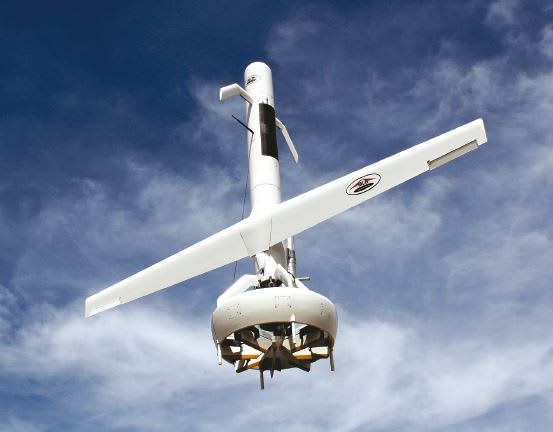
A strong mission pull exists for Tier-II sized long endurance VTOL vehicles. The V-Bat design was originally solicited by a commercial customer for aerial mapping. MLB Company has been approached by potential customers in several government agencies and by commercial groups seeking an anti-piracy solution.
The V-Bat incorporates a ducted fan lift system instead of conventional tail surfaces on a streamlined airframe, enabling vertical take-off, landing, and aerodynamic efficiency at high cruise speeds. The design concept merges the platform of sailplane-like wings and slender fuselage with the mechanically simple, ducted-fan lift system that provides control and lift for vertical flight, while simultaneously replacing the aircraft’s tail surfaces. The configuration, specifically the dual-use of the ductedfan lift system as the empennage of the aircraft, represents a minimal deviation from proven fixed-wing aircraft designs.
A key problem with many previous tail-sitter designs has been the high probability of tip-over at touchdown, which may damage the aircraft especially if it uses exposed rotor blades. The prototypes have demonstrated the ability to tip-over on landing and not sustain damage. A shock absorbing noseskid system keeps the loads from tipping over, and the duct shields the rotor and vanes from any damage when contacting the ground.
The system has been extensively field tested. A typical rotorcraft achieves an effective lift-to-drag (L/D) ratio of 6:1 in level flight. The V-Bat has a ratio of nearly 15:1 L/D.
LaserMotive Kent, WA 253-872-3300 www.lasermotive.com
For Free Info Click Here
More From SAE Media Group
Tech Briefs
Algorithms Improve Quadrotor Drone Performance
Tech Briefs
Anti-Phase Noise Suppression Rotor Technologies
Aerospace & Defense Tech Briefs
MTSI’s Latest Project Gives Fixed-Wing Aircraft Vertical Cargo Lift Capabilities
Air Force Research Laboratory Technology Horizons
Unmanned SkyTote Demonstrates Capabilities
Tech Briefs
Aircraft Vertical Takeoff and Landing
Aerospace & Defense Tech Briefs
Unmanned Aerial Vehicle
Tech Briefs
Fixed-Wing Angle eVTOL
Tech Briefs
Stop-Rotor Rotary Wing Aircraft
Aerospace & Defense Tech Briefs
NASA and AeroVironment Are Building a Helicopter for Mars
Aerospace & Defense Tech Briefs
Autonomous Black Hawk Helicopter
Tech Briefs
Hinge Design Helps Quadrotors Climb
Aerospace & Defense Tech Briefs
Paterson Composites to Build Components for Astro Aerospace Autonomous Passenger Drone
Aerospace & Defense Tech Briefs
Advanced Assembly Solutions for the Airbus RACER Joined-Wing Configuration
Aerospace & Defense Tech Briefs
CityAirbus Urban Air Mobility Vehicle Completes First Flight
Aerospace & Defense Tech Briefs
Fabrication and Testing of High-Speed Single-Rotor and Compound-Rotor Systems
Aerospace & Defense Tech Briefs
Foreign Counter-Unmanned Aerial Systems: Developments in the International Arms Markets
Aerospace & Defense Tech Briefs
Boeing’s CAV Makes First Outdoor Flight
Aerospace & Defense Tech Briefs
Aerodynamic Modeling of a Flapping Wing Unmanned Aerial Vehicle
Aerospace & Defense Tech Briefs
Vertical Flight Society Applauds EVTOL Innovation, Bell Nexus UAM Concept
Aerospace & Defense Tech Briefs
Jetoptera, GE Aviation Collaborate On, Demonstrate Hover with Fluidic Propulsion
Aerospace & Defense Tech Briefs
Transport Canada Grants Astro Aerospace a Flight Test Certificate for Autonomous Urban Air Mobility Vehicle
Aerospace & Defense Tech Briefs
Airbus Helicopters VSR700 Makes First Fully Autonomous Flight
Aerospace & Defense Tech Briefs
Sikorsky’s All-New Raider Helicopter Prototype is Ready to Fly
Aerospace & Defense Tech Briefs
Vertical Takeoff and Landing Drone
Aerospace & Defense Tech Briefs
Martin UAV VTOL Unmanned Aircraft Taps Persistent Systems Wave Relay Data Link Technology

Tech Briefs
Autonomous Aircraft: See the XQ-67A Fly
Tech Briefs
Bio-Inspired Wing Design for Small Drones
Aerospace & Defense Tech Briefs
Military Aircraft Systems Technology
Top Stories
INSIDERManufacturing & Prototyping
 How Airbus is Using w-DED to 3D Print Larger Titanium Airplane Parts
INSIDERManned Systems
 FAA to Replace Aging Network of Ground-Based Radars
NewsTransportation
 CES 2026: Bosch is Ready to Bring AI to Your (Likely ICE-powered) Vehicle
NewsSoftware
 Accelerating Down the Road to Autonomy
EditorialDesign
 DarkSky One Wants to Make the World a Darker Place
INSIDERMaterials
 Can This Self-Healing Composite Make Airplane and Spacecraft Components Last...
Webcasts
Defense
 How Sift's Unified Observability Platform Accelerates Drone Innovation
Automotive
 E/E Architecture Redefined: Building Smarter, Safer, and Scalable...
Power
 Hydrogen Engines Are Heating Up for Heavy Duty
Electronics & Computers
 Advantages of Smart Power Distribution Unit Design for Automotive...
Unmanned Systems
 Quiet, Please: NVH Improvement Opportunities in the Early Design...
