




Quantum Sensing Atomic Gyroscope
Defense Innovation Unit
Washington D.C.
This email address is being protected from spambots. You need JavaScript enabled to view it.
www.DIU.mil
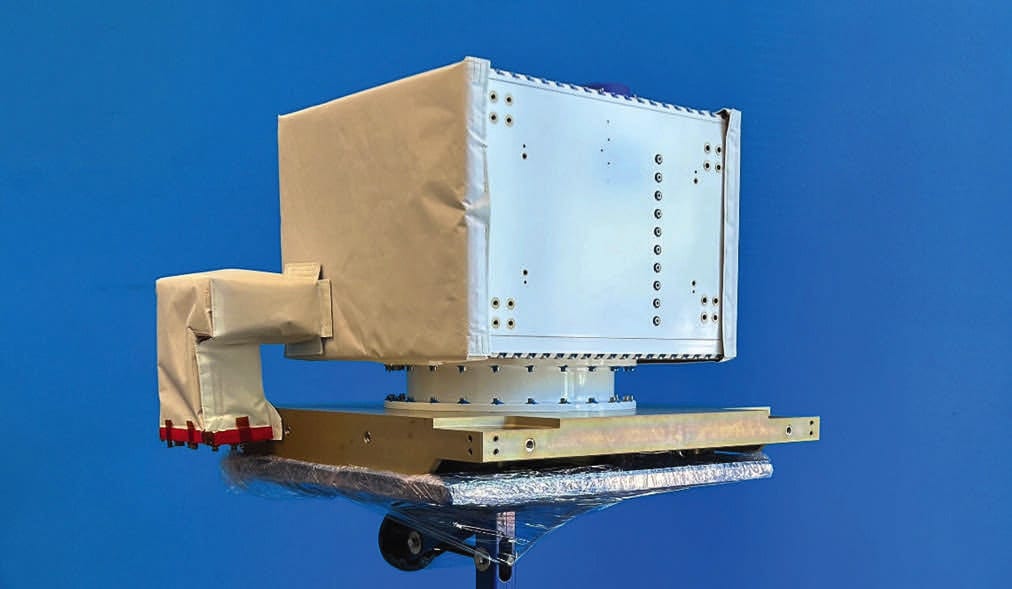
The Defense Science Board identified three areas of quantum technology that will be most relevant to the Department of Defense’s (DoD) technological superiority: sensing, encryption, and communications. Of these, quantum sensing is the most mature and promising for use in military technologies reliant on accurate positioning, navigation, and timing (PNT). PNT is critical to the function of key capabilities such as imaging, earth observation, and communication.
Recognizing these imperatives, Defense Innovation Unit (DIU) - in collaboration with the Office of the Undersecretary of Defense for Research & Engineering’s Quantum directorate, kicked-off a quantum sensing initiative in late 2020. The program focuses on moving atomic sensors out of the lab and to the real world. Today, the program is bearing fruit with delivery of a quantum sensor that can meet the rigors of space.
For this project, DIU awarded a contract to Vector Atomic, a 5-year old California start-up focused on fielding and commercializing atomic instruments. Recently, Vector Atomic, in partnership with Honeywell Aerospace, delivered a fully integrated, high-performance atomic gyroscope. This is the first atomic gyroscope to undergo space qualification and is expected to be the first atomic inertial sensor to operate in space.
To rapidly prototype the technology, DIU focused on validating the core technology in mission-relevant environments while avoiding overly prescriptive design requirements. Despite supply chain challenges and other COVID-19 complications, Vector Atomic went from a paper design to delivery in about two years. For Estep, the quick turnaround from design to delivery for space, particularly for a novel instrument, is quite an achievement. This speed is necessary when the objective is to transition the technology to address operational gaps.
Gyroscopes measure rotational motion, a critical function for drones, ships, aircraft, satellites, and even consumer electronics, and make up a multibillion-dollar per year market. An atomic gyroscope uses atoms and precise laser interactions to act as rulers to discern angular rates, compared to current state-of-the-art approaches that rely on photons (i.e., light). Atoms, in principle, are massive and slow in comparison, and thus, the effects on them are more apparent when experiencing rotation. The added sensitivity and precision offered by the quantum inertial sensor means reducing positional error, and most importantly, the reliance on external PNT signals provided from systems like GPS.
“Quantum inertial sensors are not only scientifically intriguing, but they also have direct defense applications,” said Lt. Col. Nicholas Estep, the Technical Program Manager for the effort. “If we can field devices that provide a leap in sensitivity and precision for observing platform motion over what is available today, then there’s an opportunity for strategic gains across the DoD.”
Getting quantum sensors out into the wild has not happened overnight, however. “This project represents decades of investment by the Department of Defense, particularly DARPA, into quantum based inertial sensors. It is so exciting to see the capabilities come to fruition, thanks to this development push from DIU and funding support from OUSD R&E amongst many other agencies,” said John Burke, PhD, Principal Director of Quantum Science, Under Secretary of Defense for Research & Engineering.
DIU’s quantum inertial sensor project doesn’t stop with the demonstration of the atomic gyroscope in space. The next phase of the project will include the demonstration of a fully integrated atomic inertial measurement unit (IMU), composed of independent accelerometers and gyroscopes to sense motion along all degrees of freedom. The IMU is a building block of inertial navigation solutions to platforms, regardless of domain.
Further information regarding this spaceflight demonstration to be published at a later date.
Visit Here
More From SAE Media Group

Aerospace & Defense Tech Briefs
Counter-Directed Energy Weapons: Defense of Air Assets
Photonics & Imaging Technology
Making Measurements with a Fine-Toothed Comb
Tech Briefs
Products of Tomorrow
Aerospace & Defense Tech Briefs
On the Pulsed Laser Ablation of Metals and Semiconductors
Aerospace & Defense Tech Briefs
Inertial Measurement Unit
Aerospace & Defense Tech Briefs
Towards Greater Sensitivity: A Brief FTIR and Infrared-Based Cavity Ring Down Spectroscopy Comparative Study
Photonics & Imaging Technology
Researchers Generate Terahertz Laser with Laughing Gas
Tech Briefs
Getting NASA Data to the Ground with Lasers
Photonics & Imaging Technology
Advancements Make Laser-Based Imaging Simpler and Three-Dimensional
Tech Briefs
Sub-Pixel Spatial Resolution Interferometry
Aerospace & Defense Tech Briefs
Coherent, Efficient and Practical Polariton Lasers Using a Designable Cavity
Aerospace & Defense Tech Briefs
Multimode Optical Fiber Sensing
Photonics & Imaging Technology
Getting NASA Data to the Ground With Lasers
Photonics & Imaging Technology
A First-Of-Its-Kind Integrated Optical Isolator
Photonics & Imaging Technology
A Laser That Could Reshape the Landscape of Integrated Photonics
Aerospace & Defense Tech Briefs
Detection with Quantum Radar
Aerospace & Defense Tech Briefs
Fabrication and Electrical Characterization of Correlated Oxide Field Effect Switching Devices for High Speed Electronics
Aerospace & Defense Tech Briefs
Inter-Laboratory Combat Helmet Blunt Impact Test Method Comparison
Tech Briefs
Metasurfaces Control Polarized Light at Will
Tech Briefs
Material Increases Efficiency of LED Devices
Aerospace & Defense Tech Briefs
Frequency Agile Plasmonic Antennas and Sensors

Aerospace & Defense Tech Briefs
Modeling Optical Time and Frequency Generation and Transfer Systems
Aerospace & Defense Tech Briefs
Ultrafast Optics: Vector Cavity Lasers — Physics and Technology
Medical Design Briefs
OPO Lasers Spur Advances in Mass Spectrometry Diagnostics
Aerospace & Defense Tech Briefs
Drift Improvement with Reinforcement Training of Inertial Sensors
Tech Briefs
Optical Signal Amplifying Technique
Top Stories
NewsSensors/Data Acquisition
 Microvision Aquires Luminar, Plans Relationship Restoration, Multi-industry Push
INSIDERAerospace
 How Airbus is Using w-DED to 3D Print Larger Titanium Airplane Parts
INSIDERManned Systems
 A Next Generation Helmet System for Navy Pilots
ArticlesTransportation
 Accelerating Down the Road to Autonomy
INSIDERWeapons Systems
 New Raytheon and Lockheed Martin Agreements Expand Missile Defense Production
NewsAutomotive
 Ford Announces 48-Volt Architecture for Future Electric Truck
Webcasts
Defense
 Cooling a New Generation of Aerospace and Defense Embedded...
Test & Measurement
 Battery Abuse Testing: Pushing to Failure
Connectivity
 A FREE Two-Day Event Dedicated to Connected Mobility
Automotive
 Quiet, Please: NVH Improvement Opportunities in the Early Design Cycle
Electronics & Computers
 Advantages of Smart Power Distribution Unit Design for Automotive &...
Energy
 Sesame Solar's Nanogrid Tech Promises Major Gains in Drone Endurance