




Coherent, Efficient and Practical Polariton Lasers Using a Designable Cavity
How using a designable hybrid photonic crystal cavity (HPCC) polariton system can contribute to advancing the fundamental understanding and technological innovation in semiconductor photonics.
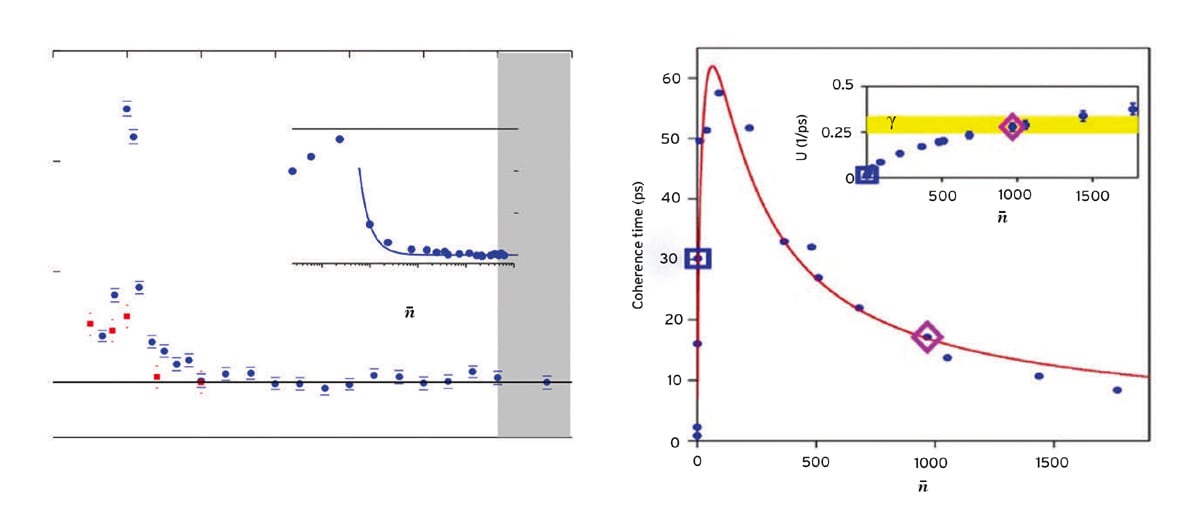
Coherence properties are what distinguish a laser from other sources of light and make it useful. This research demonstrates for the first time a polariton laser with coherence reaching the intrinsic limit of single-mode matter-wave lasers. It further demonstrates intensity coherence at the shot-noise limit expected of an ideal coherent state (Figure 1, left), and phase coherence revealing interactions within the polariton condensate due to its matter-wave nature (Figure 1, right).
This research also demonstrates a new mechanism of frequency comb generation using coupled polariton condensates. It results from the dynamic interplay between on-site nonlinearity and inter-site couplings. This is distinct from other systems, such as microtoroidal resonators and quantum cascade lasers that are based on cascaded four-wave mixing process. A unique feature of this form of frequency comb generation is that the comb spacing is not given by the cavity transverse mode spacing and can be engineered from GHz to THz without having to drastically change the physical dimension of the system. Furthermore, since it is based on polariton condensation, the polariton comb allows a very low threshold and an incoherent pump, including electrical injection.
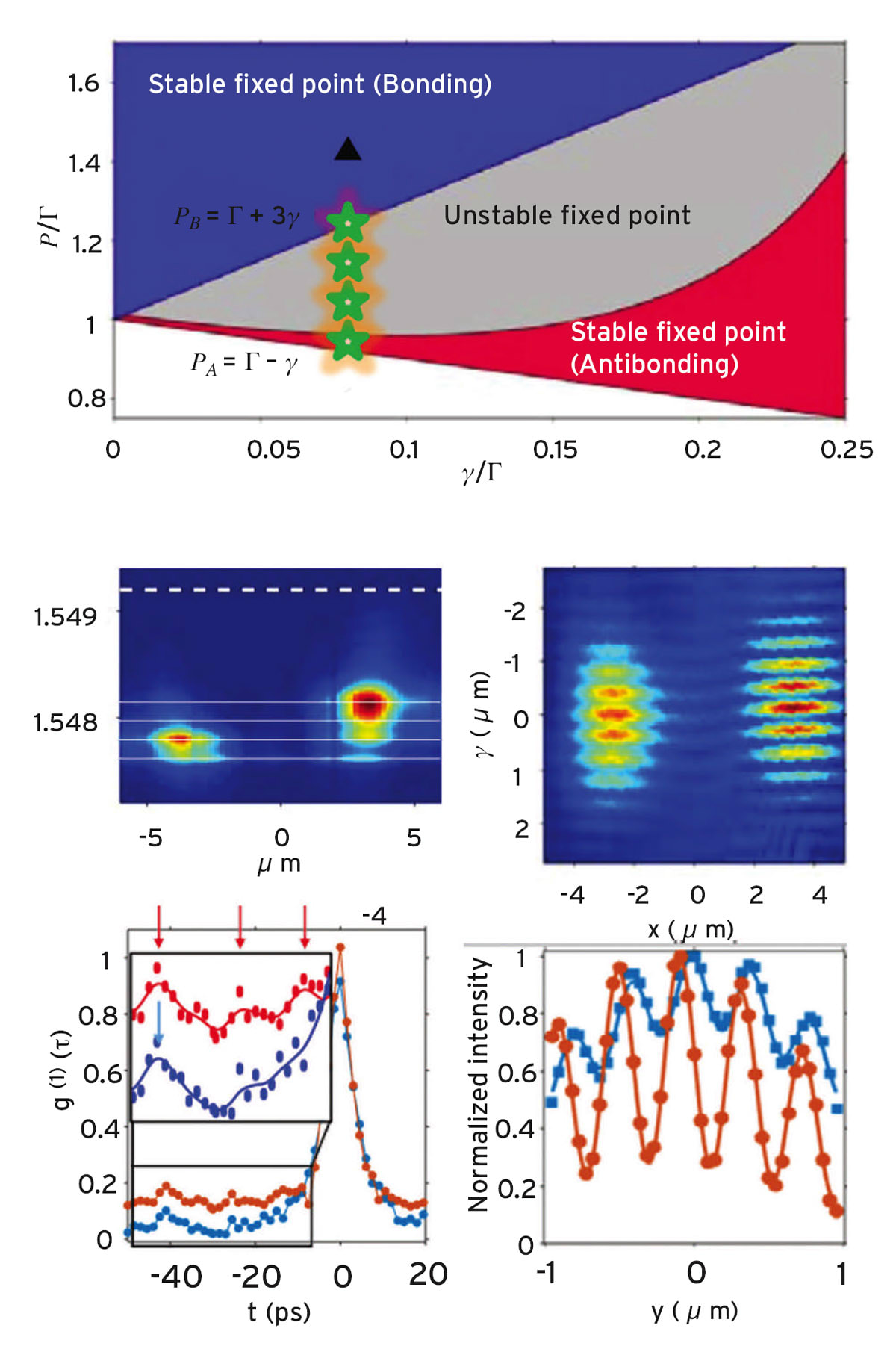
The matter-wave frequency comb is created using the designable HPCC cavity with a suspended high-contrast grating mirror, which allows the creation of two coupled condensate, as well as engineering their interaction and coupling via deformation of the suspended mirrors. Extensive experimental and theoretical evidence was obtained to support the results, including spectroscopy and interferometric measurements showing equidistant frequency lines and characteristic phase relations between the two coupled condensates (Figure 2).
This work paves the way for future development and optimization of low threshold optical frequency comb sources and will open doors to other novel phenomena and device concepts based on dissipatively-coupled nonlinear cavity systems.
This research also demonstrated the first polariton laser in the Bardeen-Coo-per-Schrieffer (BCS) regime, which is also the first demonstration of the particle-hole type BCS state as well as matter-light hybrid BCS state. It validates and pushes forward many decades of theoretical efforts on this subject.
Both the BEC and BCS states were postulated in excitonic systems half a century ago. Research on exciton- and especially polariton-BEC has exploded recently, with a large part of the community accepting spectral features as experimental evidence of a polariton BEC despite persistent skepticism. BCS has been considered much more difficult to achieve, and no experimentally accessible hallmark signatures have been identified.
In the HPCC polariton system, both the weakly and strongly cavity-cou-pled excitons coexist and share the same hot carrier reservoir, enabling access to the electronic media at the presence of polariton lasing. In what would have been commonly accepted as a polariton BEC, fermionic gain and population inversion (Figure 3) were measured directly, unambiguously distinguishing it from a polariton BEC. Stark contrast in spectral properties between the BCS polariton laser and a conventional photon laser were also shown, thereby unambiguously distinguishing it from the commonly known photon laser. A theory based on extended semiconductor Bloch equation reproduces the experimental results and in turn reveals the BCS nature of the new many-body phase.
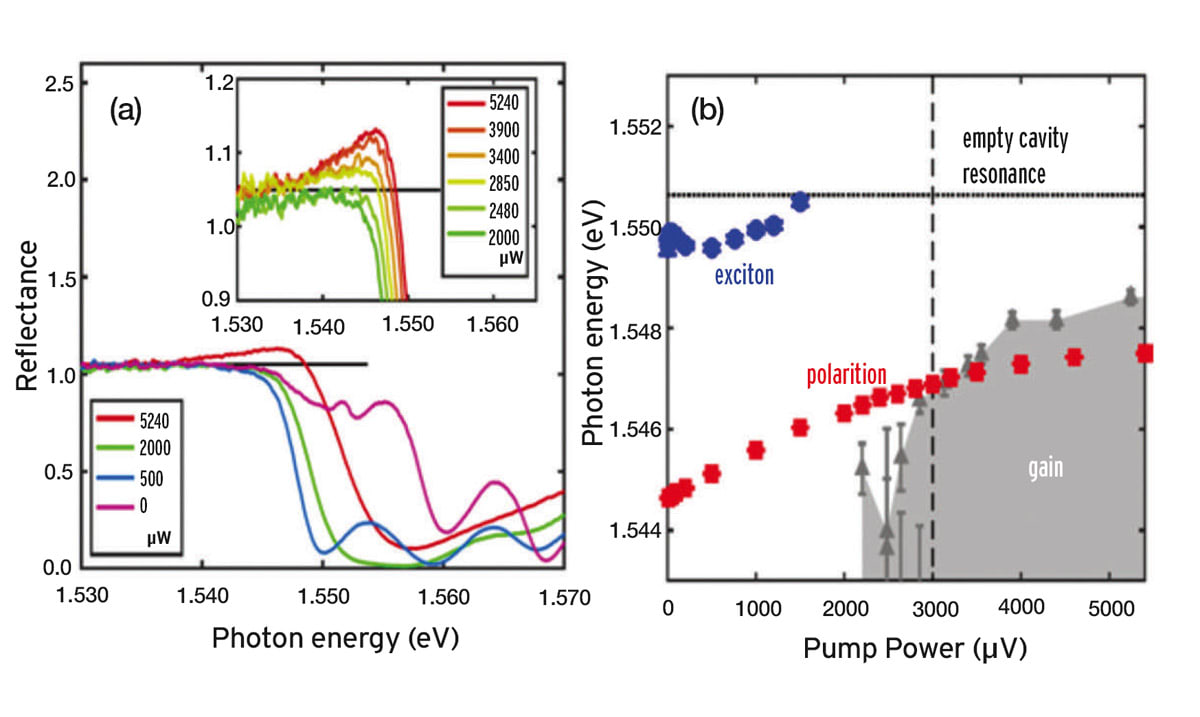
These findings challenge the previous understanding and experimental interpretation of polariton BEC while at the same time reconfirming that strong electronic correlations underline phenomena so far associated with polariton BEC.
This work was performed by Hui Deng of the Regents of the University of Michigan for the Air Force Research Laboratory. For more information, download the Technical Support Package (free white paper) at mobilityengineeringtech.com/tsp under the Optics, Photonics & Lasers category. AFRL-0308
This Brief includes a Technical Support Package (TSP).
Coherent, Efficient and Practical Polariton Lasers Using a Designable Cavity
(reference AFRL-0308) is currently available for download from the TSP library.
Don't have an account?
More From SAE Media Group
Aerospace & Defense Tech Briefs
Modeling Optical Time and Frequency Generation and Transfer Systems
Photonics & Imaging Technology
A Laser That Could Reshape the Landscape of Integrated Photonics
Aerospace & Defense Tech Briefs
On the Pulsed Laser Ablation of Metals and Semiconductors
Aerospace & Defense Tech Briefs
3D Meta-Optics for High-Energy Lasers
Medical Design Briefs
Tunable Lasers Expand for Time-Resolved Spectroscopy
Aerospace & Defense Tech Briefs
Ultrafast Optics: Vector Cavity Lasers — Physics and Technology
Photonics & Imaging Technology
SPIE Photonics West 2023 Preview
Photonics & Imaging Technology
Researchers Generate Terahertz Laser with Laughing Gas
Photonics & Imaging Technology
A First-Of-Its-Kind Integrated Optical Isolator
Tech Briefs
Optimal Information About the Invisible
Photonics & Imaging Technology
Making Measurements with a Fine-Toothed Comb
Photonics & Imaging Technology
Optimal Information About the Invisible
Aerospace & Defense Tech Briefs
Integration of Adaptive Optics Into High-Energy Laser Modeling And Simulation
Photonics & Imaging Technology
Using Magnets to Toggle Nanolasers Leads to Better Photonics
Photonics & Imaging Technology
Ultrafast Beam-Steering Breakthrough at Sandia Labs
Photonics & Imaging Technology
Continuous and Stable Lasing Achieved From Low-Cost Perovskites at Room Temperature
Aerospace & Defense Tech Briefs
Frequency Agile Plasmonic Antennas and Sensors

Aerospace & Defense Tech Briefs
Streamlined Microcomb Design Provides Control With The Flip of a Switch
Tech Briefs
Free-Space Fiber Optic Laser Rod
Tech Briefs
Shock-Sensing Apparatus
Aerospace & Defense Tech Briefs
New Class of Excimer-Pumped Atomic Lasers (XPALS)

Tech Briefs
Multiplexed Optical Antennas
Aerospace & Defense Tech Briefs
Counter-Directed Energy Weapons: Defense of Air Assets
Aerospace & Defense Tech Briefs
This Laser Clock Could Transform Satellite Navigation Accuracy
Overview
The final report titled "Coherent, Efficient and Practical Polariton Lasers Using a Designable Cavity," authored by Hui Deng from the University of Michigan, outlines significant advancements in the field of semiconductor photonics achieved between July 15, 2015, and July 14, 2018. Sponsored by the Air Force Office of Scientific Research, this research focuses on the development of a hybrid photonic crystal cavity (HPCC) polariton system, which has implications for both fundamental understanding and technological innovation in laser technology.
One of the primary contributions of this project is the demonstration of a coherent polariton laser, which distinguishes itself from traditional light sources through its coherence properties. The report highlights that this polariton laser achieved coherence at the intrinsic limit of single-mode matter-wave lasers for the first time. This was evidenced by the demonstration of intensity coherence at the shot-noise limit, which is characteristic of an ideal coherent state. Additionally, the phase coherence observed within the polariton condensate revealed interactions that are unique to its matter-wave nature.
The findings were published in the journal "Physical Review X" (2016), and the work has been discussed in various scientific publications, emphasizing its significance in the field. The report also outlines several other contributions, both experimental and theoretical, that further enhance the understanding of polariton lasers and their potential applications in optical computing and quantum mechanics.
The research underscores the importance of coherence in laser technology, which is crucial for various applications, including telecommunications, medical devices, and quantum computing. The innovative design of the HPCC allows for the manipulation of light-matter interactions, paving the way for more efficient and practical laser systems.
Overall, this report encapsulates a pivotal moment in the development of polariton lasers, showcasing the potential for future advancements in photonics and related technologies. The work not only contributes to academic knowledge but also holds promise for practical applications that could revolutionize the way lasers are utilized in various fields. The findings are publicly available, encouraging further exploration and collaboration in this exciting area of research.
Top Stories
NewsSensors/Data Acquisition
 Microvision Aquires Luminar, Plans Relationship Restoration, Multi-industry Push
INSIDERRF & Microwave Electronics
 A Next Generation Helmet System for Navy Pilots
INSIDERWeapons Systems
 New Raytheon and Lockheed Martin Agreements Expand Missile Defense Production
NewsAutomotive
 Ford Announces 48-Volt Architecture for Future Electric Truck
INSIDERAerospace
 Active Strake System Cuts Cruise Drag, Boosts Flight Efficiency
ArticlesTransportation

Webcasts
Aerospace
 Cooling a New Generation of Aerospace and Defense Embedded...
Energy
 Battery Abuse Testing: Pushing to Failure
Power
 A FREE Two-Day Event Dedicated to Connected Mobility
Automotive
 Quiet, Please: NVH Improvement Opportunities in the Early Design Cycle
Electronics & Computers
 Advantages of Smart Power Distribution Unit Design for Automotive &...
Unmanned Systems
 Sesame Solar's Nanogrid Tech Promises Major Gains in Drone Endurance