




Review of Recent Capability Improvements in Ultrashort Pulse Laser Sources: Closing the Relevancy Gap for Directed Energy Applications
A new generation of ultrashort pulse lasers (USPLs) have moved to new gain materials and new architectures that have realized not only an improvement in environmental tolerance, but also significant reductions in size, weight, and power consumption metrics.
Recent developments indicate the horizon for directed energy (DE) applications using ultrashort pulse lasers (USPLs) is quickly approaching.
Historically, USPLs were mainly confined to laboratory applications due to strict environmental requirements and complex operations requiring a high degree of operator education. These USPLs were based on solid-state technology involving titanium:sapphire (Ti:Sa) gain material, which is highly intolerant of temperature and humidity changes, vibrations, and atmospheric particulates. The new generation of USPLs have moved to new gain materials and new architectures that have realized not only an improvement in environmental tolerance but also significant reductions in size, weight, and power consumption (SWaP) metrics. This has led to new classes of USPLs that have achieved average powers (Pavg) and pulse repetition rates (fp) orders-of-magnitude higher than commercially available systems from as late as 2015.
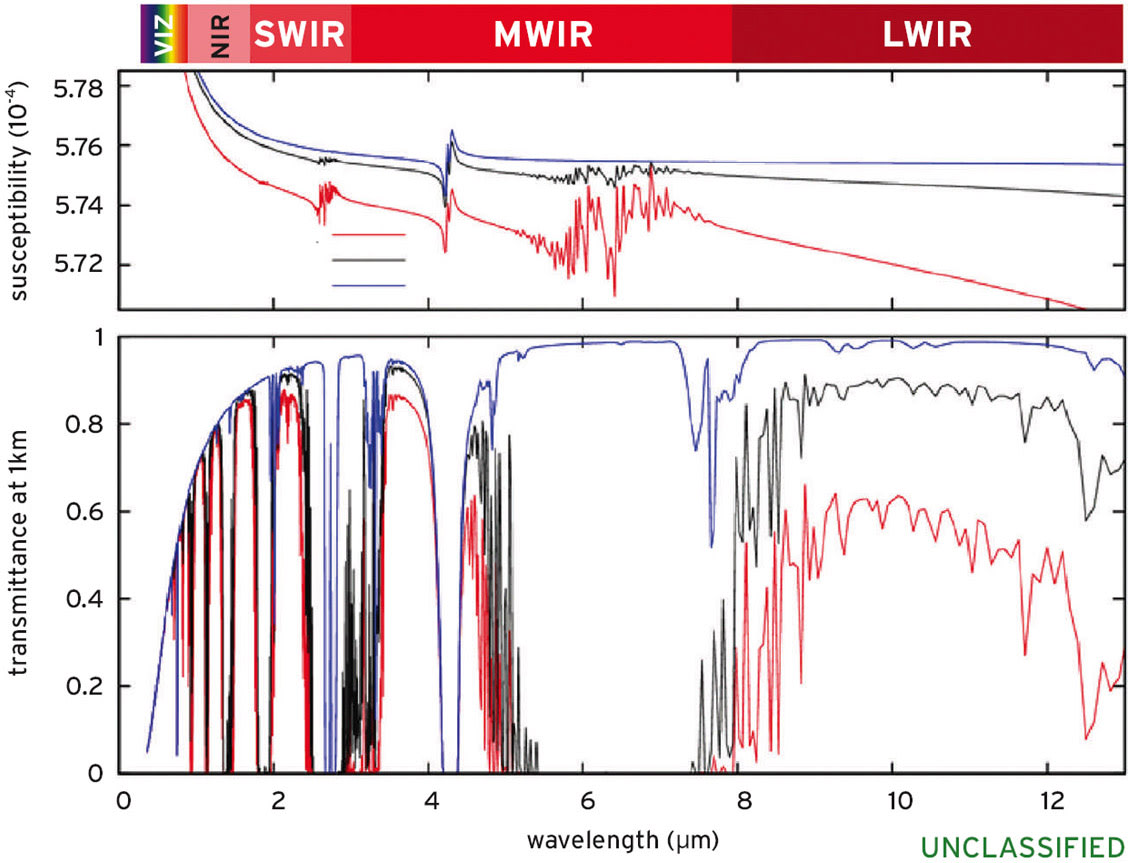
USPLs operate over a wide range of wavelengths (λ), primarily in the infrared spectrum. The infrared is roughly broken down into the near (NIR, 0.7-1.4 μm), shortwave (SWIR, 1.4–3.0 μm), midwave (MWIR, 3.0–8.0 μm), longwave (LWIR, 8.0–15.0 μm), and far (FIR, 15.0–30.0 μm) ranges. For DE applications, we are often interested in propagating in air and thus limit our interests to particular wavelength ranges that minimize losses like absorption and scattering. These “atmospheric windows” are roughly in the visible and NIR (0.4–1.4 μm), the SWIR (2.0–2.5 μm), the MWIR (3.0–5.0 μm), and LWIR (8.0–14.0 μm) (see accompanying illustration).
In addition, the human retina is sensitive in the NIR and common silicon-based sensors are sensitive up to about 1.0 μm. An ideal USPL system for DE would emit at a wavelength in one of the atmospheric windows and be outside the sensitivity range of the retina and silicon sensor to minimize collateral effects.
There is a sizeable range of applications of USPLs and the specific requirements of laser systems can vary, limiting certain improvements that currently lack a business case. With the new generation of high average power USPLs being commercially available, new applications and new markets could develop in the next few years. “Table-top” sources of X-rays, electron beams, and proton beams could see widespread use as diagnostic tools for medicine, preventive maintenance, and materials science with improved SWaP metrics and reductions in cost. Yet all of these applications will one way or another make use of the special realm of physics, nonlinear optics, that USPLs are able to access.
This work was done by Anthony Valenzuela and Daniel Matyas for the Army Research Laboratory. For more information, download the Technical Support Package (free white paper) below. ARL-0241
This Brief includes a Technical Support Package (TSP).
Review of Recent Capability Improvements in Ultrashort Pulse Laser Sources: Closing the Relevancy Gap for Directed Energy Applications
(reference ARL-0241) is currently available for download from the TSP library.
Don't have an account?
More From SAE Media Group
Aerospace & Defense Tech Briefs
3D Meta-Optics for High-Energy Lasers
Photonics & Imaging Technology
Blue Lasers: Leveraging Fundamental Physics for High Performance
Photonics & Imaging Technology
Ultrafast Laser Micromachining
Medical Design Briefs
Optical Design Considerations for Additive Manufacturing
Photonics & Imaging Technology
How to Innovate and Overcome the Challenges of Blue Laser Beam Shaping
Aerospace & Defense Tech Briefs
MOVPE Growth of LWIR AlInAs/GaInAs/InP Quantum Cascade Lasers: Impact of Growth and Material Quality on Laser Performance
Photonics & Imaging Technology
Can Harmful Gas Detection Improve With a New Way of Generating Powerful Lasers?
Aerospace & Defense Tech Briefs
On the Pulsed Laser Ablation of Metals and Semiconductors
Aerospace & Defense Tech Briefs
Development of Photoacoustic Sensing Platforms
Photonics & Imaging Technology
New Blue Light Technique Could Enable Advances in Understanding Nanoscale Technologies

Photonics & Imaging Technology
Essential Principles for Designing and Specifying Laser Optics


Aerospace & Defense Tech Briefs
Rare-Earth-Doped Soft Glass Optical Fibers for Coherent Wavelength Sources Above 2 Microns
Photonics & Imaging Technology
Optical Coatings Technology
Tech Briefs
Chip Measures Quantities with Quantum Precision
Aerospace & Defense Tech Briefs
Room-Temperature Sub-Diffraction-Limited Plasmon Laser
Tech Briefs
High-Power, Portable Terahertz Laser
Photonics & Imaging Technology
OPO Lasers Put Optical Components to the Test
Photonics & Imaging Technology
A Sharper Look at the Interior of Semiconductors

Photonics & Imaging Technology
A First-Of-Its-Kind Integrated Optical Isolator
Photonics & Imaging Technology
Photonics West 2021 Preview
Photonics & Imaging Technology INSIDER
Quantum Dot Breakthrough Could Create Cheaper Infrared Sensors
Photonics & Imaging Technology
Blue Laser Power Beaming for Planetary Exploration
Medical Design Briefs
Self-Cleaning Optical Fiber Can Help in Diagnosing Cancer, Monitoring Environment
Aerospace & Defense Tech Briefs
Integration of Adaptive Optics Into High-Energy Laser Modeling And Simulation
Tech Briefs
Device Measures Laser Power in Real Time
Aerospace & Defense Tech Briefs
Nonlinear Effects in Transformation Optics-Based Metamaterial Shields for Counter Directed Energy Weapon Defense
Overview
The document titled "Review of Recent Capability Improvements in Ultrashort Pulse Laser Sources: Closing the Relevancy Gap for Directed Energy Applications," authored by Anthony Valenzuela and Daniel Matyas, presents a comprehensive overview of advancements in ultrashort pulse laser (USPL) technology and its potential applications in directed energy systems.
Historically, USPLs were primarily utilized in laboratory settings due to their stringent environmental requirements and the complexity of their operation, which necessitated highly trained operators. These lasers typically relied on solid-state technology using titanium:sapphire gain materials, which are sensitive to temperature, humidity, vibrations, and atmospheric particulates. However, recent developments have led to the emergence of a new generation of USPLs that utilize innovative gain materials and architectures. These advancements have significantly improved the environmental tolerance of USPLs while also reducing their size, weight, and power consumption.
The report highlights that these new USPLs have achieved remarkable improvements in performance metrics, including average power and pulse repetition rates, which are orders of magnitude higher than those of commercially available systems as of 2015. This progress indicates that the horizon for directed energy applications using USPLs is rapidly approaching, making them more viable for military and defense applications.
The authors emphasize the importance of these technological improvements in closing the relevancy gap for directed energy applications. By enhancing the operational capabilities of USPLs, the military can leverage these systems for various applications, including precision targeting, counter-drone operations, and other tactical scenarios where traditional weapon systems may fall short.
In conclusion, the document underscores the transformative potential of ultrashort pulse laser technology in directed energy applications. The advancements discussed not only enhance the operational effectiveness of these systems but also pave the way for their integration into modern military strategies. As the technology continues to evolve, it is expected to play a crucial role in shaping the future of directed energy weaponry, providing the military with advanced tools to address emerging threats and challenges.
Top Stories
NewsSensors/Data Acquisition
 Microvision Aquires Luminar, Plans Relationship Restoration, Multi-industry Push
INSIDERRF & Microwave Electronics
 A Next Generation Helmet System for Navy Pilots
INSIDERWeapons Systems
 New Raytheon and Lockheed Martin Agreements Expand Missile Defense Production
NewsAutomotive
 Ford Announces 48-Volt Architecture for Future Electric Truck
INSIDERAerospace
 Active Strake System Cuts Cruise Drag, Boosts Flight Efficiency
ArticlesTransportation

Webcasts
Aerospace
 Cooling a New Generation of Aerospace and Defense Embedded...
Energy
 Battery Abuse Testing: Pushing to Failure
Power
 A FREE Two-Day Event Dedicated to Connected Mobility
Automotive
 Quiet, Please: NVH Improvement Opportunities in the Early Design Cycle
Electronics & Computers
 Advantages of Smart Power Distribution Unit Design for Automotive &...
Unmanned Systems
 Sesame Solar's Nanogrid Tech Promises Major Gains in Drone Endurance