




New Class of Excimer-Pumped Atomic Lasers (XPALS)
Research demonstrates the viability of an atomic laser having a quantum efficiency greater than one.
The focus of this research program was the investigation of XPAL properties, and new pumping schemes, as well as modeling, and measuring critical photoionization and excited state-excited state reaction rates in order to improve the performance of XPALs.
The first several experiments were conducted to measure the smallest energy defect that can exist between the pumped and lasing states in a three-level laser system. This is a problem critical to the cooling of the laser medium by pumping it through the lower lying states. In short, Rb-Xe gas mixtures were used to demonstrate the collapse of a three-level laser when the thermal energy kT reaches approximately the energy defect between the laser and pumped levels.
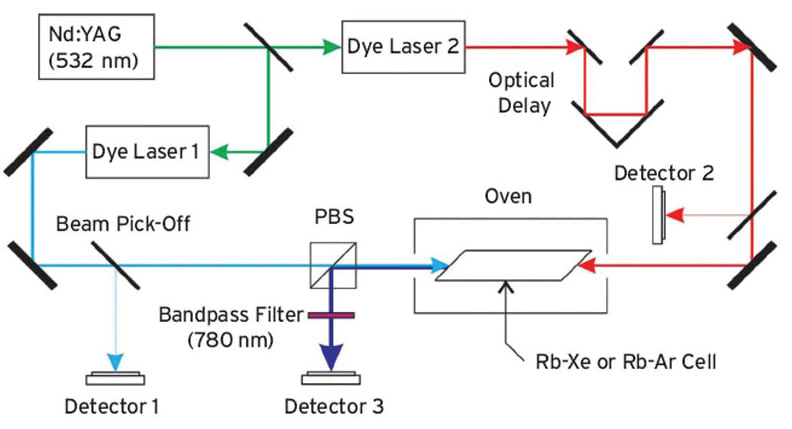
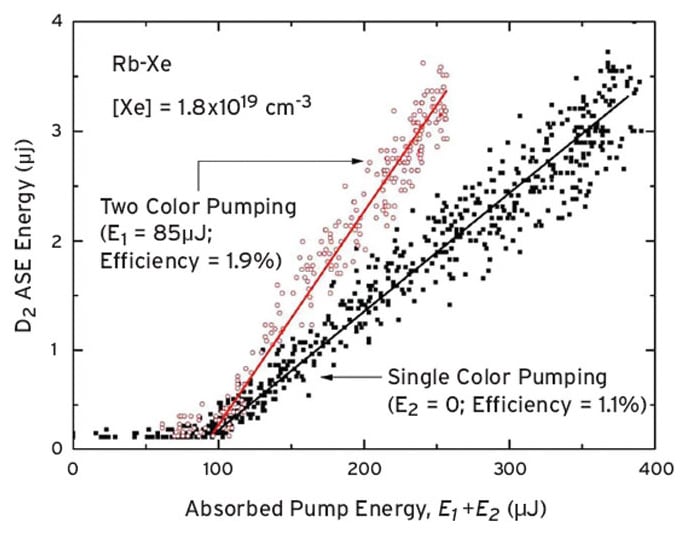
It has been shown through experimentation that the suggested two-color pumping scheme shown in Figure 1 allows the laser’s efficiency to be increased by a factor of 1.7 (Figure 2). In addition, the pump absorption coefficient was increased by more than an order of magnitude, as compared to the classical XPAL pumping scheme.
As shown in Figure 1, a quartz cell filled with an alkali-noble gas mixture was pumped longitudinally with two dye lasers. The first pump pulse was used to prepare the system and populated the upper laser level to a point slightly below the lasing threshold. The second (main) pump pulse created the population inversion and triggered lasing on the Rb D2 line transition at 780 nm.
The most important feature of this pumping scheme is that the wavelength of the main pump was longer than the wavelength of the Rb D2 line laser. In other words, the energy of the emitted photons was higher than the energy of the pump photons. This fact implies the extraction of thermal energy from the gain medium to compensate for the energy difference between the ASE and excitation photons.
It has been demonstrated (Figure 2) that, in addition to the quantum efficiency being above one, the two-color pumped system exhibits higher slope efficiency as compared to the single color pumped case. It is important to note that the absolute efficiencies shown in Figure 2 describe the ASE signals due to the specific experimental arrangement and, therefore, the actual D2 line laser efficiency is significantly higher.
During the same reporting period, the kinetics of the higher energy excited states of Rb and Cs were studied in laser excitation experiments. It was previously shown that the higher excited states are significantly populated by energy pooling processes when the D1 or D2 lines are strongly excited (e.g., optical pumping conditions). For the XPAL system, these higher excited states may be photoionized, resulting in loss of both input energy and metal atom number density. In a conventional DPAL system the higher excited states may react with hydrocarbons, producing metal hydride particles and carbon deposits.
Attempts were made to observe the ionization of Rb and Cs in the presence of 500 Torr of Ar. The D 2 lines were excited using pulsed laser intensities of approximately 0.5 MW/cm2. A time-delayed, pulsed dye laser probe was used to detect metal vapor loss due to ionization. These measurements indicated that less than 1% of the neutral Rb or Cs was lost via ionization. Direct photoionization in the presence of 500 Torr of Ar, using 266 nm and 193 nm radation (P>1MW/cm2), was also found to be inefficient. Loss of ground state atoms was not detected, and there was negligible atomic line fluorescence.
Time-resolved fluorescence and laser pump-probe measurements were used to study the interactions of Rb(6p) with H2, CH4, and C2H6. At room temperature, the total removal, rate constants were found to be kH2=(7.0±0.2)×10-10, kCH4=(6.2±0.2) ×10-10, and kc2H6=(8.1±0.3)×10 -10 cm3 s-1. These values are consistent with earlier determinations. Electronic structure calculations were used to investigate the deactivation mechanisms. Quenching of Rb(6p) by H2 proceeds via a curve crossing with the potential energy curve of the Rb(6s)+H 2 collision pair, while CH4 and C2H6 quench via electronic-to-vibrational energy transfer. Measurements of ground state population recovery were used to estimate the fraction of the quenching that could be attributed to chemical reactions. For H2 the reaction channel accounted for 12% of the total removal rate constant. Production of RbH was confirmed by observing the laser induced fluorescence (LIF) spectrum of the A1Σ+-X1Σ+ transition. Reactive loss in the collisions with CH4 and C2H6 accounted for 3% and 6% of the total removal rate constants. Searches for RbH produced by these reactions yielded negative results.
This work was done by James Eden, University of Illinois Champaign, for the Air Force Research Laboratory. AFRL-0255
This Brief includes a Technical Support Package (TSP).
New Class of Excimer-Pumped Atomic Lasers (XPALS)
(reference AFRL-0255) is currently available for download from the TSP library.
Don't have an account?
More From SAE Media Group
Aerospace & Defense Tech Briefs
Terahertz Fiber-Optic Lasers for Detection of Explosives
Aerospace & Defense Tech Briefs
On the Pulsed Laser Ablation of Metals and Semiconductors
Photonics & Imaging Technology
Researchers Generate Terahertz Laser with Laughing Gas
Tech Briefs
Compact Laser Source Detects Pollution
Aerospace & Defense Tech Briefs
Integration of Adaptive Optics Into High-Energy Laser Modeling And Simulation
Tech Briefs
Optimal Information About the Invisible
Photonics & Imaging Technology
Pratt & Whitney, Virginia Tech Pioneer Laser-Optical Approach for Turbofan Engine Thrust Measurement
Photonics & Imaging Technology
A Laser That Could Reshape the Landscape of Integrated Photonics
Tech Briefs
High-Power, Portable Terahertz Laser

Photonics & Imaging Technology
Blue Laser Power Beaming for Planetary Exploration
Tech Briefs
Low-Energy Nanolaser Shines in all Directions
Photonics & Imaging Technology
Ultrafast Beam-Steering Breakthrough at Sandia Labs
Photonics & Imaging Technology
A First-Of-Its-Kind Integrated Optical Isolator
Photonics & Imaging Technology
Continuous and Stable Lasing Achieved From Low-Cost Perovskites at Room Temperature
Photonics & Imaging Technology
Nanoscale Machines Convert Light into Work
Tech Briefs
Material Increases Efficiency of LED Devices
Photonics & Imaging Technology
Creating High-Precision Glass for NIR Lasers
Photonics & Imaging Technology
Making Measurements with a Fine-Toothed Comb
Tech Briefs
Free-Space Fiber Optic Laser Rod
Photonics & Imaging Technology
How to Innovate and Overcome the Challenges of Blue Laser Beam Shaping
Photonics & Imaging Technology INSIDER
Tiny Diamond Mirrors Could Smooth Out Already Revolutionary X-Ray Lasers
Tech Briefs
Products of Tomorrow
Photonics & Imaging Technology INSIDER
Quantum Dot Breakthrough Could Create Cheaper Infrared Sensors

Tech Briefs
Laser Spark Distribution and Ignition System

Air Force Research Laboratory Technology Horizons
Patterned Gallium Arsenide Devices for Infrared Countermeasures
Photonics & Imaging Technology
Essential Principles for Designing and Specifying Laser Optics
Tech Briefs
Multiplexed Optical Antennas
Overview
The final report titled "New Class of Excimer-Pumped Atomic Lasers (XPALS)" was prepared by J.G. Eden and A.E. Mironov for the Office of Naval Research, detailing a research program conducted from June 1, 2012, to November 14, 2015. The primary objective of the program was to investigate the properties of excimer-pumped atomic lasers, specifically focusing on their quantum efficiency and scalability.
The report highlights a significant breakthrough: the demonstration of an atomic laser with a quantum efficiency greater than one. This finding is pivotal as it suggests that the laser system can produce more energy in the form of laser light than the energy input, which is a remarkable advancement in laser technology. The report emphasizes that the gain medium of this laser is cooled by the emission of every laser photon, which is a novel approach that could enhance the performance and longevity of the laser.
In addition to the main findings, the research included detailed modeling and experimental studies of photoionization processes in alkali-noble gas mixtures. The team measured the smallest energy difference that can exist between the pumped and lasing states in a three-level laser system, providing valuable insights into the operational dynamics of these lasers.
The report also discusses the modeling of XPAL and OPAL (Optically Pumped Alkali Lasers) systems, as well as the mechanisms of plasma formation during high-power pumping. These studies are crucial for understanding the underlying physics that govern the operation of these advanced laser systems.
The document includes references to several archival publications resulting from the research, showcasing the collaborative efforts and contributions to the field of laser physics. Notable publications include studies on two-color pumping of the Rb D2 line laser and the role of excited state photoionization in cesium lasers.
Overall, the report presents a comprehensive overview of the advancements made in the field of excimer-pumped atomic lasers, highlighting the potential for future applications in various technological domains. The findings not only contribute to the scientific understanding of laser systems but also pave the way for innovative applications in both military and civilian sectors.
Top Stories
INSIDERDefense
 New Raytheon and Lockheed Martin Agreements Expand Missile Defense Production
NewsAutomotive
 Ford Announces 48-Volt Architecture for Future Electric Truck
INSIDERManufacturing & Prototyping
 Active Strake System Cuts Cruise Drag, Boosts Flight Efficiency
ArticlesTransportation
 Accelerating Down the Road to Autonomy
INSIDERMaterials
 How Airbus is Using w-DED to 3D Print Larger Titanium Airplane Parts
Road ReadyTransportation

Webcasts
Electronics & Computers
 Cooling a New Generation of Aerospace and Defense Embedded...
Power
 Battery Abuse Testing: Pushing to Failure
Connectivity
 A FREE Two-Day Event Dedicated to Connected Mobility
Automotive
 Quiet, Please: NVH Improvement Opportunities in the Early Design Cycle
Transportation
 Advantages of Smart Power Distribution Unit Design for Automotive &...
Aerospace
 Sesame Solar's Nanogrid Tech Promises Major Gains in Drone Endurance