




Modeling Optical Time and Frequency Generation and Transfer Systems
Developing a unique set of computational algorithms based on dynamical systems theory that allow the rapid and unambiguous determination of the stability and noise performance of lasers and microresonators.
As originally proposed, this research was closely tied to work that was led by Nathan Newbury at NIST, and the principal goal was to support the development of advanced laser sources.
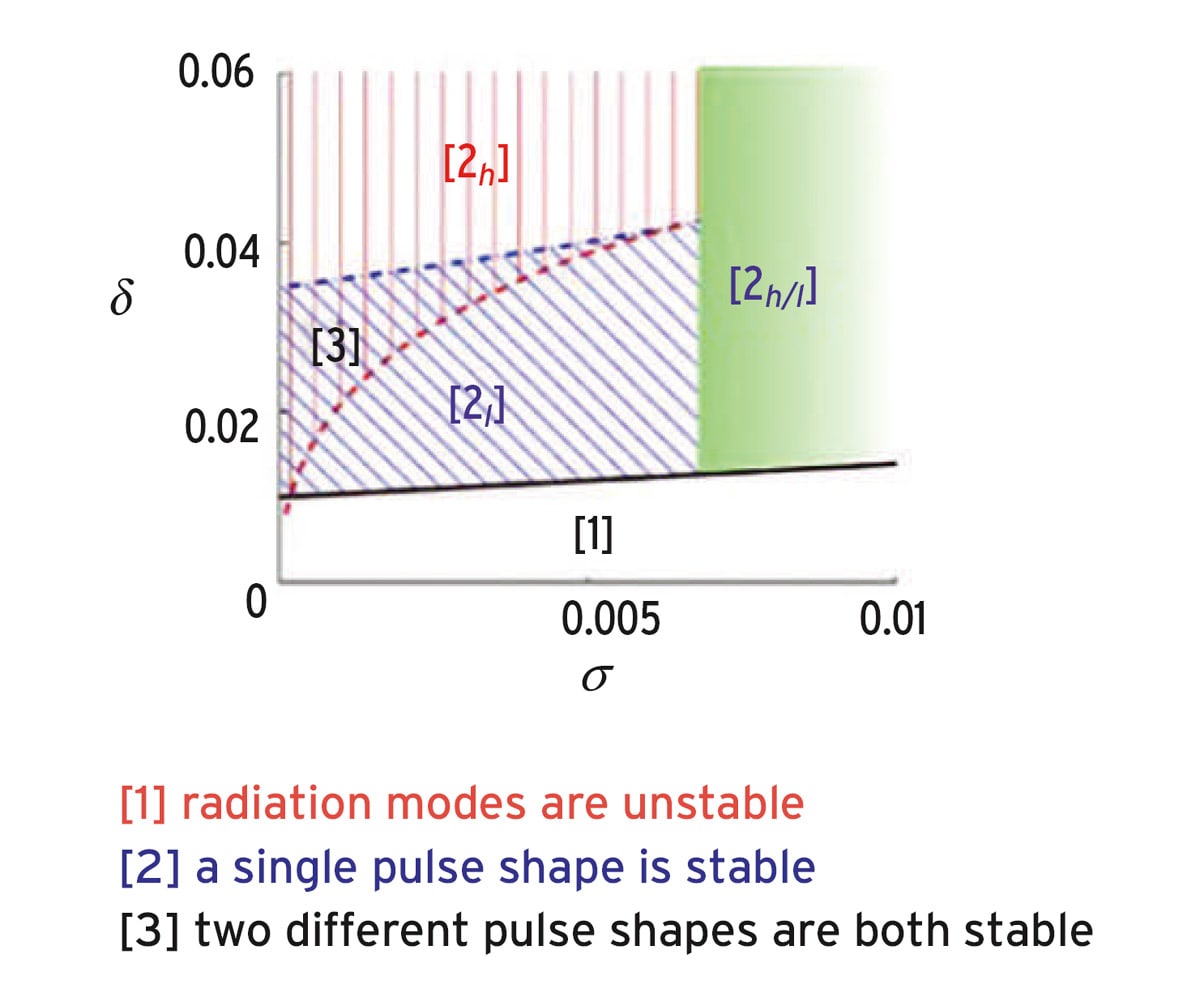
In order to develop robust, carrier-envelope-phase-locked sources that can be transported without losing lock, the Newbury team used semiconductor saturable absorbing mirrors (SESAMs) to provide saturable absorption in their laser systems. This technology replaced nonlinear polarization rotation using the Kerr effect in optical fibers to provide the saturable absorption. As was demonstrated theoretically and the Newbury group had seen experimentally, nonlinear polarization is not a stable source of saturable absorption because the polarization state of standard optical fibers varies randomly due to environmental perturbations. The use of SESAMs, combined with polarization-preserving fibers, solved this problem. However, it led to some unexplained issues. First, it was found that it was not possible to operate too close to the zero dispersion wavelength. Second, it was found that in some cases, parasitic frequency sidebands appeared.
This necessitated explaining both of these phenomena and determining how to avoid them. This goal was accomplished within the first three years of the project. It was also proposed that atmospheric effects that would limit the performance of the free-space optical frequency transfer system that the Newbury team developed be examined. This proposed goal turned out to be superfluous because atmospheric effects were not a significant limit.
In the last two years of the project, the goals were to optimize the laser parameters to obtain higher pulse energies and to increase the wall plug efficiency, both of which were achieved. Unfortunately, this work did not have a strong impact on the experimental work of the Newbury team. At a fairly early stage in the DARPA PULSE project, the team effectively froze their laser development and focused on developing good control over their multiple laser combs using field-programmable gate arrays (FPGAs) that could be computer controlled and controlled remotely and on the application of their laser systems to free-space frequency transfer.
Nonetheless, the techniques that were developed to characterize the stable operating regimes of the lasers and their noise performance appear likely to be of significant future value. Algorithms were developed that perform many orders of magnitude faster than standard techniques that are based on brute-force solution of the evolution equations.
An additional goal of the project was to model solitons in microresonators. The goal in this case was to examine alternatives to the conventional approach to obtaining solitons, which is to start the system in a chaotic state and move to a parameter regime in which solitons will randomly appear. While engineering solutions have been found that can produce solitons with reasonable reliability, they are still randomly generated, and the search for a deterministic path to obtain solitons continues. At the suggestion of Dr. Andrew Weiner of Purdue University, the study of transverse mode interactions and soliton molecules was pursued, as was work on cnoidal waves (also known as Turing rolls). The work on cnoidal waves has been highly successful. A path was identified that can produce a broadband train of solitons deterministically.
This work was performed by Curtis R. Menyuk of the University of Maryland Baltimore County for DARPA. For more information, download the Technical Support Package (free white paper) at mobilityengineeringtech.com/tsp under the Optics, Photonics & Lasers category. DARPA-0016
This Brief includes a Technical Support Package (TSP).
Modeling Optical Time and Frequency Generation and Transfer Systems
(reference DARPA-0016) is currently available for download from the TSP library.
Don't have an account?
More From SAE Media Group
Aerospace & Defense Tech Briefs
Ultrafast Optics: Vector Cavity Lasers — Physics and Technology
Tech Briefs
Free-Space Fiber Optic Laser Rod
Aerospace & Defense Tech Briefs
3D Meta-Optics for High-Energy Lasers
Photonics & Imaging Technology
A Laser That Could Reshape the Landscape of Integrated Photonics
Aerospace & Defense Tech Briefs
On the Pulsed Laser Ablation of Metals and Semiconductors
Photonics & Imaging Technology
A First-Of-Its-Kind Integrated Optical Isolator
Aerospace & Defense Tech Briefs
Integration of Adaptive Optics Into High-Energy Laser Modeling And Simulation
Photonics & Imaging Technology
OPO Lasers Put Optical Components to the Test
Tech Briefs
Optical Signal Amplifying Technique
Aerospace & Defense Tech Briefs
Coherent, Efficient and Practical Polariton Lasers Using a Designable Cavity
Photonics & Imaging Technology
Using Magnets to Toggle Nanolasers Leads to Better Photonics

Photonics & Imaging Technology
Optical Signal Amplifying Technique
Aerospace & Defense Tech Briefs
Determining Optical Material Parameters With Motion in Structured Illumination

Photonics & Imaging Technology
Ultrafast Beam-Steering Breakthrough at Sandia Labs
Aerospace & Defense Tech Briefs
Streamlined Microcomb Design Provides Control With The Flip of a Switch
Medical Design Briefs
OPO Lasers: Putting Optical Components to the Test


Photonics & Imaging Technology
Making Measurements with a Fine-Toothed Comb
Tech Briefs
Compact Laser Source Detects Pollution
Tech Briefs
Shock-Sensing Apparatus
Photonics & Imaging Technology
Tackling Aircraft Laser Strikes from the Ground
Tech Briefs
Multiplexed Optical Antennas
Photonics & Imaging Technology
Can Harmful Gas Detection Improve With a New Way of Generating Powerful Lasers?
Aerospace & Defense Tech Briefs
Frequency Agile Plasmonic Antennas and Sensors
Aerospace & Defense Tech Briefs
Physicists Develop a New Type of Antenna
Overview
The document titled "Modeling Optical Time and Frequency Generation and Transfer Systems" is a final technical report detailing a research project conducted by Curtis R. Menyuk at the University of Maryland Baltimore County, funded by the Defense Advanced Research Projects Agency (DARPA) and the U.S. Army. The project spanned from September 1, 2013, to December 31, 2018, and focused on theoretical and computational modeling of frequency comb sources to support experimental efforts in the DARPA PULSE program.
The primary objectives of the project were twofold: to model semiconductor saturable absorbing mirror (SESAM) fiber lasers used by the Newbury team at NIST for free-space frequency transfer experiments, and to investigate frequency comb generation in microresonators, particularly focusing on solitons and cnoidal waves. The research aimed to address performance limitations of these laser systems and optimize their operation.
Significant accomplishments of the project included the development of advanced computational methods based on dynamical systems theory, which enabled rapid determination of stable operating regimes for lasers and resonators. This approach was significantly faster than conventional techniques, allowing for more efficient analysis and optimization. The team identified wake modes as the source of sidebands in SESAM lasers and explored the wake mode instability that hindered operation near the zero dispersion point.
The project also made strides in understanding dark soliton structures, which were theorized as soliton molecules, and successfully developed analytical expressions for cnoidal wave solutions in both lossless and lossy conditions. The research identified conditions for achieving broadband solutions and stable operation of cnoidal waves with varying periodicities.
Throughout the project, the team produced numerous publications and presentations, contributing to the academic community's understanding of these complex systems. The grant also supported two PhD students, one of whom has graduated and is now applying the computational techniques learned during the project in the insurance industry.
Overall, the report highlights the successful integration of theoretical modeling and experimental validation, leading to advancements in laser technology and frequency comb generation, with implications for various applications in optical communications and precision measurement.
Top Stories
NewsSensors/Data Acquisition
 Microvision Aquires Luminar, Plans Relationship Restoration, Multi-industry Push
INSIDERRF & Microwave Electronics
 A Next Generation Helmet System for Navy Pilots
INSIDERWeapons Systems
 New Raytheon and Lockheed Martin Agreements Expand Missile Defense Production
NewsAutomotive
 Ford Announces 48-Volt Architecture for Future Electric Truck
INSIDERAerospace
 Active Strake System Cuts Cruise Drag, Boosts Flight Efficiency
ArticlesTransportation

Webcasts
Aerospace
 Cooling a New Generation of Aerospace and Defense Embedded...
Energy
 Battery Abuse Testing: Pushing to Failure
Power
 A FREE Two-Day Event Dedicated to Connected Mobility
Automotive
 Quiet, Please: NVH Improvement Opportunities in the Early Design Cycle
Electronics & Computers
 Advantages of Smart Power Distribution Unit Design for Automotive &...
Unmanned Systems
 Sesame Solar's Nanogrid Tech Promises Major Gains in Drone Endurance