




Aerospace & Defense Technology - December 2023
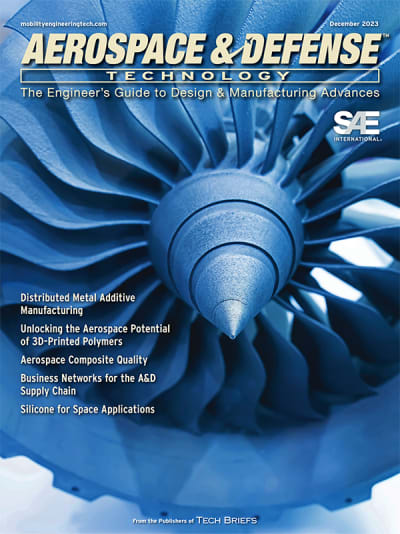
Inside this issue
Overview
The December 2023 issue of Aerospace and Defense Technology delves into several key topics and innovations shaping the aerospace and defense (A&D) industry. This edition highlights advancements in manufacturing technologies, material science, and supply chain management, reflecting the industry's ongoing evolution in response to increasing demand and complex challenges.
1. Distributed Metal Additive Manufacturing: One of the standout features of this issue is the exploration of distributed metal additive manufacturing. This technology is unlocking new potentials for the aerospace sector, particularly in the production of lightweight, high-strength components. The article discusses how 3D-printed metals can reduce waste and lead times, allowing manufacturers to produce parts on-demand and closer to the point of use. This shift not only enhances efficiency but also supports sustainability efforts by minimizing material waste and energy consumption.
2. 3D-Printed Polymers: In addition to metals, the issue examines the growing role of 3D-printed polymers in aerospace applications. The use of advanced polymers can lead to significant weight reductions in aircraft, which is crucial for improving fuel efficiency and overall performance. The article outlines various polymer formulations that are being developed for specific aerospace applications, emphasizing their mechanical properties and resistance to environmental factors.
3. Aerospace Composite Quality: Quality assurance in aerospace composites is another critical topic covered in this issue. As the industry increasingly relies on composite materials for their strength-to-weight ratios, ensuring the integrity and performance of these materials becomes paramount. The magazine discusses the latest techniques in composite testing and inspection, including non-destructive testing methods that help identify defects without compromising the material. This focus on quality is essential for maintaining safety and reliability in aerospace applications.
4. Business Networks for the A&D Supply Chain: The issue also addresses the importance of robust business networks within the A&D supply chain. As demand for aircraft and defense systems continues to rise, the ability to manage complex supply chains effectively is crucial. The article highlights strategies for enhancing collaboration among suppliers, manufacturers, and OEMs (original equipment manufacturers). By fostering stronger partnerships and improving communication, companies can better navigate challenges such as component shortages and production delays.
5. Silicone for Space Applications: Another innovative material discussed is silicone, particularly its applications in space environments. The magazine explores how silicone's unique properties, such as thermal stability and flexibility, make it an ideal choice for various space applications, including seals, gaskets, and insulation. The article emphasizes ongoing research into silicone formulations that can withstand the extreme conditions of space, ensuring the reliability of spacecraft and satellites.
6. Challenges in the A&D Industry: The issue does not shy away from discussing the challenges facing the A&D industry, particularly in light of recent supply chain disruptions. With a record backlog of aircraft orders and ongoing issues with parts suppliers, manufacturers are under pressure to ramp up production. The magazine highlights the urgent need for improved inventory resilience and planning to mitigate delays caused by sourcing bottlenecks. It suggests that companies focus on enhancing transparency across the supply chain and developing better forecasting methods to anticipate potential disruptions.
7. Skilled Labor Shortages: A significant concern raised in this issue is the attrition and inexperience within the skilled labor force in the A&D sector. The article discusses how this shortage is impacting manufacturing output, efficiency, and quality. It calls for initiatives to attract and train new talent, ensuring that the industry has the skilled workforce necessary to meet future demands.
8. Future Outlook: Looking ahead, the magazine emphasizes the importance of innovation and adaptability in the A&D industry. As manufacturers strive to meet higher production targets, they must embrace new technologies and methodologies. The issue concludes with a call to action for companies to invest in research and development, enhance their supply chain strategies, and prioritize workforce development to remain competitive in a rapidly evolving market.
In summary, the December 2023 issue of Aerospace and Defense Technology provides a comprehensive overview of the current state of the A&D industry, highlighting both the exciting advancements and the challenges that lie ahead. From the transformative potential of additive manufacturing to the critical need for quality assurance and skilled labor, this edition serves as a valuable resource for industry professionals seeking to navigate the complexities of the aerospace and defense landscape.
Features
-
Application Briefs
35 Quantum Sensing Atomic Gyroscope
-
Articles
4 How Distributed Metal Additive Manufacturing Can Add a Surge to Military Supplier Strategies
8 Ensure Aerospace Composite Quality with Force Measurement, Material Testing
13 How Business Networks Can Help Stabilize the A&D Supply Chain
16 Unlocking the Potential of 3D-Printed Polymers in Aerospace and Defense
Tech Briefs
-
Aerospace
31 Composite Repair Engineering Case Studies for U.S. Army Aerostructures
32 Assessment of Noncommercial Icing Prediction Capabilities for Army Applications
33 Modeling and Experimenting with 2D Materials for CMOS Type Devices and Digital Integrated Circuits
Products
-
38 New Products
Top Stories
NewsRF & Microwave Electronics
 Microvision Aquires Luminar, Plans Relationship Restoration, Multi-industry Push
INSIDERAerospace
 A Next Generation Helmet System for Navy Pilots
INSIDERDesign
 New Raytheon and Lockheed Martin Agreements Expand Missile Defense Production
INSIDERMaterials
 How Airbus is Using w-DED to 3D Print Larger Titanium Airplane Parts
NewsPower
 Ford Announces 48-Volt Architecture for Future Electric Truck
ArticlesAR/AI

Webcasts
Electronics & Computers
 Cooling a New Generation of Aerospace and Defense Embedded...
Automotive
 Battery Abuse Testing: Pushing to Failure
Power
 A FREE Two-Day Event Dedicated to Connected Mobility
Unmanned Systems
 Quiet, Please: NVH Improvement Opportunities in the Early Design Cycle
Automotive
 Advantages of Smart Power Distribution Unit Design for Automotive &...
Energy
 Sesame Solar's Nanogrid Tech Promises Major Gains in Drone Endurance