




RS-25 Rocket Engines
L3Harris Technologies
Melbourne, FL
585-465-3592
www.l3harris.com
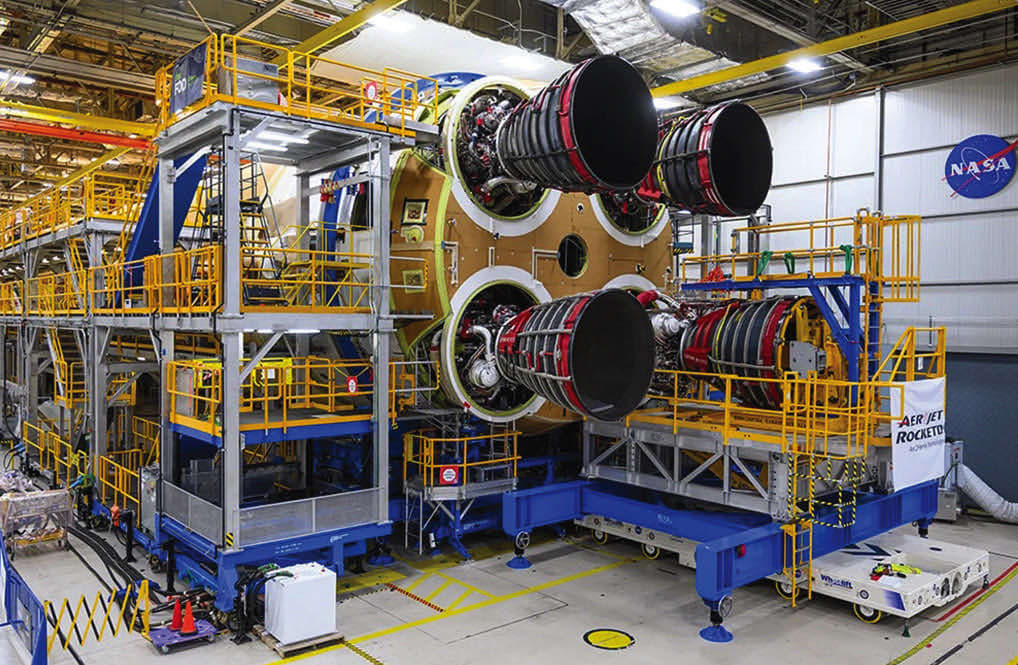
Aerojet Rocketdyne, an L3Harris Technologies company, recently completed installation of all four RS-25 main engines on the core stage of NASA’s second Space Launch System (SLS) exploration rocket, binding them to a common destiny: launching humans beyond low Earth orbit for the first time in more than five decades.
Two of the RS-25 engines are upgraded Space Shuttle Main Engines (SSMEs) that flew before; and two will make their inaugural flight on the Artemis II mission. Slated to launch in 2024, all four RS-25 engines will help send NASA’s Artemis II crew aboard the Orion spacecraft around the Moon, marking the first time a woman and a person of color has made this journey.
The RS-25 engines for the initial SLS rockets that will power the early Artemis missions were upgraded with new controllers and other features to enable deep space exploration. All four Artemis II engines have at least one component that flew aboard Space Shuttle Columbia during STS-1, the first shuttle mission. Engine 2047 flew on STS-135, the final shuttle mission, while engine 2059 flew on STS-134, the program’s penultimate flight. Between them, engines 2047 and 2059 flew 20 space shuttle missions.
Engine numbers 2062 and 2063 are unique among the 16 engines from the shuttle inventory, as they have never flown in space, although they do contain some components, such as high- and low-pressure pumps and valves that have. Aerojet Rocketdyne assembled both engines using main components that were built for the shuttle program but never had the chance to fly, including the nozzles and main combustion chambers.
Starting with its fifth mission, the SLS will use brand new RS-25 engines that will cost 30 percent less than the engines produced for the shuttle program. Major components for these engines are already being built by Aerojet Rocketdyne using the latest manufacturing technologies and processes to achieve the targeted cost savings. Once produced, all RS-25 engines will be tested at NASA’s Stennis Space Center near Bay St. Louis, Mississippi, prior to launch on an SLS flight.
Visit Here
More From SAE Media Group
Aerospace & Defense Tech Briefs
NASA Budget Amendment to Help Send Americans to Moon by 2024, Then Mars
Aerospace & Defense Tech Briefs
Northrop Grumman Tests, Qualifies Orion Launch Abort Motor for Flight in Cold Conditions
Aerospace & Defense Tech Briefs
Soyuz MS-10 Launch Abort Prompts Investigation into Booster Anomaly
Aerospace & Defense Tech Briefs
OmegA Rocket Sustains Explosion During First Static Test, Northrop Grumman Maintains Test Was a Success
Aerospace & Defense Tech Briefs
Orbex Debuts Innovative Smallsat Launch Vehicle
Aerospace & Defense Tech Briefs
NASA Selects Frontier Aerospace to Continue Development of New Deep Space Thruster
Aerospace & Defense Tech Briefs
JAXA Launches HTV7 Unmanned Cargo Spacecraft on Resupply Mission to ISS
Aerospace & Defense Tech Briefs
Jeff Bezos Lays out Blue Origin’s Moon Shot, Debuts Lunar Lander
Aerospace & Defense Tech Briefs
To the Moon and Beyond with Additive Manufacturing
Aerospace & Defense Tech Briefs
U.K. Space Agency Partners with Industry to Advance Spaceflight Program
Tech Briefs
Thrusters Support GOES-R Satellite Series

Aerospace Manufacturing and Machining INSIDER
NASA Builds Welding Test Article for SLS Exploration Upper Stage
Aerospace & Defense Tech Briefs
ULA Selects Blue Origin Advanced Booster Engine for Vulcan Centaur Rocket System
Aerospace & Defense Tech Briefs
AVIO Software Developers Leverage AdaCore GNAT pro Assurance for ESA Vega C Launch Vehicle
Tech Briefs
Artemis II: The Final Countdown

Tech Briefs
How Artemis I Launched
Aerospace INSIDER
Abort Motor for NASA’s Orion Spacecraft Successfully Tested

Aerospace & Defense Tech Briefs
AVIO Engineers Evolve Vega Rocket Design, Enhance Avionics and Propulsion

Aerospace & Defense Tech Briefs
Hybrid Propulsion Systems
Tech Briefs
Going Back to the Moon with Orion
Tech Briefs
Crew Test Module Provides Launch Escape System
Aerospace & Defense Tech Briefs
SAE International Extends Call for Abstracts, Seeks Submissions for AeroTech Conference
Aerospace INSIDER
NASA Tests Artemis II Crew Seat and Flight Suit
Aerospace INSIDER
Orion Spacecraft Launched to Moon on Historic Artemis I Mission
Top Stories
INSIDERDefense
 New Raytheon and Lockheed Martin Agreements Expand Missile Defense Production
NewsAutomotive
 Ford Announces 48-Volt Architecture for Future Electric Truck
INSIDERManufacturing & Prototyping
 Active Strake System Cuts Cruise Drag, Boosts Flight Efficiency
ArticlesTransportation
 Accelerating Down the Road to Autonomy
INSIDERMaterials
 How Airbus is Using w-DED to 3D Print Larger Titanium Airplane Parts
Road ReadyTransportation

Webcasts
Electronics & Computers
 Cooling a New Generation of Aerospace and Defense Embedded...
Power
 Battery Abuse Testing: Pushing to Failure
Connectivity
 A FREE Two-Day Event Dedicated to Connected Mobility
Automotive
 Quiet, Please: NVH Improvement Opportunities in the Early Design Cycle
Transportation
 Advantages of Smart Power Distribution Unit Design for Automotive &...
Aerospace
 Sesame Solar's Nanogrid Tech Promises Major Gains in Drone Endurance