




Everyday Life, Improved by Light: GRYPHON’s Photonic Discoveries
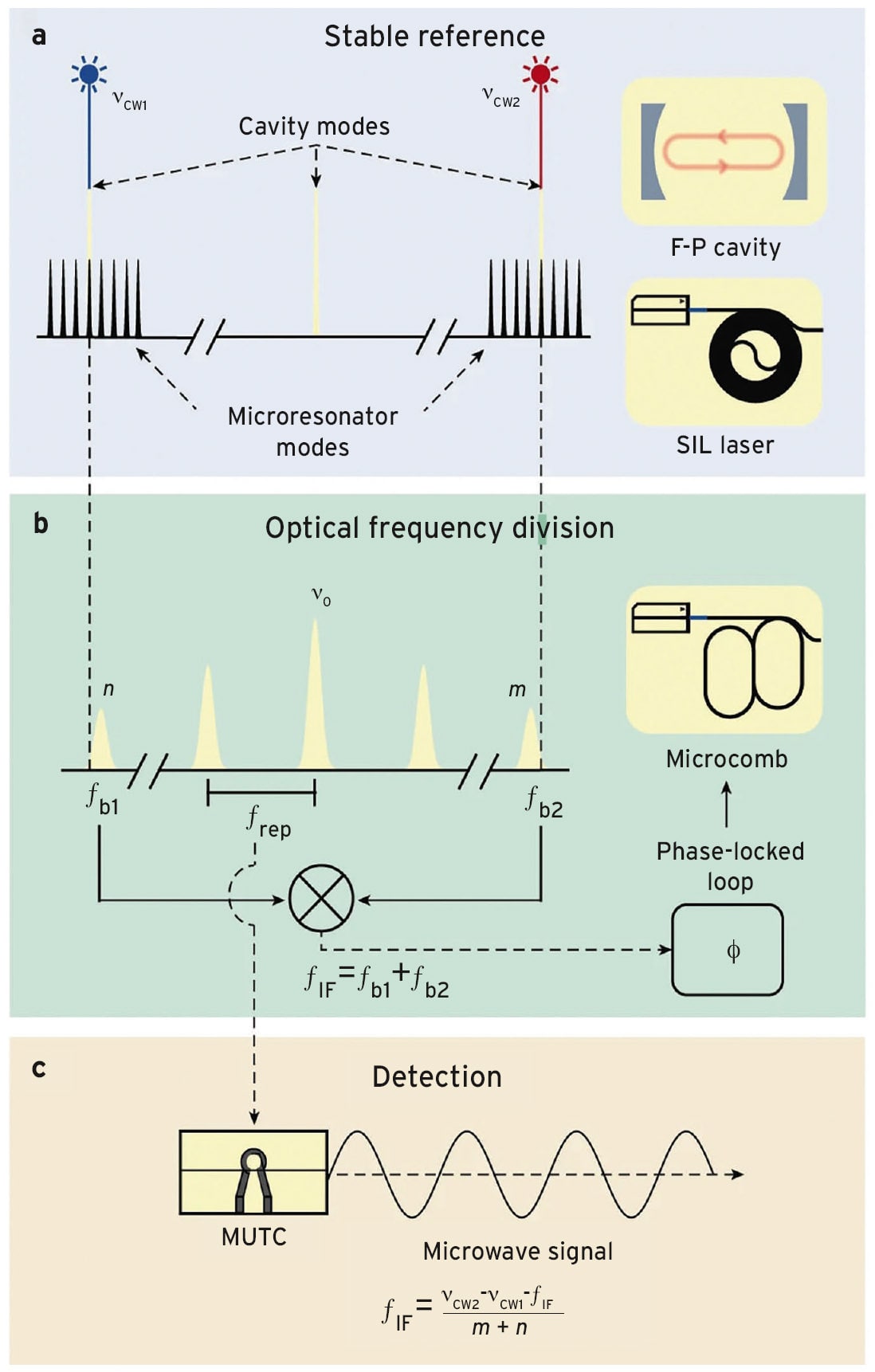
Radio frequency (RF) and microwave signals are integral carriers of information for technology that enriches our everyday life – cellular communication, automotive radar sensors, and GPS navigation, among others. At the heart of each system is a single-frequency RF or microwave source, the stability and spectral purity of which is critical. While these sources are designed to generate a signal at a precise frequency, in practice the exact frequency is blurred by phase noise, arising from component imperfections and environmental sensitivity, that compromises ultimate system-level performance.
This reality drives undesirable tradeoffs between performance, environmental sensitivity, and size that make the simultaneous achievement of stability, precision, and agility in an ultra-compact form factor an elusive feat. However, DARPA’s Generating Radio Frequency with Photonic Oscillators for Low Noise (GRYPHON) program could change all of that, as performers recently demonstrated in the first phase of the program aimed at developing compact, ultra-low-noise microwave frequency oscillators.
The GRYPHON program seeks to develop compact microwave frequency oscillators with extremely low phase noise to enable advanced sensing and communication applications. In the last decade, major advances in oscillator performance have been realized using optical techniques to synthesize high-fidelity microwave signals. Such oscillators employ optical frequency division to reach world-record phase noise levels. The solutions demonstrated to date, however, have sacrificed other important attributes in pursuit of spectral purity. Such trade-offs are problematic, because module size, cost, tunability, and environmental sensitivity are also critical factors that determine the applicability of microwave sources to commercial and military systems.
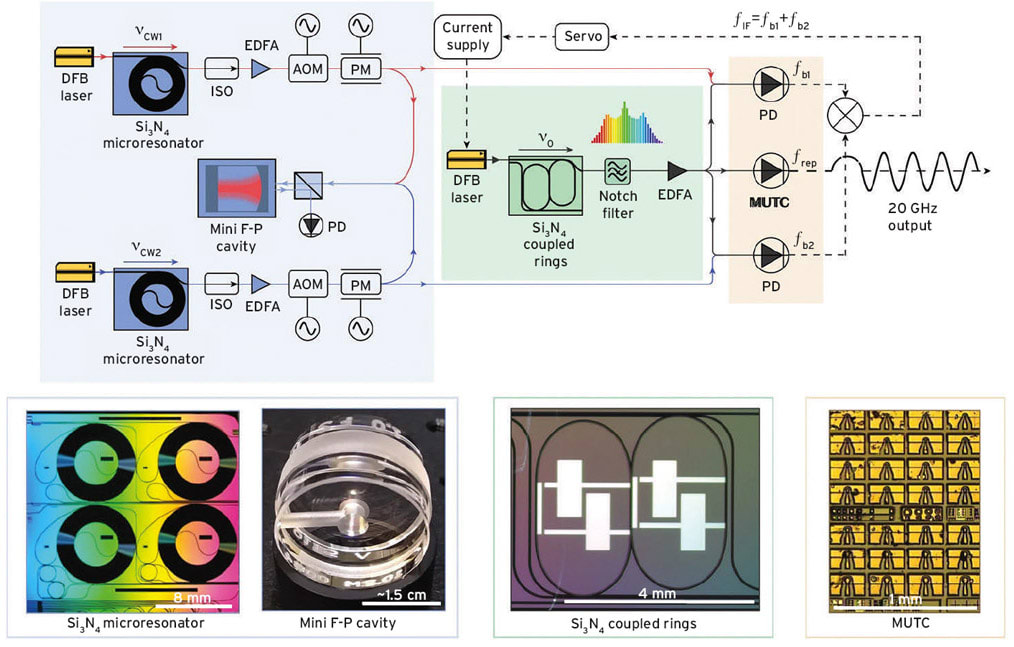
GRYPHON will leverage recent developments in nonlinear photonics and photonic-electronic integration to develop microwave sources with noise performance that meets or exceeds that of the best discrete oscillator modules, yet occupy a compact volume typical of far noisier chip-scale voltage-controlled oscillators (VCOs). Moreover, by program end, GRYPHON microwave sources will operate as synthesizers with the ability to tune to any frequency from 1 to 40+ GHz during operation. This combination of features is unprecedented in today’s state of the art, and will establish a new regime of source technology that is expected to transform the types and capabilities of military and commercial radar and communication systems.
While extremely low phase noise sources do exist, they are expensive, lack tunability, and are impractically large for deployment on mobile platforms that would enable advanced sensing and communication applications. GRYPHON seeks to change this paradigm by realizing viable, small-footprint microwave sources that transcend today’s tradeoffs and far exceed current state of the art. Launched in January 2022, the program builds on advances in optical frequency division, integrated photonics, and non-linear optics – including those from previous DARPA efforts – to establish a new technology regime that transforms military and commercial capabilities.
GRYPHON performers, using different light-based approaches, have made critical progress towards generating high-purity microwaves in significantly reduced form factors. By integrating low-noise lasers with complex optical structures on low-loss photonic platforms, along with high-speed integrated circuits, researchers have established the viability of achieving ultra-low phase noise performance and shrinking these capabilities from conventional table-top sizes down to microchip-size form factors.
“The results and impact from Phase 1 of GRYPHON really show what’s possible. For the first time, we’re seeing how integrated photonics allows us to break from the traditional size vs. performance vs. capability trade space and operate in a regime with exquisite performance that is exponentially better than current state of the art,” said Dr. Justin Cohen, GRYPHON program manager. “Better and faster communications, more accurate sensing, improved detection capabilities – this work could disrupt and advance countless applications.”
The research findings of GRYPHON’s performers were recently featured in Science and Nature journal articles, as well as via the National Institute of Standards and Technology, highlighting the work of contributing NIST researchers and their team. Now in Phase 2, GRYPHON researchers are seeking to further reduce phase noise in their already high-performance sources while introducing tunability and compactifying to targeted form factors, all of which aim to provide systems with unprecedented utility and access to previously unattainable applications.
This article is from material provided by the Defense Advanced Research Projects Agency (Arlington, VA). For more information, contact
More From SAE Media Group
Photonics & Imaging Technology
Photonic Microwave Generation Using On-Chip Optical Frequency Combs
Aerospace & Defense Tech Briefs
Photonic Microwave Generation Using On-Chip Optical Frequency Combs
Aerospace & Defense Tech Briefs
Photonic Analog-to-Digital Converters
Tech Briefs
Next-Generation High-Performance Lasers
Aerospace & Defense Tech Briefs
Identifying and Isolating Signals Using Radio Frequency Photonics
Photonics Tech Briefs
Closed-Loop Microsphere Laser for Optoelectronic Oscillator
Tech Briefs
Inkjet Printing of Metamaterials
Photonics & Imaging Technology
Making Measurements with a Fine-Toothed Comb
Aerospace & Defense Tech Briefs
To 6G and Beyond: Penn Engineers Unlock the Next Generation of Wireless Communications
Photonics Tech Briefs
Stabilizing Microwave Frequency of a Photonic Oscillator
Photonics & Imaging Technology
System and Method for Generating a Frequency-Modulated Linear Laser Waveform
Photonics & Imaging Technology
Photonics-Based Wireless Link Breaks Speed Records for Data Transmission
Aerospace & Defense Tech Briefs
Microcomb Chips Could Improve Accuracy of GPS Systems
Tech Briefs
Light-Based Tech to Navigate the Moon
Aerospace & Defense Tech Briefs
How Laser Communications Innovation is Finally Coming of Age and Driving Innovation in Defense
Tech Briefs
New Phase Shifter to Reduce Antenna Signal Loss
Photonics & Imaging Technology
Optical Signal Amplifying Technique
Aerospace & Defense Tech Briefs
Air Force Technology Tracks “Sporadic E”
Sensor Technology
‘Impossible’ Millimeter Wave Sensor Has Wide Potential
Aerospace & Defense Tech Briefs
Heterodyne RF/Optical Links Utilizing Integrated Photonics
Tech Briefs
Radio Signals Image Hidden and Speeding Objects
Photonics Tech Briefs
Arrays of Carbon Nanotubes as RF Filters in Waveguides
Tech Briefs
Wireless, Wearable Transmitter
Photonics Tech Briefs
120-GHz HEMT Oscillator With Surface-Wave-Assisted Antenna
Photonics Tech Briefs
OEOs With Carrier Suppression for Reduction of Phase Noise
Photonics Tech Briefs
Temperature Sensors Based on WGM Optical Resonators
Automotive Engineering
Homing in on STEM Innovation
Tech Briefs
Q&A: Radar Imaging at Terahertz Frequencies
Top Stories
NewsRF & Microwave Electronics
 Microvision Aquires Luminar, Plans Relationship Restoration, Multi-industry Push
INSIDERAerospace
 A Next Generation Helmet System for Navy Pilots
INSIDERDesign
 New Raytheon and Lockheed Martin Agreements Expand Missile Defense Production
INSIDERMaterials
 How Airbus is Using w-DED to 3D Print Larger Titanium Airplane Parts
NewsPower
 Ford Announces 48-Volt Architecture for Future Electric Truck
ArticlesAR/AI

Webcasts
Electronics & Computers
 Cooling a New Generation of Aerospace and Defense Embedded...
Automotive
 Battery Abuse Testing: Pushing to Failure
Power
 A FREE Two-Day Event Dedicated to Connected Mobility
Unmanned Systems
 Quiet, Please: NVH Improvement Opportunities in the Early Design Cycle
Automotive
 Advantages of Smart Power Distribution Unit Design for Automotive &...
Energy
 Sesame Solar's Nanogrid Tech Promises Major Gains in Drone Endurance