




Taking Aim at the Drowsy-driver Threat
Hyundai Mobis is leveraging SAE Level 4 autonomy tech to move ‘departed’ drivers safely off the road.
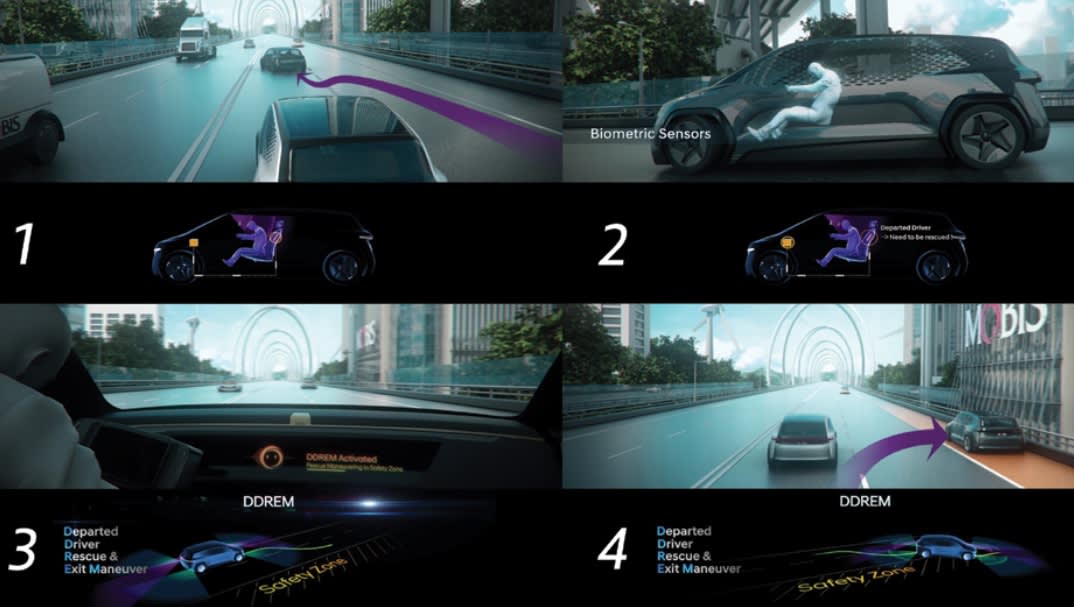
Semi-autonomous technology designed to significantly reduce the 7000 annual fatalities in the U.S. attributed to driver drowsiness has been developed by Hyundai Mobis North America. A “low-cost” production system is being readied for 2022.
“By narrowing our focus to the safety aspects of autonomy, we can quickly bring life-saving [SAE] Level 4 into passenger cars,” said David Agnew, Director of Autonomous Vehicle Development.
“Everyone talks about autonomous Level 4 where you don’t de- pend on the driver to take over; what we’re doing is using autonomous just for safety,” Agnew told Automotive Engineering. He claimed that current driver-alert systems “just detect and then give a warning” which is often ignored.
“People don’t perceive themselves as being on the cliff-edge between being alert or drowsy; they want to reach their destination,” he opined. The new Hyundai Mobis system takes over the driving to safely move the vehicle out of traffic, slowly bringing it to a halt before transmitting an emergency call.
The system, known internally as DDREM (Departed Driver Rescue & Exit Maneuver), is now undergoing road testing in prototype vehicles. It employs standard brakes, stability control and electronic power steering. There’s a production long-range radar, a forward-looking monocular camera and short-range radars, with modified software. Mobis engineers are not using lidar or redundant systems.
Monitoring the driver are three interfused sensor systems. An infrared camera focuses on the driver’s face to observe eye closing and which direction the face is looking. Fused into this are control inputs from the steering wheel and pedals. The third set of inputs detects vehicle wandering.
“We take it to almost a point of no return and then retake control of the vehicle,” Agnew explained. “Ultimately, we end up with a low-cost, low-tech Level 4 system that is a highly-effective solution for ‘departed’ drivers.”
He said much of the research done to date is based on data from industries such as mining, where huma drowsiness-detection is vital to worker safety. While the Mobis system currently does not employ physiological sensors such as heart rate, body temperature and brain function, these are being investigated for future development.
Agnew claimed that for vehicles already equipped with ADAS, the Hyundai Mobis system would represent a “low-cost” investment for OEMs. The implementation of the DDREM technology could save up to 85% of the drowsy-driver-related fatalities per year, he said.
“We are now trying to get into production as soon as we can, not necessarily with Hyundai or Kia,” he added.
More From SAE Media Group
Automotive Engineering
Mobileye Ready to Meet FMVSS 127 with Vision-Only System
Automotive Engineering
Riding Along With Mercedes and Its in-city Driver Assistance System
Autonomous Vehicle Engineering
We Finally Have Some Data on ADAS!
Automotive Engineering
Ford Approved for Hands-Off Driving on German Autobahn

Automotive Engineering
Setting Hyundai’s Safety Strategy
Autonomous Vehicle Engineering
Safety, Standards Crucial to AVs’ Advance
Autonomous Vehicle Engineering
Road Tested
Tech Briefs
Autonomous Vehicles and the Burden of Testing

Autonomous Vehicle Engineering
Standards Play a Vital Role
Autonomous Vehicle Engineering
AV Powers Bring May Flowers
Automotive Engineering
The Future of “Core” Vehicle Systems
Automotive Engineering
Uhnder Dives Into the Ocean With Digital Radar
Automotive Engineering
Fear and Loathing on the Path to Level 4 Driving
Autonomous Vehicle Engineering
When Steering Isn’t Steering Anymore
Automotive Engineering
Sony Honda Afeela Prototype 2026 Was the Easier Engineering Challenge
Off-Highway Engineering
New Mercedes-Benz Actros Loaded with ADAS, Active Safety Tech
Automotive Engineering
Welcome to the Automotive Engineering Podcast

Off-Highway Engineering
Stoneridge Innovation Truck Envisions a Digital-vision Future

Automotive Engineering
MAGNA Say Some Hurdles of Seat-reconfiguration System to Be Addressed by OEMs
Automotive Engineering
Hands Off, Eyes Off, Brain Off
Tech Briefs
Are In-Wheel Motor Systems Catching On?
Automotive Engineering
AVSC Develops Best Practices for Traceable AV Safety Inspection Protocols
Tech Briefs
How Mercedes and NVIDIA Handle City Driving
Automotive Engineering
Book Offers Engineering Trends of 2014 Concept Cars, 2015 New Passenger Cars
Autonomous Vehicle Engineering
Purpose, Perceptions for Driver-Assist Tech Solidify
Off-Highway Engineering
Digital Tech a Las Vegas Headliner
Top Stories
NewsAutomotive
 Microvision Aquires Luminar, Plans Relationship Restoration, Multi-industry Push
INSIDERDesign
 A Next Generation Helmet System for Navy Pilots
INSIDERWeapons Systems
 New Raytheon and Lockheed Martin Agreements Expand Missile Defense Production
NewsPower
 Ford Announces 48-Volt Architecture for Future Electric Truck
INSIDERAerospace
 Active Strake System Cuts Cruise Drag, Boosts Flight Efficiency
ArticlesTransportation

Webcasts
Aerospace
 Cooling a New Generation of Aerospace and Defense Embedded...
Test & Measurement
 Battery Abuse Testing: Pushing to Failure
Internet of Things
 A FREE Two-Day Event Dedicated to Connected Mobility
Transportation
 Quiet, Please: NVH Improvement Opportunities in the Early Design Cycle
Electronics & Computers
 Advantages of Smart Power Distribution Unit Design for Automotive &...
Aerospace
 Sesame Solar's Nanogrid Tech Promises Major Gains in Drone Endurance