




When Steering Isn’t Steering Anymore
High-level autonomy requires new thinking for even basic vehicle controls. Steer-by-wire technology eases some of the complexities automated driving presents—and offers desirable new possibilities.
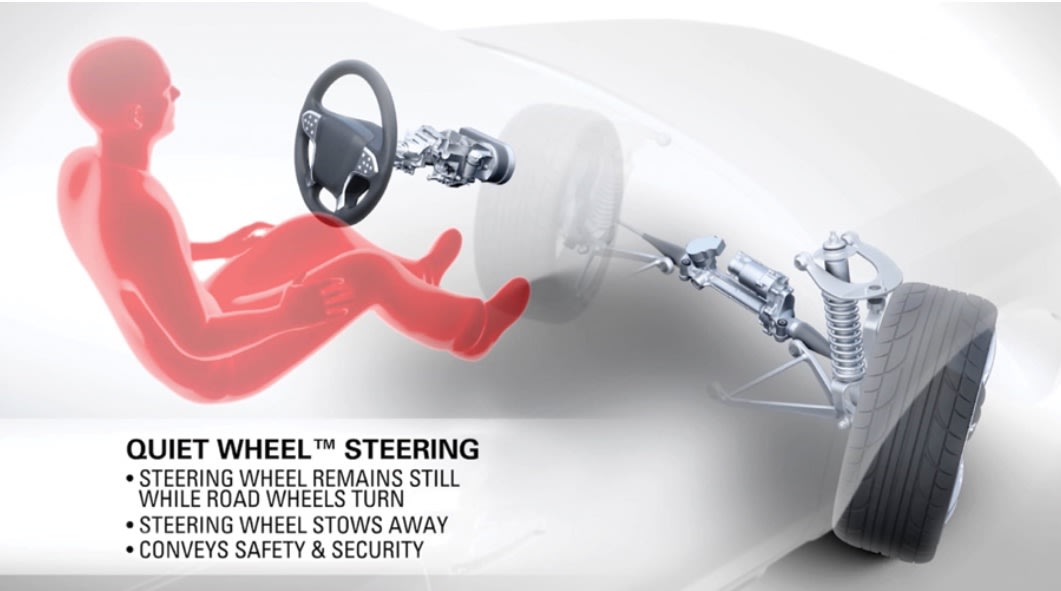
“By-wire” steering that eliminates the physical connection between the steering wheel and the linkage that directs the front wheels isn’t a new idea—Nissan’s Infiniti brand fitted the first-ever production-vehicle steer-by-wire system for its Q50 in 2013—but it’s acknowledged the technology will be vital if automated-driving capabilities are to expand into the mainstream.
One of the most intriguing features by-wire steering may enable is what steering and drive-line-systems specialist Nexteer recently detailed for Autonomous Vehicle Engineering: a system called Quiet Wheel. The technology effectively flips the script by causing the steering wheel to remain motionless as an automated vehicle maneuvers, eliminating the distraction and potential hazard of a self-moving “ghost” steering wheel.
Auburn Hills, Mich.-based Nexteer conducted research that determined many drivers, as well as other vehicle occupants, are much more comfortable with autonomous operation if the steering wheel isn’t moving in conjunction with the action of the front wheels—particularly in tight, city-driving situations in which the steering wheel is almost continually “active.” This seemingly counterintuitive revelation came as test subjects quickly became accustomed to Quiet Wheel, said Jeffery A. Zuraski, Nexteer’s executive director of research and development.
Steer-by-wire also will enable another handy “transitional autonomy” feature, the “stowable” steering wheel. For pure SAE Level 4-5 driving in which the vehicle is fully autonomous, the absence of a physical steering column means that when in autonomous mode, the steering wheel can be automatically pulled close to—or even into—the dashboard area, freeing space and permitting more flexibility in how the driver sits. If return of control to the driver is required, the steering wheel telescopes back to the driver’s comfortable reach.
The stowable wheel could collaborate with Steering on Demand, a design to transition steering control between the automated system and the driver. Nexteer sees Steering on Demand as being either manually enabled via a button or switch, or by the driver dictating the mode simply by placing hands on the steering wheel.
Then there’s this: Nexteer said its advanced steering technology will facilitate a layer of cybersecurity applied directly to the steering system. Nexteer has developed special semiconductor-based hardware modules and a multi-layered cryptographic software structure that can identify and authorize information and command flow between the steering system and other in-vehicle or external controllers. Cybersecurity at the steering-system level would make it that much more difficult for a remote hacker to assume significant control of the vehicle.
“The first hurdle for steer-by-wire is road feel,” said Zuraski (as Infiniti learned to its chagrin with the largely-maligned system launched for its Q50). But with the benefit of 30-plus years of development experience at Nexteer and a trunkful of patents, Zuraski is confident steer-by-wire will mature to a fine level, much as did conventional power steering in its migration from hydraulic assist to today’s predominant electric assist.
Leading chassis and driveline suppliers on other continents also are underway with steer-by-wire systems, which industry analysts believe will become widespread beginning sometime around 2020 as next-generation vehicle architectures embed more electrification of subsystems. The benefits will not be limited to autonomy.
Zuraski said steer-by-wire will naturally be more collaborative with braking, for example, offering a new and more-sophisticated degree of vehicle stability enhancement. Other advanced safety features might include accident avoidance (Ford recently introduced such a system, although it is with mechanically-linked steering) and other steering-related “overlay” features that reduce driving fatigue and sharpen vehicle reflexes. Nexteer said many of these technologies also are scalable, meaning they can be employed on vehicles as large as an over-the-road tractor-trailer.
More From SAE Media Group
Autonomous Vehicle Engineering
AV Powers Bring May Flowers
Automotive Engineering
The Future of “Core” Vehicle Systems
Automotive Engineering
Gearing Up Drive Axle Innovations
Automotive Engineering
Engineering AVs to ‘Play Nice’ With Humans
Off-Highway Engineering
Sensing Changes in Autonomous Trucks

Automotive Engineering
Wrecking Ball
Autonomous Vehicle Engineering
Defanging Driverless Cars
Motion Design
Self-Contained Wheel Unit
Automotive Engineering
2026 Toyota RAV4 Review: All Hybrid, All the Time
Automotive Engineering
Riding Along With Mercedes and Its in-city Driver Assistance System
Off-Highway Engineering
AxleTech Develops Electric Independent Suspension Concept for Vehicles Up to 58,000-lb GCWR
Automotive Engineering
Ford Approved for Hands-Off Driving on German Autobahn

Autonomous Vehicle Engineering
We Finally Have Some Data on ADAS!

Automotive Engineering
Suppliers Struggling to Keep Pace with Faster Product Cycles, Says IHS
Off-Highway Engineering
Yanmar CE Adds to Growing Compact Track Loader Segment
Off-Highway Engineering
Komatsu Targets Productivity, Operator Comfort With New WA480-8 Wheel Loader
Automotive Engineering
OEMs Deny Suppliers the Limelight
Autonomous Vehicle Engineering
Standards Play a Vital Role
Tech Briefs
Are In-Wheel Motor Systems Catching On?
Automotive Engineering
Mobileye Ready to Meet FMVSS 127 with Vision-Only System
Automotive Engineering
Electronic Stability Control Builds the Foundation for Safer Roads
Automotive Engineering
TRW Steering-Wheel Concept Supports Automated Driving
Automotive Engineering
Toyota Stretches SUV Line-Up with World Debut of Grand Highlander
Autonomous Vehicle Engineering
Florida’s Babcock Ranch and the Future of Autonomous Communities
Automotive Engineering
2019 Vehicle Technology Review
Off-Highway Engineering
Electrification’s Impact on Commercial-Vehicle Chassis Design
Automotive Engineering
MAGNA Say Some Hurdles of Seat-reconfiguration System to Be Addressed by OEMs
Top Stories
NewsSensors/Data Acquisition
 Microvision Aquires Luminar, Plans Relationship Restoration, Multi-industry Push
INSIDERRF & Microwave Electronics
 A Next Generation Helmet System for Navy Pilots
INSIDERWeapons Systems
 New Raytheon and Lockheed Martin Agreements Expand Missile Defense Production
NewsAutomotive
 Ford Announces 48-Volt Architecture for Future Electric Truck
INSIDERAerospace
 Active Strake System Cuts Cruise Drag, Boosts Flight Efficiency
ArticlesTransportation

Webcasts
Aerospace
 Cooling a New Generation of Aerospace and Defense Embedded...
Energy
 Battery Abuse Testing: Pushing to Failure
Power
 A FREE Two-Day Event Dedicated to Connected Mobility
Automotive
 Quiet, Please: NVH Improvement Opportunities in the Early Design Cycle
Electronics & Computers
 Advantages of Smart Power Distribution Unit Design for Automotive &...
Unmanned Systems
 Sesame Solar's Nanogrid Tech Promises Major Gains in Drone Endurance