




Electronic Stability Control Builds the Foundation for Safer Roads
How a mechanically simple idea has kept cars stable for decades, and why it can still evolve for an autonomous future.
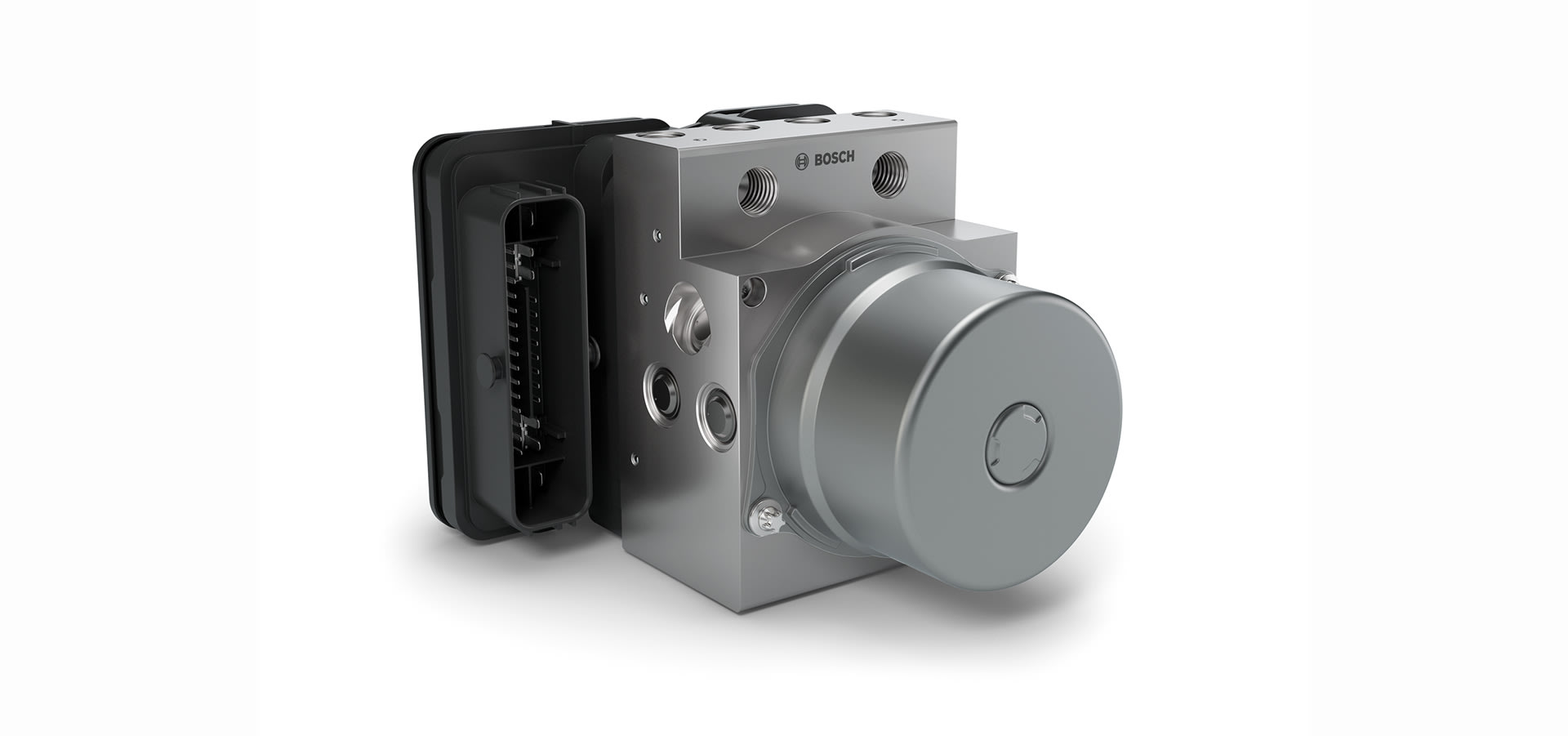
Since debuting in 1995, Bosch’s electronic stability program (ESP) has become one of the most essential safety features in modern vehicles. It’s now a standard on nearly every new car sold in America and has been deployed in over 350 million vehicles worldwide.

ESP is more than just legacy tech. It’s the foundation behind advanced driver assistance, motion control and a more automated future.
Expanding the capabilities of active safety
ESP builds on another innovation, anti-lock braking systems (ABS), which Bosch first brought to market in 1978. While ABS prevents wheel lockup during slip scenarios while braking, ESP goes further. It combines ABS, traction control, and yaw sensors to help keep vehicles on their intended path under dynamic driving conditions. It does so by selectively applying brake pressure to individual wheels.
Mechanically, ESP systems consist of electric motors, reciprocating pumps, and electronically actuated valves. These core components have remained largely consistent over the past 30 years. What has changed significantly is the surrounding electronics, computing power and, most notably, the software that enables modern features.
Software-defined control and scalable innovation
ESP was one of the first automotive systems to demonstrate how software could extend hardware capabilities. Features such as hill-hold assist, trailer sway mitigation and multiple drive modes are software enhancements that run on top of the original system architecture. Many of these capabilities require no changes to the core hardware.
To support this flexibility, Vehicle Dynamics Control 2.0, a modular software platform that can operate within the ESP unit or be distributed across zonal and centralized computing architectures, was developed. This portability enables automakers to tailor ESP deployment to a wide range of electronic vehicle architectures, whether they are distributed, centralized, or hybrid.
In parallel, ESP has advanced to meet increasing demands for processing power, storage and responsiveness. In late 2024, Bosch began producing the 10th-generation ESP units at its Charleston, South Carolina facility, incorporating improvements in efficiency, dynamic response and manufacturability.
A system built to scale: from two-wheelers to Class 7 trucks

ESP’s value extends beyond light-duty passenger cars. In North America, where high-performance trucks, heavy-duty pickups and commercial vehicles are prevalent, ESP variants can address the specific demands of larger platforms. These systems are capable of supporting up to Class 7 trucks, the upper boundary of hydraulic brake systems before they transition to air brakes in Class 8 vehicles.
These use cases present unique challenges, such as supporting variable load states and high brake fluid flow rates. ESP’s evolution addresses these through hardware adaptations, such as larger component sizing fit to the larger brake sizes, and software calibration to maintain control under wide dynamic ranges. Conversely, ESP is also being applied to smaller platforms, including motorcycles and ABS on high-speed e-bikes.
Support for commercial fleets
ESP has proven particularly valuable in the commercial vehicle sector, where operators face wide variations in load, terrain and driver training. Many fleet vehicles operate in Classes 2B through 7, a segment where ESP can improve stability, stopping performance and vehicle control, especially under dynamic weight conditions or during emergency maneuvers. ESP can help keep commercial vehicles stable, predictable, and out of the repair bay even when cargo loads vary or drivers are less experienced.
The technology also has implications for insurance and regulatory environments, as fleet operators increasingly focus on risk mitigation, uptime, and safety metrics. By applying ESP learnings from high-volume passenger car platforms, ESP can be efficiently scaled for commercial applications. That means enhanced safety, reduced insurance risks, and strong compliance on key regulatory topics like AEB.
Application-driven development
ESP has undergone continual validation and refinement through real-world and regulatory testing. In the United States, the “fishhook” maneuver became a standard used in the development of Federal Motor Vehicle Safety Standard (FMVSS) No. 126, which mandated Electronic Stability Control (ESC) on light vehicles starting in 2012.
Beyond regulatory compliance, ESP applications have been developed tailored for off-road use, recreational towing and trailering, as well as performance vehicles. Off-road drive modes, for example, adjust ESP calibration to maintain traction on loose terrain, improve steering response and enhance driver confidence. In trailering scenarios, ESP helps mitigate trailer sway through software-based detection and brake control, improving safety for users who may not have advanced towing experience.
These developments are often driven by the needs of OEM partners and reflect a broader push to integrate intelligent, adaptable motion control across various platforms and use cases.
Positioning for the future: automation and brake-by-wire
As vehicle platforms continue to evolve toward higher levels of automation, ESP plays a foundational role. Whether supporting Level 2 driver assistance or fully autonomous shuttle operations, vehicles will continue to require robust, redundant brake control systems capable of operating without direct driver input.
One solution is an electric brake booster system, like Bosch’s iBooster, that works in tandem with the ESP unit to provide pressure buildup and redundancy. This architecture supports brake-by-wire functionality while maintaining the safety and validation benefits of legacy systems.
Vehicle-level software is also expected to become more distributed across multiple domains, creating opportunities to segment control logic between central processors and local actuators. ESP software has been designed with this flexibility in mind, enabling OEMs to allocate features based on architecture constraints while preserving core system performance.
A platform that continues to deliver
Since its introduction, ESP has grown from a niche safety innovation to a global standard. It continues to serve as the underlying control for a wide variety of features, from everyday driving stability to high-performance agility and automated braking. It keeps families safe, fleets moving, and future tech grounded in something we all need: safety and control.
Its evolution has been defined not only by technological advances but also by its adaptability across platforms, use cases and regions. As the industry moves toward electrification, automation, and centralized architectures, ESP remains a critical enabler of safe, scalable vehicle motion control.
Rich Nesbitt is VP of product management for Bosch Mobility Vehicle Motion and wrote this article for SAE Media.
More From SAE Media Group
ADAS & Autonomous Vehicle Engineering
The Road to Zero Prototypes
Off-Highway Engineering
WABCO Adds Autonomous Driving 'Building Blocks' to 2019 Portfolio
Off-Highway Engineering
Knorr-Bremse Puts the Brakes on Automated Driving
Off-Highway Engineering
Israeli Startup REE Reinvents the Wheel with a Modular Approach to Future EV Design
Autonomous Vehicle Engineering
Motorcycles Enter the ADAS Age
Off-Highway Engineering
REE’s P7 Brings Advanced Suspension Control to Medium-Duty Trucks
Off-Highway Engineering
Tevva & ZF Integrate Brake-By-Wire Regen System for Last Mile BEV
Off-Highway Engineering
First Drive: REE’s Electrifying P7 Delivery Chassis
Autonomous Vehicle Engineering
Amending the Automated-Driving ‘Constitution’
Autonomous Vehicle Engineering
V2X Communication, Not Automation, to Usher in Next Road-Safety Revolution
Off-Highway Engineering
Automated, Electric Monarch Tractor Ready for 2021 Deliveries
Automotive Engineering
Stability Control Boosts Motorcycle Safety
Automotive Engineering
AVSC Develops Best Practices for Traceable AV Safety Inspection Protocols
Automotive Engineering
ZF’s Current Innovations Build for EV, AV Future
Off-Highway Engineering
Removing Complexity for Autonomous Trucks
Automotive Engineering
Talking SDVs and Zonal Architecture with TE Connectivity
Automotive Engineering
Brembo’s Sensify Aims to Revolutionize Braking
Automotive Engineering
Chassis Brakes International Debuts First NA-Produced Products
Off-Highway Engineering
Peloton Develops a Level 4 Automated Platooning System, but Keeps the Driver in Charge
Automotive Engineering
New 2019 Yamaha Niken Steers a Radical Path
Automotive Engineering
WCX 2021: Systems Thinking as Powerful as Propulsion Systems
Automotive Engineering
Full Speed Ahead for Second-Generation Indy Autonomous Racers
Autonomous Vehicle Engineering
GM Announces Door-To-Door Ultra Cruise ADAS
Autonomous Vehicle Engineering
Extending EV Range with AV Programming
Off-Highway Engineering
Peloton CEO Talks Level 4 ‘Automated Following’
Autonomous Vehicle Engineering
Hopeful but Closer Scrutiny for SAE Level 4 Automation
Autonomous Vehicle Engineering
BMW 7-Series Drives Itself Through Own Assembly
Autonomous Vehicle Engineering
AV Powers Bring May Flowers
Automotive Engineering
Hitachi-Astemo and the Electrified Future
Top Stories
INSIDERManufacturing & Prototyping
 How Airbus is Using w-DED to 3D Print Larger Titanium Airplane Parts
INSIDERManned Systems
 FAA to Replace Aging Network of Ground-Based Radars
NewsTransportation
 CES 2026: Bosch is Ready to Bring AI to Your (Likely ICE-powered) Vehicle
NewsSoftware
 Accelerating Down the Road to Autonomy
EditorialDesign
 DarkSky One Wants to Make the World a Darker Place
INSIDERMaterials
 Can This Self-Healing Composite Make Airplane and Spacecraft Components Last...
Webcasts
Defense
 How Sift's Unified Observability Platform Accelerates Drone Innovation
Automotive
 E/E Architecture Redefined: Building Smarter, Safer, and Scalable...
Power
 Hydrogen Engines Are Heating Up for Heavy Duty
Electronics & Computers
 Advantages of Smart Power Distribution Unit Design for Automotive...
Unmanned Systems
 Quiet, Please: NVH Improvement Opportunities in the Early Design...
