Talking SDVs and Zonal Architecture with TE Connectivity
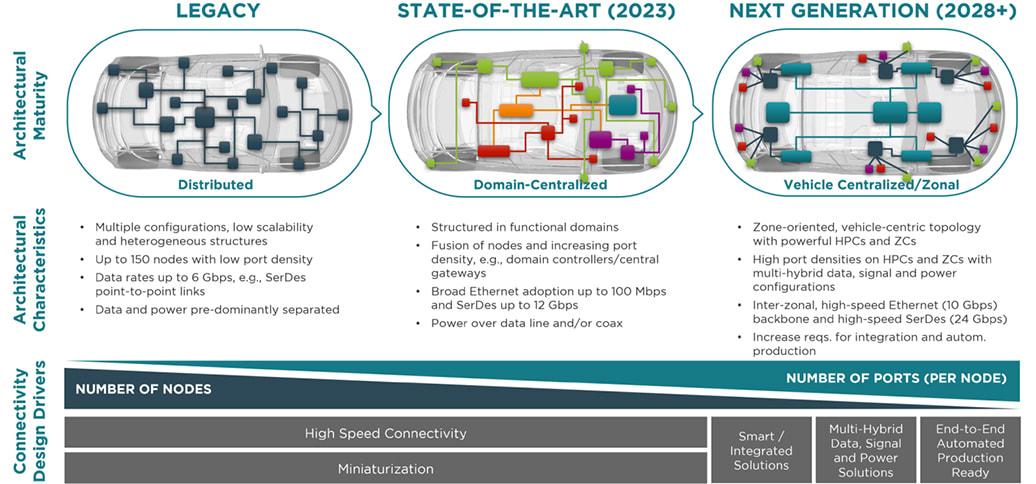
For a company focused on selling components to make physical connections in vehicles, TE Connectivity is more than ready for future growth in software-defined vehicles (SDVs) and the corresponding rise in vehicles with zonal architectures.
Ruediger Ostermann, vice president and chief technology officer for Global Automotive at TE Connectivity, said TE agrees with industry estimates that the number of cars with a zonal architecture will rise from around 2% in 2023 to between 35-40% in the mid-2030s.
In SDVs with a zonal architecture, low-voltage electronics (commonly 12-volt but sometimes 48-volt and even down to 5-volt components) are grouped by location, not function, which leads to fewer ECUs overall and zone controllers installed in regions throughout the vehicle. The zone controllers are regional hubs for distributing power and data and are themselves connected to a central computer that operates the vehicle’s core software. For a company like TE, this means a lot fewer point-to-point wires and connectors to the ECUs. But TE’s assumption is that the number of connectors in an SDV will increase overall, Ostermann said, because even with fewer ECUs, there is a growing number of things to connect at their far ends.
“The sensors, the activators, the motors. Regardless of zonal control or not, all of these elements are still there, and they will increase because autonomous driving needs even more sensors [rather] than fewer sensors,” he said. “And we have cameras everywhere and now [zonal architectures are] proliferating in the lower-class models, too, so we are not really afraid of the number of connectors inside a car.”
A new, automated business model

More, smaller connectors give a company like TE a potential new business model, too, Ostermann said, if the now smaller harnesses can be produced through automation. Given TE’s work on automated harness production for non-automotive industries like home appliances might give it a lead here.
“You will see that the software-defined vehicle, even if that’s not the intention, is pushing harness automation,” he said. “That’s a very interesting effect. We don’t want to be a competition to the traditional wiring harness makers, but if they are smaller units, which can be automatically produced, that would be something we are looking at in our business.”
Automated harness production could also be beneficial for autonomous driving, Ostermann said.
“We need more safe connections,” he said. “We need to have that to make sure that autonomous driving isn’t at any risk. People make mistakes on the wiring harness. Even if you test the connections, it’s still less than what a machine could do.”
Ostermann, who previously worked at Lear, United Technologies Automotive and Sumitomo, said there’s a comparison between the recent growth in AI and what’s coming for SDVs. People have been talking about “intelligent” machines for decades, he said, but only now is technology able to deliver something along that promise. Zonal architecture shares ideas with older automotive technologies like smart junction boxes, but what’s different now is the growth of electronics in a vehicle driven by new safety, comfort and infotainment features.
“The problem with smart junction boxes in the mid-‘90s was that it was more expensive than an ordinary junction box,” he said. “It was, I don’t know, $10-15, and then you’re done, and electronics were always more expensive than that. You could not save enough wires in the harness to really make that a business case. Now there’s a change in that we have even more electronics in the car. Given the amount of electronics in the cars, it makes sense then to move also other things into that electronics space and software space.”
TE’s Global Automotive team is made of 2,000 engineers in different regions, and Ostermann said there are certainly regional differences in how new zonal architectures will be used.
“It’s very interesting if you think about China,” he said. “During [the global coronavirus pandemic], they really shifted and they produced more Chinese cars they focused on the end consumer and they made cars which are more appealing to them, and this comes with this software definition.”
Chinese vehicle buyers are more interested in instant connections as soon as they enter the car, placing an order or having a preferred television series come on for the passenger
“It is really more software-defined, and that is for me a society thing,” he said. “Because in my day, we were looking at horsepower displacement, the sound of a car, the looks of a car. Those features were, for us, interesting. And there’s a shift, I think, also, that this is not so important anymore, but other things are important.”
More From SAE Media Group
Automotive Engineering
Volvo EX90 Uses AI, NVIDIA SoC to Make Automated Driving Safer
Automotive Engineering
WCX 2024: The Technologies That Will Define Future Mobility
Autonomous Vehicle Engineering
Hopeful but Closer Scrutiny for SAE Level 4 Automation
Automotive Engineering
Electrifying Opportunities at IAV
Autonomous Vehicle Engineering
Going the Last Mile
Automotive Engineering
CES 2021: Bosch Consolidates Computing Talent in New Mobility Division
Autonomous Vehicle Engineering
BMW 7-Series Drives Itself Through Own Assembly
Automotive Engineering
Software Transforming Vehicle Development
Automotive Engineering
WCX 2019: Start Your Self-Driving Racecars
Off-Highway Engineering
Scalable Hardware-Software Interface Answers Overlooked AV Testing Need
Automotive Engineering
Power over Coaxial in Automotive: A Simplified Path to Advanced Vehicle Systems
Autonomous Vehicle Engineering
Harman Using Empathy to Help Elevate the User Experience
Automotive Engineering
The Navigator: The Not-So-Hidden Cost of “Free”
Automotive Engineering
The Navigator: Explosion in Compute Power Enables Automated Driving
Autonomous Vehicle Engineering
Gathering Clouds Will Form Autonomy’s Computing Backbone
Automotive Engineering
Full Speed Ahead for Second-Generation Indy Autonomous Racers
Autonomous Vehicle Engineering
GM Announces Door-To-Door Ultra Cruise ADAS

Off-Highway Engineering
Automated, Electric Monarch Tractor Ready for 2021 Deliveries
Automotive Engineering
CASE Struggles to Fulfil Expectations
Autonomous Vehicle Engineering
Deere Touts Software, AI Tech at CES
ADAS & Autonomous Vehicle Engineering
Mercedes-Benz Architecting Its Own Operating System
Automotive Engineering
Snapdragon Ride Flex Puts Safety, Infotainment onto Single Chip
Automotive Engineering
Challenges Galore for Connected Cars
Autonomous Vehicle Engineering
BlackBerry Tech Duo Sees Emergence of Vehicle-Based Platforms
Automotive Engineering
Using AI and Machine Learning for Vehicle Inspection
Off-Highway Engineering
WCX 2021: Top Engineers Talk Industry Transformation
Autonomous Vehicle Engineering
New Digital Tools Driving Restructuring for Autonomy
Autonomous Vehicle Engineering
Complexity of Autonomous-Systems Simulation, Validation Soars to the Clouds
Automotive Engineering
BlackBerry’s CTO Points to a Holistic and Standards-Based Future for Vehicle Cybersecurity
Top Stories
INSIDERManufacturing & Prototyping
 How Airbus is Using w-DED to 3D Print Larger Titanium Airplane Parts
INSIDERManned Systems
 FAA to Replace Aging Network of Ground-Based Radars
NewsTransportation
 CES 2026: Bosch is Ready to Bring AI to Your (Likely ICE-powered) Vehicle
NewsSoftware
 Accelerating Down the Road to Autonomy
EditorialDesign
 DarkSky One Wants to Make the World a Darker Place
INSIDERMaterials
 Can This Self-Healing Composite Make Airplane and Spacecraft Components Last...
Webcasts
Defense
 How Sift's Unified Observability Platform Accelerates Drone Innovation
Automotive
 E/E Architecture Redefined: Building Smarter, Safer, and Scalable...
Power
 Hydrogen Engines Are Heating Up for Heavy Duty
Electronics & Computers
 Advantages of Smart Power Distribution Unit Design for Automotive...
Unmanned Systems
 Quiet, Please: NVH Improvement Opportunities in the Early Design...
Power

Similar Stories
Technology ReportSensors/Data Acquisition
 ZF’s Smart Chassis Sensors Debut in Cadillac Celestiq
NewsAR/AI
 Revolutionizing Vehicle Technology Through Intelligent Actuators
Q&ADesign
 Electrifying Opportunities at IAV
NewsUnmanned Systems
 WCX 2024: The Technologies That Will Define Future Mobility