




ZF’s Smart Chassis Sensors Debut in Cadillac Celestiq
In development for a decade, ZF’s new sensors can provide a better ride, but that’s just the beginning.
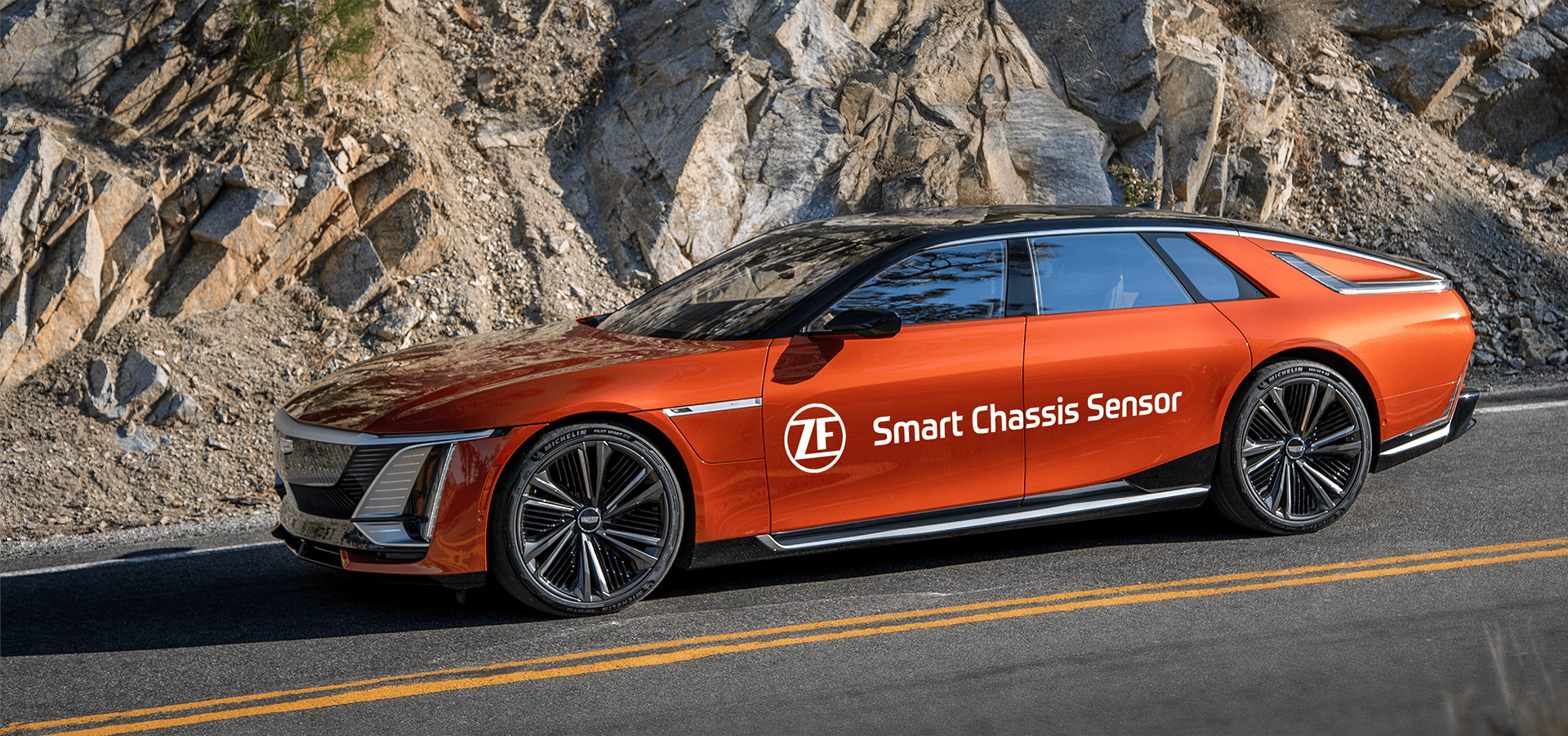
The Cadillac Celestiq is full of new technologies, from the 130+ parts made using additive manufacturing to the 655hp (488 kW) dual-motor AWD powertrain. ZF announced in early July that the $340,000, built-to-order EV is also the first vehicle with ZF’s smart chassis sensors in series production

ZF’s smart chassis sensors are mounted on a control arm and use a magnetic measurement system that is integrated into the ball or cross axis joint of the control arm. A digital sensor detects the change in magnetic field with more than 2,000 increments over the full range of motion of the ball joint’s articulation. “This means that even very small changes in the angle of the ball joint can be detected and translated into a change in height for the vehicle,” Matt Charboneau, communications manager for ZF North America, Inc, told SAE Media.
ZF has been talking about its intelligent chassis components for at least a decade, saying they can replace height sensors and add intelligent functions with additional components. ZF said its smart chassis sensors are lighter, cheaper, and less susceptible to the environment than previous height sensors, while also providing a “significantly more reliable signal quality.” ZF debuted the Chassis 2.0 SDV solution in 2015 and said in 2021 that it was busy developing software for the advanced data analysis that the smart chassis sensors would require and allow.
ZF claims one benefit of using its smart chassis sensors is a weight savings of over 400 g (0.88 lbs) per vehicle through function integration. For example, ZF’s integrated sensors can replace common height sensors that need to be mounted separately to the chassis system. In the Celestiq, a standard sensor was mounted between the vehicle body and the chassis. The ZF smart chassis sensor measures the suspension travel or suspension position of the wheel to the vehicle body on the control arm without any additional connection elements. The system can then electronically control suspension damping and headlamp leveling, for example, using information from the smart algorithms in the sensors.
Integrating smart sensors into a production vehicle, though, presented its own challenges. The eventual solution involved ZF integrating the Celestiq sensors into all four suspension ball joints itself. “[The sensors are] integrated at the point in time that the ball joint is assembled on our assembly equipment,” Charboneau said. “This technology involves components that are internal to the joint, magnets, and external to the joint, the sensor that clips onto the end cap. Once the ball joint assembly is completed and the sensor attached, it is calibrated and shipped to GM for assembly to the vehicle. Once at the GM facility, the arm is installed to the chassis and the cable is plugged in, linking the sensor to the vehicle computer.”
A better ride isn’t the only thing ZF is promising its smart chassis sensors can deliver for OEMs. The smart sensors also enable road condition monitoring, ERC (Electronic Roll Control) roll stabilization and active or semi-active damping systems.
More From SAE Media Group
Off-Highway Engineering
WCX 2021: Top Engineers Talk Industry Transformation
Automotive Engineering
Making Connections: New V2X Tech Brings in Smartphones, Next-Gen ECall
Autonomous Vehicle Engineering
Delivering on Autonomous Transport
Automotive Engineering
Mercedes CEO Talks SDVs and 30 Years in Silicon Valley
Automotive Engineering
GM Readies Comprehensive New Vehicle-Software Platform
Autonomous Vehicle Engineering
Aptiv’s Satellite Route to ‘Democratizing’ Autonomous Tech
Automotive Engineering
Upstream: Better Data Collection, Processing Will Reduce SDV Recalls
Automotive Engineering
Advanced Electrical Architectures Demand New Developmental Strategies
Autonomous Vehicle Engineering
Smart Tech Revolutionizing the Traffic Light
Off-Highway Engineering
Cloud Simulation Assists Active-Safety Development for Electric Refuse Truck
Autonomous Vehicle Engineering
Autonomy’s Computing Edge

ADAS & Autonomous Vehicle Engineering
The Subscriptions Are Coming for Your Wallet
Automotive Engineering
Full Speed Ahead for Second-Generation Indy Autonomous Racers
Autonomous Vehicle Engineering
Data Drives Driverless Truck Launch
Automotive Engineering
CES 2021: GM Creates BrightDrop, a New Electrified Delivery and Logistics Company
Automotive Engineering
Talking SDVs and Zonal Architecture with TE Connectivity
Automotive Engineering
Cadillac Lyriq Spearheads GM’s EV Assault
Off-Highway Engineering
Sensors Evolve to Satisfy CV Demands
Autonomous Vehicle Engineering
Harman Using Empathy to Help Elevate the User Experience
Automotive Engineering
BlackBerry’s CTO Points to a Holistic and Standards-Based Future for Vehicle Cybersecurity
Aerospace & Defense Tech Briefs
Curtiss-Wright Black Boxes Receive European Approval
Automotive Engineering
Software Transforming Vehicle Development
Automotive Engineering
Automotive Cybersecurity Needs Serious Work
Autonomous Vehicle Engineering
Daimler-Xilinx Linkup Spotlights Growing Use of FPGAs
Automotive Engineering
Real-Time Processors Key to the Zonal E/E Revolution
Autonomous Vehicle Engineering
C-2VX Is Finally Gaining Momentum in the U.S.
Automotive Engineering
2025 Volvo EX90 Review: Update Required
Automotive Engineering
Volkswagen Turns Classic Van into Innovative, Retro-Ride EV
Automotive Engineering
The Navigator: The Not-So-Hidden Cost of “Free”
Top Stories
NewsSensors/Data Acquisition
 Microvision Aquires Luminar, Plans Relationship Restoration, Multi-industry Push
INSIDERRF & Microwave Electronics
 A Next Generation Helmet System for Navy Pilots
INSIDERWeapons Systems
 New Raytheon and Lockheed Martin Agreements Expand Missile Defense Production
NewsAutomotive
 Ford Announces 48-Volt Architecture for Future Electric Truck
INSIDERAerospace
 Active Strake System Cuts Cruise Drag, Boosts Flight Efficiency
ArticlesTransportation

Webcasts
Aerospace
 Cooling a New Generation of Aerospace and Defense Embedded...
Energy
 Battery Abuse Testing: Pushing to Failure
Power
 A FREE Two-Day Event Dedicated to Connected Mobility
Automotive
 Quiet, Please: NVH Improvement Opportunities in the Early Design Cycle
Electronics & Computers
 Advantages of Smart Power Distribution Unit Design for Automotive &...
Unmanned Systems
 Sesame Solar's Nanogrid Tech Promises Major Gains in Drone Endurance