




New Mercedes-Benz Actros Loaded with ADAS, Active Safety Tech
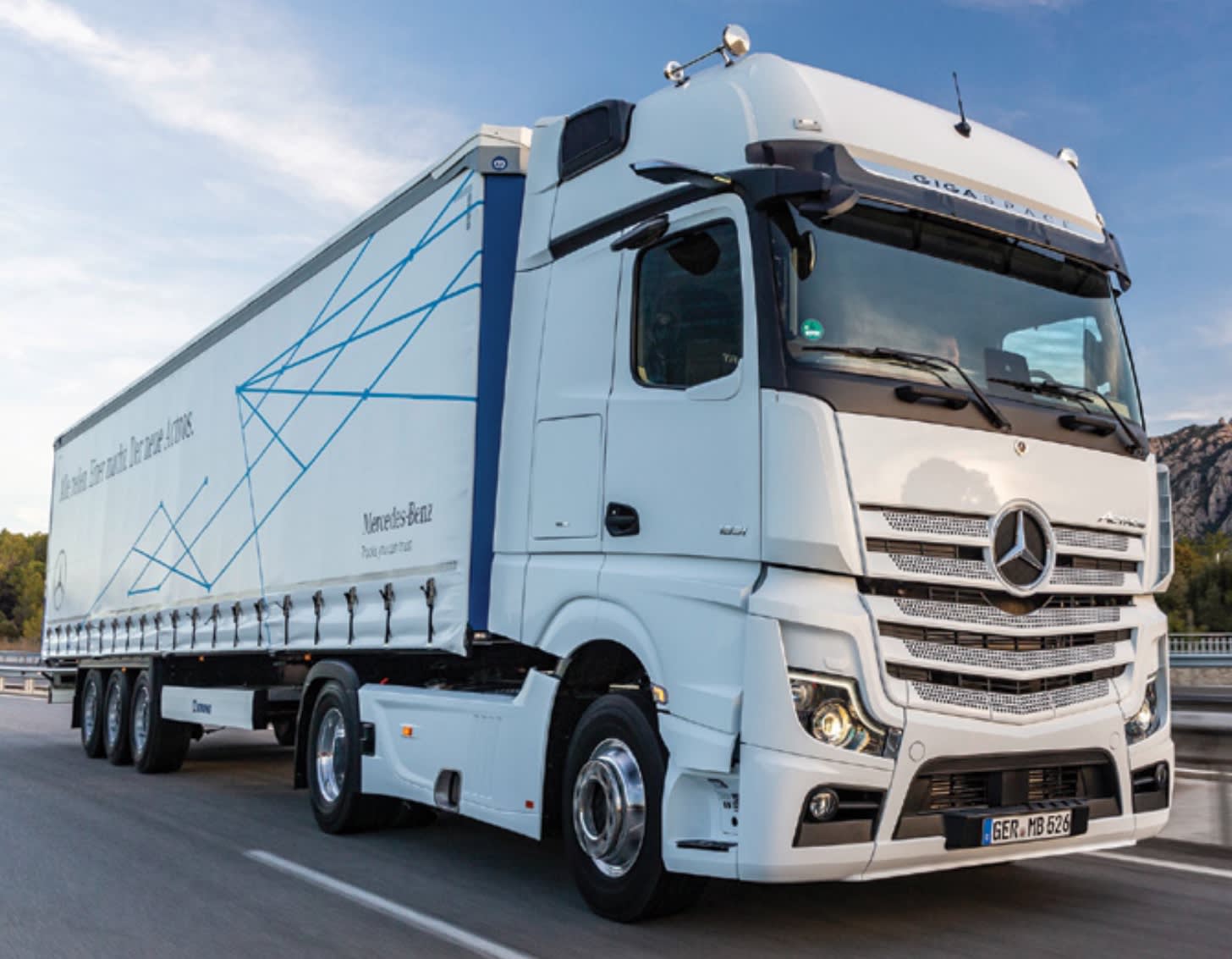
Mercedes-Benz Trucks, the European arm of the Daimler Trucks business, has launched an updated Actros heavy-duty truck flagship, packed with new technologies, vehicle safety and driver-assistance features. While this fifth-generation Actros may have changed little in outward appearance, there have been significant updates under the skin.
Active Drive Assist, MirrorCam and Active Brake Assist 5 are all new, along with updates to Sideguard Assist and Predictive Powertrain Control. Actros comes with a new multimedia cockpit and is the first truck on European roads to replace conventional rearview mirrors with a camera and screen system, called MirrorCam.
“In the past, we focused on sheet metal; now our focus is on electronics,” said head of product engineering Prof. Dr. Uwe Baake. “The development of the new Actros focused particularly on new assistance systems. But we do not innovate for the sake of innovation, [rather] to benefit our customers. One of our customers’ major concerns is a lack of drivers. We needed to make the truck a better place to work, safer, more fuel efficient and one that could offer more uptime for the customer.”
Camera monitor system
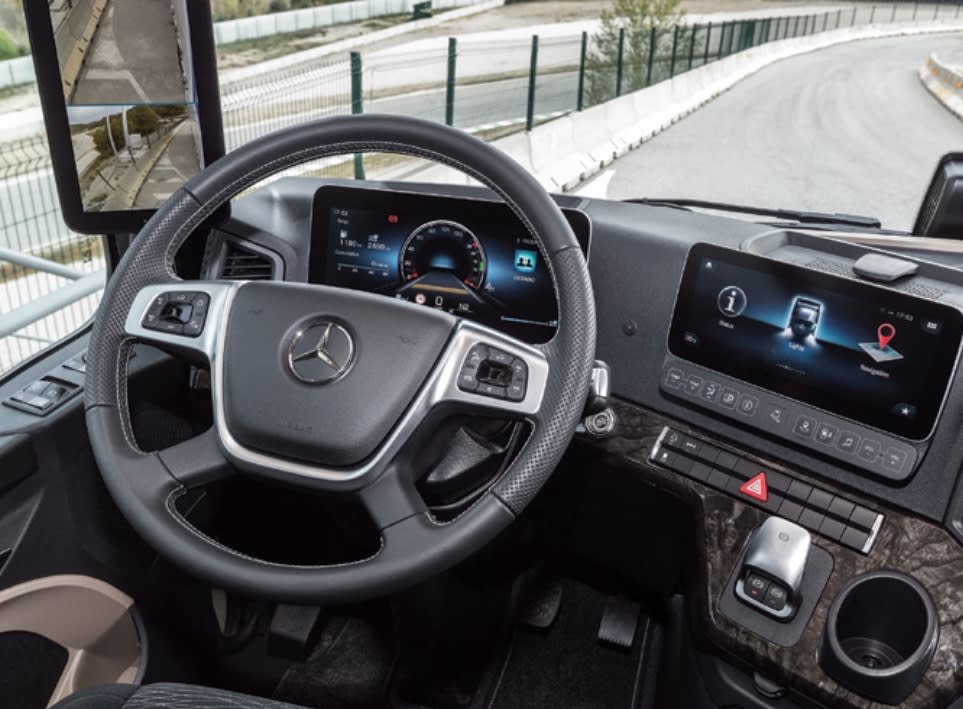
MirrorCam uses streamlined cameras from Daimler’s conventional mirror supplier Mekra Lang, mounted above each door. These relay a full color image to large Bosch screens mounted inside the cab’s A-pillars. As with conventional glass mirrors, the screen provides two views, with the lower one showing a wider angle to reduce blind spots. This lower screen pans with the truck as you turn, ensuring that the rear corner of the trailer always remains in the center of the screen, even during tighter turns.
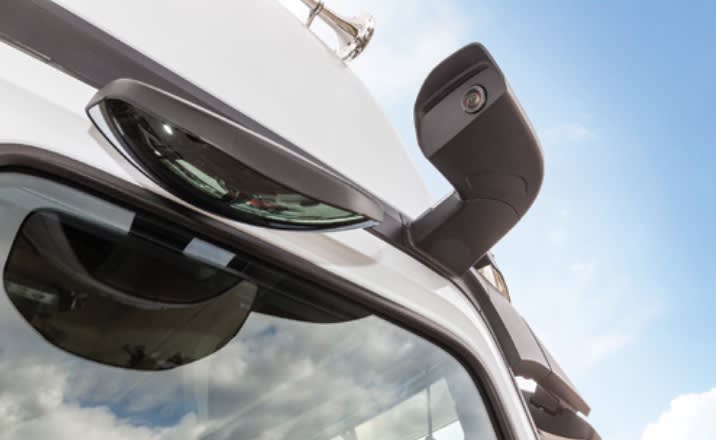
However, as the view is two-dimensional rather than the 3D view of a contemporary mirror, the system provides dotted lines in the screen to indicate the position of the rear of the trailer, along with safe points at which you can move back into a lane after an overtaking maneuver. It works in low-light conditions such as tunnels and at night, and the cameras are heated.
A novel benefit of the MirrorCam system is that the driver can turn on the cameras from the bunk during rest periods, if he or she hears a noise around the truck while parked at night, for instance.
MirrorCam also works with an optional Sideguard Assist system that warns the driver of cyclists and other obstructions that may have moved into the previous blind spot on the off-side of the truck. Using short-range radars on the side of the vehicle, Sideguard Assist monitors the whole length of the vehicle combination, plus a further 2 m (6.6 ft) to the front and 1 m (3.3 ft) to the rear of the truck.
MirrorCam technology will be used by Daimler’s Fuso division in the Far East. However, Freightliner will not be able to use the technology at present in the U.S., as North American legislation currently calls for physical mirrors on the outside of the truck cab. (Read more on camera monitor systems in the U.S. in June 2019 issue of TOHE.)
Multimedia cockpit
Actros adopts Mercedes’ multimedia cockpit, using two tablet-style screens already seen in the company’s passenger car and light-van ranges. These provide information to the driver, along with access to the truck’s safety and assistance features. At present, the system does not have the MBUX voice activation that is offered in cars and vans, though this may come in time.
The standard fit will include a 12-inch monitor in front of the driver, with a secondary 10-inch screen to the side, curved slightly around the driver’s seat. An optional Multimedia Cockpit Interactive is also available, with twin 12-inch screens, while those who prefer can down-spec the cab with a Classic conventional two-dial dash.
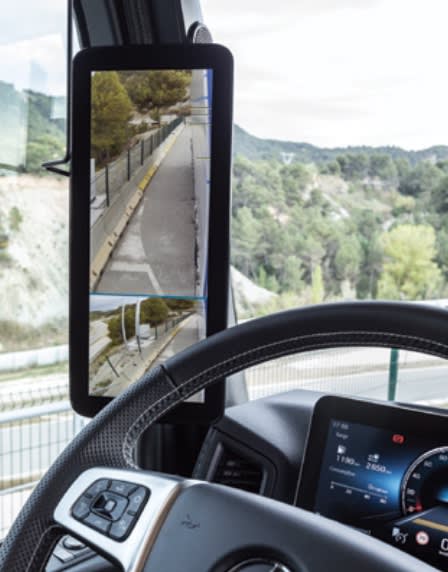
The main dash screen, which uses Visteon software, is controlled by buttons on the left-hand side of the steering wheel, while the secondary screen can be controlled by thumb buttons on the right-hand side of the wheel. This includes touch-sensitive roller controls to swipe through the menus on screen. The secondary monitor is also a touchscreen, so can be activated directly, while some functions, such as cabin temperature up and down and home buttons for satellite-navigation, can be accessed through a row of physical buttons below the screen.
The view on the main screen can be customized to suit the driver’s preference. It can be set to show one large speed dial and two sets of linear information to the sides, or twin dials for engine rpm and speed, or, when cruise control is activated, lane and speed recognition information, along with distance to the vehicle in front, with the speed represented digitally. The screen also shows intended speeds for upcoming bends when using the inter-urban setting in Predictive Powertrain Control.
The truck can remember the preferred settings of up to seven drivers, automatically changing screens and settings to suit, as different driver cards are registered by the vehicle’s tachograph. This even works across multiple vehicles, with the tacho card itself carrying the driver’s preferred information between Actros models.
“Today’s truck drivers have to deal with much more than just driving,” said Dr. Rainer Muller-Finkeldei, head of mechatronic development. “They have to maintain contact with the customer and with the dispatcher, plan their routes and react to changes flexibly. The Actros offers drivers all systems in a clearly arranged interface, so the driver can concentrate on the road.”
Partial automated driving
Active Drive Assist delivers partially automated driving across all speeds, assisting with steering the truck, accelerating and braking. Using cameras in the front windscreen and a radar mounted in the front grille, Active Drive Assist provides active lane guidance, steering the truck back into its lane if it crosses a white line without the driver indicating and can even steer through multiple curves without driver input. The lane guidance function continues to work even if the driver has deactivated Active Drive Assist.
The driver can take his or her hands off the wheel for up to 15 seconds, before the system provides visual and audible warnings that the driver should resume control. This relies on the Actros trucks being equipped with a new electrically operated steering system, which can detect the steering torque of a driver holding the steering wheel.
The system also allows the driver to set the distance to the vehicle in front and follow at that distance on cruise control, with the truck automatically slowing and accelerating to maintain the gap between the vehicles. This works down to a halt, providing assistance in stop and go slow-moving traffic.
Predictive control
Active Drive Assist also works in cooperation with the latest version of Mercedes’ Predictive Powertrain Control (PPC) to ensure that maximum economy is achieved. Mercedes claims up to a 3% fuel improvement in long-distance haulage and a 5% boost in interurban use when using the system.
PPC uses GPS and mapping data to ensure that the truck remains in the correct gear on the highway, holding a ratio as the truck approaches the brow of a hill, for example, rather than changing down as the system knows that the truck will crest the hill in the current gear. PPC now also comes with an intercity or rural road function, which allows the driver to tackle twisting hilly rural roads without needing to use the pedals at all. Through the GPS and mapping data, the truck knows how severe upcoming corners are and predicts a safe speed to take the curve. While using cruise control, the truck reduces the vehicle’s speed to a suitable rate for the curve, returning to the pre-set cruising speed when possible.
“The intelligent cruise control processes high-resolution digital road maps and automatically regulates the vehicle speed, both on motorways and on winding out-of-town roads,” said Andreas von Wallfeld, head of marketing, sales and service. “This not only relieves the driver, it also noticeably reduces fuel consumption.”
It is a very effective system and one that is relatively easy to get the hang of, though there will be a definite requirement for driver training to get the best out of the many systems on offer.
Full-stop emergency braking
Though perhaps not as revolutionary as some of the other systems on the new Actros, Active Brake Assist 5 has been developed to provide improved safety for pedestrians. Through an interaction between the camera and radar systems, Mercedes has been able to provide improved response to pedestrians at speeds below 30 mph (48 km/h). Active Brake Assist 5 can now carry out emergency braking when a pedestrian is crossing the road ahead.
The system provides a three-stage warning, firstly with a visual and audible warning. If the driver fails to react, partial braking is activated, and if the driver still fails to take control, a maximum full-stop braking application is made, halting the vehicle and activating the hazard warning lights. Once stopped, the truck then applies the new electronic parking brake automatically.
More From SAE Media Group
Off-Highway Engineering
Freightliner’s Medium-Duty Makeover
Off-Highway Engineering
WABCO Adds Autonomous Driving 'Building Blocks' to 2019 Portfolio
Off-Highway Engineering
Bosch Electrohydraulic Steering Advances Driver Assistance
Off-Highway Engineering
Western Star Ups Vocational-Truck Ante with All-New 49X
Off-Highway Engineering
Bosch Quantifies Cost Savings for ADAS-Equipped Trucks
Off-Highway Engineering
Traxen ‘Trains’ AI-Based Adaptive Cruise Control for Trucks
Automotive Engineering
Mobileye Ready to Meet FMVSS 127 with Vision-Only System
Off-Highway Engineering
Rearview Cameras for CVs Edge Closer to Regulatory Approval
Autonomous Vehicle Engineering
Hopeful but Closer Scrutiny for SAE Level 4 Automation
Off-Highway Engineering
REE Unveils P7-C Chassis Cab at ACT Expo
Off-Highway Engineering
Peloton Develops a Level 4 Automated Platooning System, but Keeps the Driver in Charge
Off-Highway Engineering
ZF Premieres AxTrax 2 Electric Axle Platform at ACT Expo
Automotive Engineering
Ford Approved for Hands-Off Driving on German Autobahn
Automotive Engineering
Nvidia’s New Level 2+ Autonomy Platform Is Making Cars Safer Today
Off-Highway Engineering
Freightliner Unveils Latest Cascadia Class 8 Truck

Off-Highway Engineering
Daimler Shows It's Serious About Electric and Automated Truck Development
Autonomous Vehicle Engineering
BMW 7-Series Drives Itself Through Own Assembly
Off-Highway Engineering
Automating Machines for Off-Highway Environs Is Simple, Yet Difficult
Off-Highway Engineering
Knorr-Bremse Puts the Brakes on Automated Driving
Off-Highway Engineering
ADAS Features Expand Role, V2V Looms
Autonomous Vehicle Engineering
We Finally Have Some Data on ADAS!
Off-Highway Engineering
Blue Arc Amps up for EV Production
Autonomous Vehicle Engineering
Predicting the Road to Efficiency
Autonomous Vehicle Engineering
Platform-Agnostic Interface Aims to Accelerate Truck Autonomy
Off-Highway Engineering
Stoneridge Innovation Truck Envisions a Digital-vision Future
Automotive Engineering
Riding Along With Mercedes and Its in-city Driver Assistance System
Off-Highway Engineering
Electrification’s Impact on Commercial-Vehicle Chassis Design
Off-Highway Engineering
Volvo Reveals New VNL with SuperTruck Influence
Off-Highway Engineering
Digital Tech a Las Vegas Headliner
Top Stories
NewsSensors/Data Acquisition
 Microvision Aquires Luminar, Plans Relationship Restoration, Multi-industry Push
INSIDERRF & Microwave Electronics
 A Next Generation Helmet System for Navy Pilots
INSIDERWeapons Systems
 New Raytheon and Lockheed Martin Agreements Expand Missile Defense Production
NewsAutomotive
 Ford Announces 48-Volt Architecture for Future Electric Truck
INSIDERAerospace
 Active Strake System Cuts Cruise Drag, Boosts Flight Efficiency
ArticlesTransportation

Webcasts
Aerospace
 Cooling a New Generation of Aerospace and Defense Embedded...
Energy
 Battery Abuse Testing: Pushing to Failure
Power
 A FREE Two-Day Event Dedicated to Connected Mobility
Automotive
 Quiet, Please: NVH Improvement Opportunities in the Early Design Cycle
Electronics & Computers
 Advantages of Smart Power Distribution Unit Design for Automotive &...
Unmanned Systems
 Sesame Solar's Nanogrid Tech Promises Major Gains in Drone Endurance