




Stoneridge Innovation Truck Envisions a Digital-vision Future
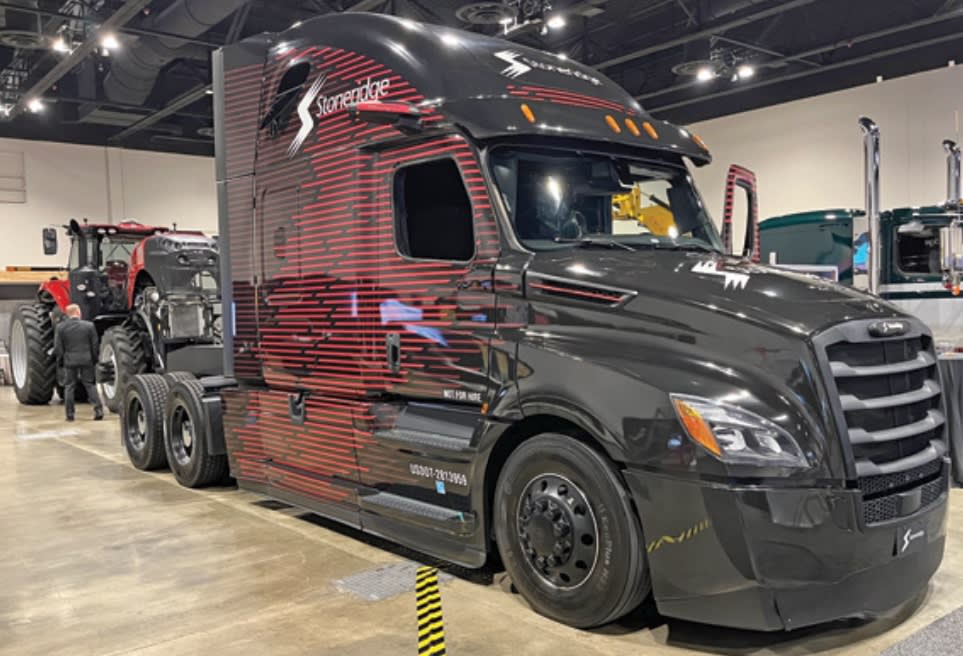
Stoneridge displayed its vision for the future of commercial vehicle technology on the SAE COMVEC 2025 exhibit floor. The Innovation Truck showcases the Tier 1 supplier’s next-generation vision and driver-assistance technologies designed to enhance driver safety and fleet optimization.
Mario Gafencu, product design and evaluation specialist at Stoneridge, gave Truck & Off-Highway Engineering a tech truck walkaround at the event. The first technology Gafencu detailed was the second-generation MirrorEye camera monitor system that’s designed to replace the glass mirrors on the sides of a truck.
“The manufacturers when they build the trucks still must have a glass mirror from production. But then once the truck is sold, the trucking companies are regulated by FMCSA and that’s who we have an exemption with that makes any truck equipped with our camera system, either from aftermarket retrofit or directly from the OEM, 100-percent legal with the side mirrors removed,” he said.
Stoneridge expects by the end of 2025 that every North American truck OEM is going to have a version of MirrorEye to install directly from production. Some OEMs decide to put the cameras in separate wings above the doors like Stoneridge’s aftermarket retrofit system. Other OEMs mount the cameras at the bottom of mirrors that have been modified to be smaller and more aerodynamic.
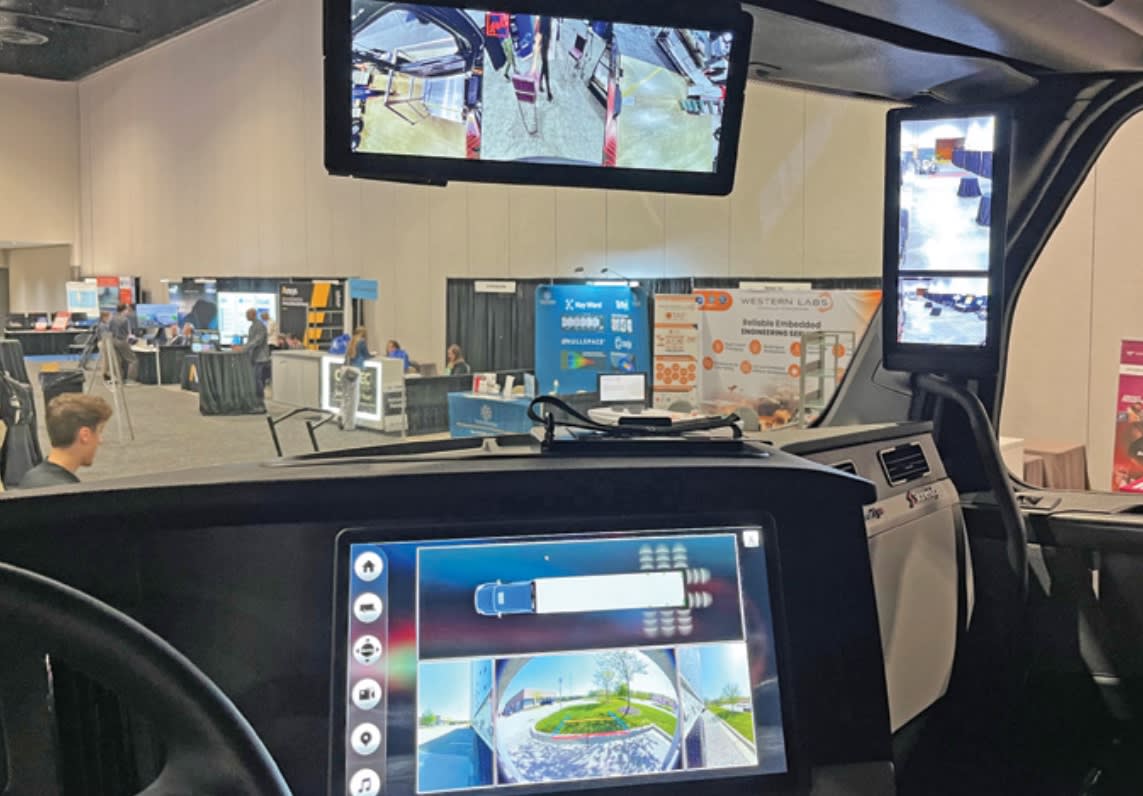
“With our system and the exemption, one of the benefits is when you remove the mirrors, they are quite big and bulky and create a lot of drag on the vehicle,” Gafencu said. “So you’re able to improve aerodynamics, we advertise between 2 and 4 percent.” The “direct-to-driver benefits” are the removal of blind spots that mirrors create and extended visibility with the high-definition cameras and monitor. “You can see double what you can see in the regular glass mirror,” he added.
Stoneridge’s aftermarket retrofit system has five cameras, two on the driver’s side, two on the passenger side, and another on the passenger side looking down toward the steps to eliminate additional blind spots. “The reason why we have five cameras is because of the redundancies built into the system,” he said. “One camera is main, the second one is redundant. If anything happens to the first camera, the system flips to the secondary camera to provide the driver with the same view.”
All the OEM setups using Stoneridge’s vision system only have a single camera on both the driver and passenger sides. “Some of the OEMs did opt for and are providing a look-down camera on the right side to eliminate the blind spots; some don’t, it just depends on what the customer specced and what they want,” Gafencu said.
The regulations in Europe already allow digital mirrors from the factory. “As a matter of fact, right now the camera monitor system is default,” he said. “If you want the glass mirror, you have to order it special and pay extra, because all the OEMs are going to digital mirrors.”
Stoneridge helped to set some of the standards in the European markets, Gafencu said, and it’s working to help establish new standards for North America. “This is proven technology,” he said.
Seeing inside the cab
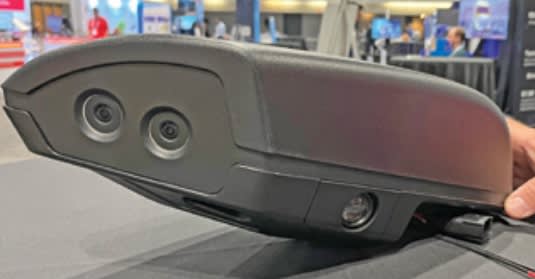
In the cab of the Innovation Truck are monitors on the driver’s side, the passenger side and a 7-inch monitor on a RAM mount for the look-down camera that usually gets positioned in the middle of the instrument panel to not interfere with any other safety systems in the truck.
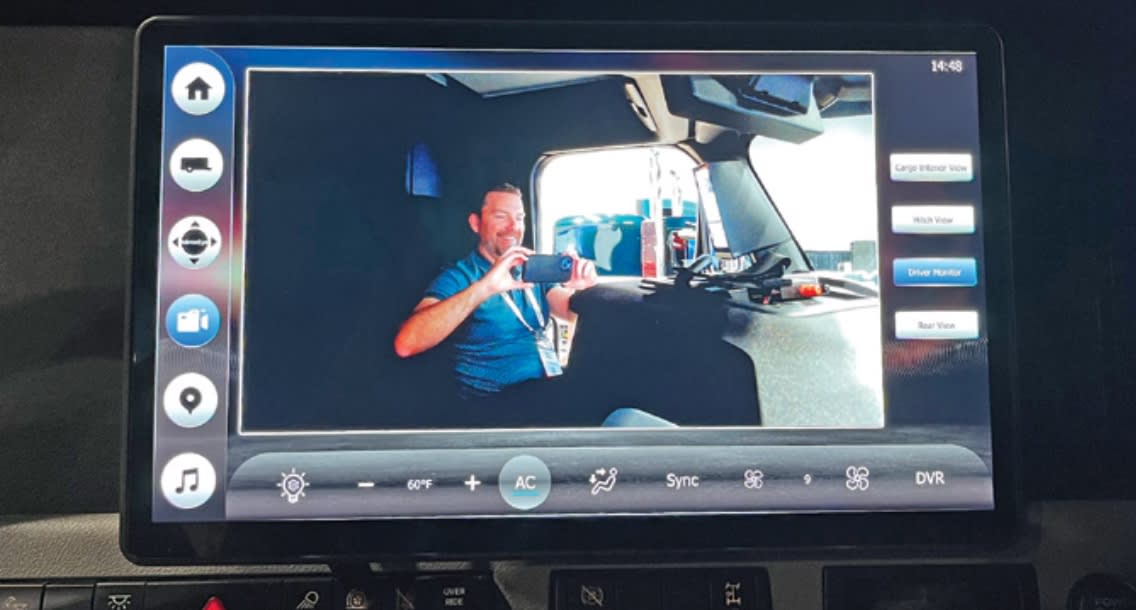
Stoneridge’s truck also showcases a large display in the dash. “It’s our first prototype of a secondary information display to show the OEMs that you can integrate almost everything — your radio, HVAC, switches, your information display, GPS, telematics, your dispatching software,” Gafencu said.
“What we kept hearing from everybody is, ‘We want to have a single supplier for all of our camera needs in and outside of the vehicle.’ That’s why we created this truck,” he added. “So we’ve actually mounted a camera in this [passenger side] monitor to provide driver monitoring to the company.”
The MirrorEye monitor mimics the views of a regular mirror. It provides a flat view at the top and wide-angle view at the bottom. “But because it’s a digital system, we can do certain things that the regular mirror cannot do,” Gafencu said. “One thing we can do is provide the driver with situational awareness lines. The red line indicates where the end of the trailer is, yellow is going to be about 75 feet behind the trailer, and the green one is about 150 feet behind the trailer. So the driver can quickly see how far or close the vehicles are, if it’s safe to change lanes depending on what they’re trying to maneuver around.” The lines are adjustable to accommodate different trailers or loads if necessary.
The MirrorEye system is hooked up to the CAN bus of the vehicle. “We are passively listening and take inputs to use in our algorithms to be able to pan this image to where it maintains the visibility at the end of the trailer as the driver is maneuvering through a turn,” Gafencu explained. The driver can also manually adjust the image. “With our aftermarket system, this controller gets mounted into the cab. With OEM systems, this controller no longer exists because it’s integrated into the door control module and with buttons on the driver’s side monitor, or possibly a small menu into the secondary information display as well.”
A zoom feature is only available on Stoneridge’s aftermarket system, which allows the driver to toggle between regular views and zoom view as necessary. None of the OEM systems currently implement this function. The system also records and loads video to a cloud-based web portal where safety managers can retrieve videos off the truck to use in accident investigations, for example, or to coach the driver.
Two other innovations demonstrated in Stoneridge’s truck are 360-degree visibility and Connected Trailer, an “industry first” hardwired connectivity solution that enables tractor and trailer data transmission, including video, through the existing vehicle architecture.
Six cameras would be used to offer mirror replacement and a 360-degree view of the truck. “Those views may not be necessarily provided to the driver, but everybody wants all these cameras recorded in case of an accident, exoneration and whatnot,” Gafencu said.
For Connected Trailer, no cables are added to the truck. “We’re able to do that by superimposing a wide bandwidth of data over the existing power lines,” he said. “And the biggest thing is we have not modified the seven-pin [SAE] J560 connector. You start changing that to a 12-pin, to a 15-pin, and there’s going to be an issue at some point when they get damaged in the field.”
Stoneridge’s demo trailer is equipped with four cameras and technologies like tire pressure monitoring and smart lights. “We can transfer all that data to the cab. So if a light goes out, this box turns red and it’ll notify the driver,” he said. Stoneridge plans to offer a Connected Trailer package, with one camera and a separate monitor, by the end of 2025.
Camera-based object detection coming
The MirrorEye camera monitor system is not tied to any ADAS features a truck may offer to assist in active safety measures. “The system does not tell the truck to do anything right now at the moment,” Gafencu said. “You notice on our [Innovation] Truck the red boxes that keep popping up [on the monitors]. We are working on other features for the future to be able to introduce camera-based object detection. Like there, it just picked up that guy coming around the left,” he pointed out while sitting in the cab.
A red box indicates a pedestrian, and a yellow box signifies vehicles. “As of right now, this is the only truck in the world that can do this,” he claimed. “We are working to finalize the features. Right now, we’re working to be able to detect VRU, which is vulnerable road user — pedestrians, bicyclists, wheelchairs — and then non-VRU, which would be your motorcycles and all the motor vehicles on the road.”
Trucks that have radars outfitted from the factory for blind spot detection can be tied to the Stoneridge monitor. For example, the new fifth-generation Freightliner Cascadia has five radars around the front and sides, according to Gafencu. “If those radars pick up a pedestrian within that blind spot around the truck, we display an icon on the monitor to alert the driver where the pedestrian is, left or right,” he said. “But that’s the radars doing the work, not our cameras on that system.”
“With what we’re doing with camera vision-based object detection, we are working towards being able to provide that input to the OEM and then they can integrate it with the rest of the ADAS systems within the truck to help the driver and help the vehicle maintain its lane or possibly not allow the driver to change lanes, if we pick up there’s a vehicle next to it,” Gafencu said. “But that’s still a few years out. Depending on the demand and the OEM requirements, it may be coming sooner than later. It all depends on the interest and the demand that the industry creates.”
More From SAE Media Group
Off-Highway Engineering
Sensing Changes in Autonomous Trucks
Off-Highway Engineering
Digital Tech a Las Vegas Headliner
Automotive Engineering
Mobileye Ready to Meet FMVSS 127 with Vision-Only System
Off-Highway Engineering
New Mercedes-Benz Actros Loaded with ADAS, Active Safety Tech
Off-Highway Engineering
Uhnder and Spartan to Partner on Hi-rez Radar
Photonics & Imaging Technology
Add LiDAR to ADAS for Pedestrian Safety
Off-Highway Engineering
Cloud Simulation Assists Active-Safety Development for Electric Refuse Truck
Off-Highway Engineering
Autonomous Quarry Haulage in High Demand
Automotive Engineering
The Future of “Core” Vehicle Systems
Tech Briefs
Is LiDAR Necessary for Autonomous Vehicles?
Automotive Engineering
Riding Along With Mercedes and Its in-city Driver Assistance System
Off-Highway Engineering
Freightliner’s Medium-Duty Makeover
Off-Highway Engineering
SuperTruck REDUX
Autonomous Vehicle Engineering
GM Announces Door-To-Door Ultra Cruise ADAS
Automotive Engineering
Sensitive Subjects
Tech Briefs
How Mercedes and NVIDIA Handle City Driving
Off-Highway Engineering
Automating Machines for Off-Highway Environs Is Simple, Yet Difficult

Autonomous Vehicle Engineering
Ensuring No Child Left Inside
Tech Briefs
Life-Saving Changes to HGV Design
Off-Highway Engineering
ZF Advancing ADAS, Autonomy with Next-Gen Sensors
Off-Highway Engineering
ZM Trucks Starts Production in Fontana, California
Automotive Engineering
Valeo Debuts New Lidars, EV Tech at CES 2022
Autonomous Vehicle Engineering
Detecting Pedestrians
Off-Highway Engineering
WABCO Adds Autonomous Driving 'Building Blocks' to 2019 Portfolio
Automotive Engineering
Taking Aim at the Drowsy-driver Threat
Automotive Engineering
IAA 2025: Qualcomm’s Superbrains Are Here to Help With Automated Driving
Automotive Engineering
MAGNA Say Some Hurdles of Seat-reconfiguration System to Be Addressed by OEMs
Autonomous Vehicle Engineering
Hopeful but Closer Scrutiny for SAE Level 4 Automation
Top Stories
INSIDERAerospace
 How Airbus is Using w-DED to 3D Print Larger Titanium Airplane Parts
NewsUnmanned Systems
 Microvision Aquires Luminar, Plans Relationship Restoration, Multi-industry Push
INSIDERWearables
 A Next Generation Helmet System for Navy Pilots
ArticlesUnmanned Systems
 Accelerating Down the Road to Autonomy
INSIDERWeapons Systems
 New Raytheon and Lockheed Martin Agreements Expand Missile Defense Production
ArticlesDesign
 CES 2026: Bosch is Ready to Bring AI to Your (Likely ICE-powered) Vehicle
Webcasts
Electronics & Computers
 Advantages of Smart Power Distribution Unit Design for Automotive...
Unmanned Systems
 Quiet, Please: NVH Improvement Opportunities in the Early Design...
Electronics & Computers
 Cooling a New Generation of Aerospace and Defense Embedded...
Energy
 Battery Abuse Testing: Pushing to Failure
Transportation
 A FREE Two-Day Event Dedicated to Connected Mobility
