




ZM Trucks Starts Production in Fontana, California

To say 2025 has been a bumpy ride for North American electric vehicle OEMs would be an understatement not heard since Jack Swigert informed Houston that Apollo 13 was experiencing a problem. However, despite a tariff tug of war, EPA upheaval and continually changing tax incentives, OEMs are pushing ahead with plans to electrify the commercial truck segment.
In late August, ZM Trucks celebrated the grand opening of its U.S. headquarters and assembly facility in Fontana, California. SAE Media was in attendance for the opening ceremony, which included the U.S. debut of the ZM8 Class 4/5 truck.
“Despite policy uncertainty, we’re charging ahead,” said Joost de Vries, global CEO of ZM Trucks. “Our investment in Fontana demonstrates that commercial EVs are not just viable, they’re a superior solution for urban truck operators, delivering lower costs, higher performance and a smarter path toward total cost of ownership.”
New digs
ZM’s facility in Fontana encompasses 9.67 acres and includes a 210,000-square-foot factory floor. This facility will also serve as the company’s regional headquarters. During the grand opening, ZM’s executives made it clear that while the Trump administration’s policies have directly affected the company’s production plans, they are still serious about gaining a foothold in the North American market.
“In 2023, we had a very different administration than what we have today,” de Vries said. “And that’s okay. Right now, it’s a bit messy. Import duties to change every week. We have a lot of challenges to make sure we understand what our costs are. But for our customers and our suppliers, I can tell you this, we did not invest in this for just 12 months or 24 months. This is a long-term investment, and hopefully in six months, when things come down and we know where we are, we’ll reset ourselves.”
The ZM8 truck is intended to support 12-, 14- and 16-foot box configurations and features dual ePTOs, which allow integration with liftgates, refrigeration units and other auxiliary equipment. The ZM8 is available in both Class 4 and Class 5 configurations. Class 4 versions have a payload capacity of 8,950 pounds (4,060 kg) with an estimated range of 165 miles (265 km). Class 5 versions have a payload capacity of up to 12,450 pounds (5,647 kg), with an estimated range of 150 miles (240 km).
Earlier this year, ZM also unveiled the electric T75 terminal tractor that was designed to meet the requirements of logistics and port operations. While full production has not yet begun at the Fontana facility, ZM made it clear that the factory is already operational. “We currently have more than 60 trucks produced, and we haven’t even turned the big line on,” de Vries said.
Simply light
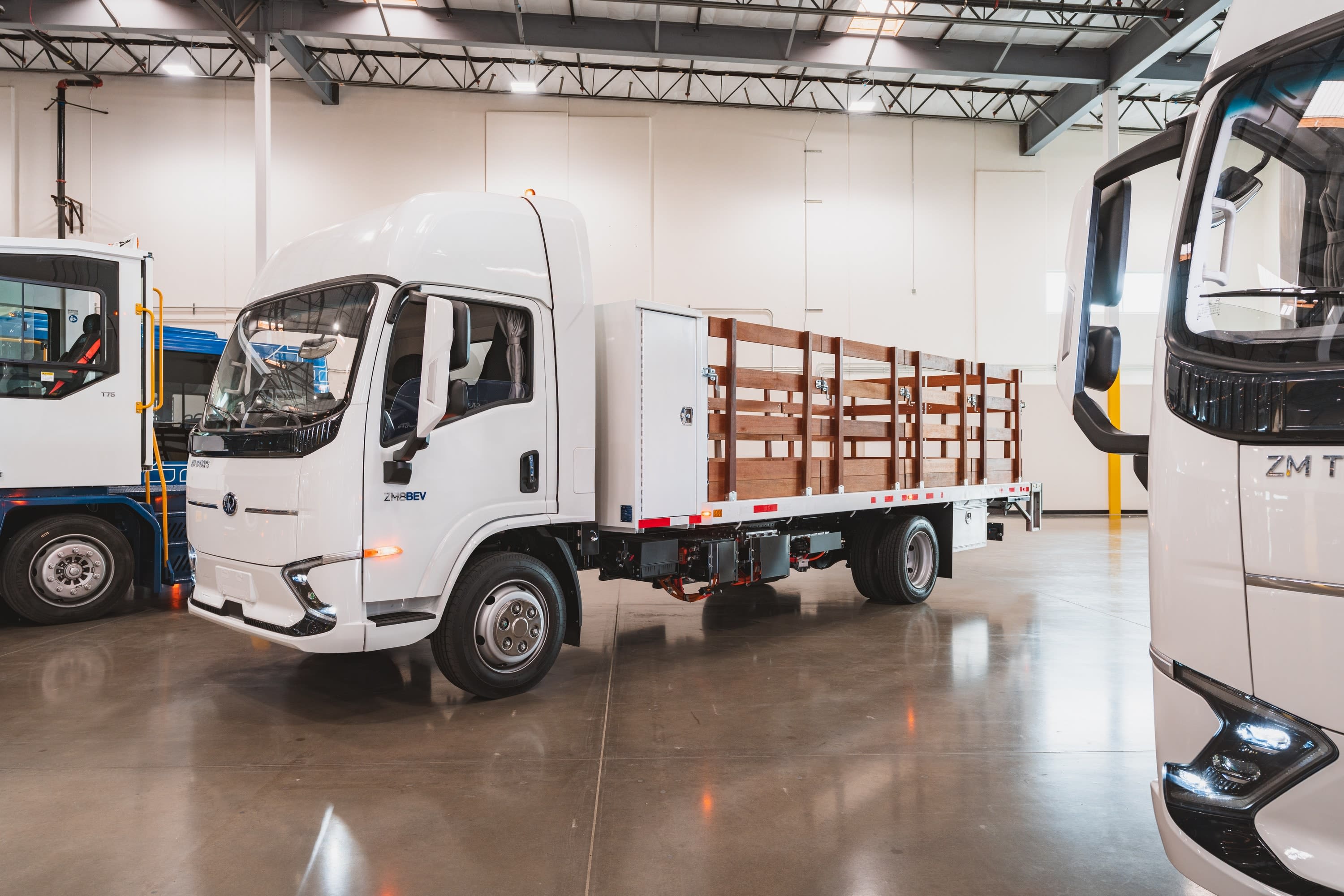
On the surface, the ZM8 chassis looks like a very basic Class 4/5 design with a ladder frame, leaf springs, hydraulic dampers and a live rear axle. But it’s that baked-in simplicity that defines the platform and underscores the overall design goals of the truck.
“What we did was ask ourselves who our prime competitor was in diesel. And from there we decided that our [truck’s] weight cannot be more than a thousand pounds above that,” de Vries explained in an interview with SAE Media. “The reason why we set our target at 1,000 lb is because it’s relatively simple to take that figure out of the upfit. I can get up to 2,000 lb out of the upfit, but then you get really sketchy on how strong the equipment is. But we can get 1,000 lb out relatively easily. It means the payload for the customer is still the same as a diesel truck.”
de Vries detailed how ZM achieved that target figure. “Unlike typical cab/chassis trucks, we have e-axles, so there’s no prop shaft. The battery packs are carbon fiber moldings and we really focused on the integration of electronic components. If you look at earlier generations of electric vehicles, there were a ton of individual components. Today, you’ll see four boxes on one side and one box on the other side. That’s it, and if you look under the cab, there’s nothing there. The cab doesn’t even tilt anymore. By concentrating all these components into bigger blocks, you also take a lot of weight out because the wiring becomes easier,” de Vries explained. “The amount of high-voltage cables that you need to run also becomes less.”
“If you look at how many ECUs were in a Mercedes S-Class 10 years ago, I think it was 167, versus now, everything is software defined. You can cluster so much processing power that it takes a significant amount of weight out. You can also be clever with the consolidation of components and your packaging of the e-motors. That’s another 50-60 pounds you can take out and then on top of that you don’t need as many braces.”
de Vries also explained how ZM lightweighted the chassis of the ZM8 to retain as much payload as possible. “If you look at our chassis, it’s like Swiss cheese. It’s got holes everywhere. And that doesn’t negatively affect its strength. It’s fine. We literally punched [holes in] the frame from front to back. Like most Japanese companies, we believe that reducing weight is everything.”
Succeed through failure
Of course, making a truck light and maximizing payload is only part of the equation. Satisfying the requirements of various abbreviated government agencies is always a challenge for any new player in a market. To that end, ZM leveraged its years of data and modeling to speed up the certification process.
“We have exceedingly rich data models for this type of work,” de Vries said. “If you have enough history and you have enough reference points, you can do an immense amount of engineering work purely digitally to the point where you don’t have to build anything visible. You need to have a lot of data, but since we’re a little bit more mature than some other companies, we had those data points. We saved a ton of time by just living in a digital world, because then you only have to go in the physical world to do the actual test instead of test, fail, test, fail for your supplier, or your prototypes where you must prove yourself right or wrong. So far, we’ve proven ourselves in most cases, right.”
The development of the ZM8 wasn’t all sunshine and rainbows though. de Vries discussed a particular aspect that the engineering team had to revise during the truck’s development, which was keeping the occupants cool.
“We did initially fail on air conditioning. I’ll tell you that honestly. Our models showed us that we had enough capacity, and as it turned out, we didn’t. So we had to make a change there. Since we also sell [trucks] in the Middle East, we found out that the reserve capacity of our cooling system was not as high as what we thought. We made a lot of changes to the cooling capacity for that market as well as North America. Nevada is not the same as Quebec, but by knowing what we did wrong in Dubai, we figured out that we had to expand our thinking on temperature ranges.”
The cooling system for the ZM8 is another example of the simplistic packaging and integration design ZM stuck to when developing the ZM8. “There’s a heater on the right side of the frame and it’s the only box on that side. There are three separate cooling systems in the truck, one for the traction motor, one for the batteries and one for the cab. They’re independent of each other but they’re all combined into a block where we have all the valving and other components.”
Valuable data
One of the challenges electric truck OEMs have had to overcome is the question of residual value. With EV powertrains being an unknown commodity in some markets, the residuals can often be a concern for new customers who are looking to electrify but are unsure of the financial implications. To alleviate those concerns, ZM is pulling the curtain back on the health and SOC of its battery packs for its customers.
“We’re allowing our customers to see the vehicle online with all the DTCs, including state of health in the battery,” de Vries said. “We’re not even hiding state of health. It’s open because we strongly believe that in coming years, residual value on EV trucks will be just like cars based on the state of health of the battery. It’s the most expensive component and so many OEMs are hiding that data from customers.”
“Amazon can tell you exactly what the battery degradation of battery pack A, B or C is from all these manufacturers because they have a big enough fleet, and they’re clever enough to track those things. Joe, the plumber around the corner, doesn’t. By opening all those data elements to a customer, you’re making the transition easier to comprehend. People hide this s*** and I don’t get why, be open about it. It only helps the industry and the residual value of commercial EVs.”
de Vries continued, “When we talk to finance companies like Mitsubishi Capital about residual value, they start to get it. They start asking the right questions like what is your degradation? What is your state of health? How do you measure this? How do you see how the customer uses their truck?”
“What they realize is you can use this data to measure vehicle health just like a diesel one. We have models now tested all the way up to 335,000 miles where we can prove globally, not in a specific environment, that we have less than 15% degradation over that mileage. Once you’re at that mileage, you’re talking about a 10-year-old truck which is on its third customer already.”
In their wheelhouse
ZM also didn’t muck about trying to create their own components for the ZM8 that it could just source from other suppliers. “We spend zero in-house time or money developing components that we could source from outside suppliers. That is a complete waste of money and time,” de Vries said. “We are the world’s best integrators. Bosch makes a fantastic motor, and we are really good at integrating. So we took the highest volume component we could possibly buy in the market and mated it to our chassis.”
“This is a truck that is not allowed to fail. It’s not a car; it needs to make money. It needs to go from A to B every day, so we take very high-volume components, integrate that into the frame, and we’re good at software. We’re good at integration, but we will never develop our own battery. We will never develop our own motor or power distribution module. We stick with what we know.”
More From SAE Media Group
Off-Highway Engineering
REE Unveils P7-C Chassis Cab at ACT Expo
Automotive Engineering
LEAF Turns to the 2020s
Off-Highway Engineering
Prodrive, Volta Trucks Develop Electric Truck for Urban Driving
Automotive Engineering
Engineering ‘Electron Guzzlers’
Automotive Engineering
Suppliers Struggling to Keep Pace with Faster Product Cycles, Says IHS
Off-Highway Engineering
ACT Expo 2022: Production ECascadia Ready for 230 Miles of ‘Typical Range’
Off-Highway Engineering
Kia Takes Aim at Commercial Vans with PBV Concepts
Battery & Electrification Technology
Ultracapacitor Solutions to Address Energy-Storage Needs of Vehicles
Automotive Engineering
Electrifying ‘The Ultimate Driving Machine’
Off-Highway Engineering
ZF Premieres AxTrax 2 Electric Axle Platform at ACT Expo
Off-Highway Engineering
Nikola Producing Battery-Electric Trucks, Fuel-Cell EVs Coming
Off-Highway Engineering
Freightliner’s Medium-Duty Makeover
Off-Highway Engineering
Western Star Adds ‘Weight Sensitive’ 47X to Vocational Lineup
Automotive Engineering
Packaging Honda’s all-new Insight
Off-Highway Engineering
EV Startup Prepares to Enter Commercial Market with Novel EAxle
Tech Briefs
Making EVs Accessible for All
Automotive Engineering
Time with the Teardown Titan
Automotive Engineering
Toyota Stretches SUV Line-Up with World Debut of Grand Highlander
Automotive Engineering
Pickup Shocker!
Off-Highway Engineering
AxleTech Develops Electric Independent Suspension Concept for Vehicles Up to 58,000-lb GCWR
Automotive Engineering
Ford Shifts to Vehicle Architectures
Off-Highway Engineering
ACT Expo 2022 Roundup: Bollinger, Hyundai and Volvo Clean-Vehicle Updates
Automotive Engineering
Tension and the Electric Takeover

Automotive Engineering
Climate Control Engineers Face New CAFE Test
Off-Highway Engineering
Cat 745 Articulated Truck Boasts Next-Gen Cab, New Machine-Control Features
Off-Highway Engineering
SuperTruck REDUX
Off-Highway Engineering
Volvo CE Previews ConExpo 2023 Display
Automotive Engineering
2019 Audi E-tron Quattro
Automotive Engineering
Inside Honda’s New Two-motor 50-mpg Accord Hybrid
Top Stories
INSIDERManufacturing & Prototyping
 How Airbus is Using w-DED to 3D Print Larger Titanium Airplane Parts
INSIDERManned Systems
 FAA to Replace Aging Network of Ground-Based Radars
NewsTransportation
 CES 2026: Bosch is Ready to Bring AI to Your (Likely ICE-powered) Vehicle
NewsSoftware
 Accelerating Down the Road to Autonomy
EditorialDesign
 DarkSky One Wants to Make the World a Darker Place
INSIDERMaterials
 Can This Self-Healing Composite Make Airplane and Spacecraft Components Last...
Webcasts
Defense
 How Sift's Unified Observability Platform Accelerates Drone Innovation
Automotive
 E/E Architecture Redefined: Building Smarter, Safer, and Scalable...
Power
 Hydrogen Engines Are Heating Up for Heavy Duty
Electronics & Computers
 Advantages of Smart Power Distribution Unit Design for Automotive...
Unmanned Systems
 Quiet, Please: NVH Improvement Opportunities in the Early Design...
