




IAA 2025: Qualcomm’s Superbrains Are Here to Help With Automated Driving
The long-awaited Snapdragon Ride Pilot will debut in the 2026 BMW iX3.
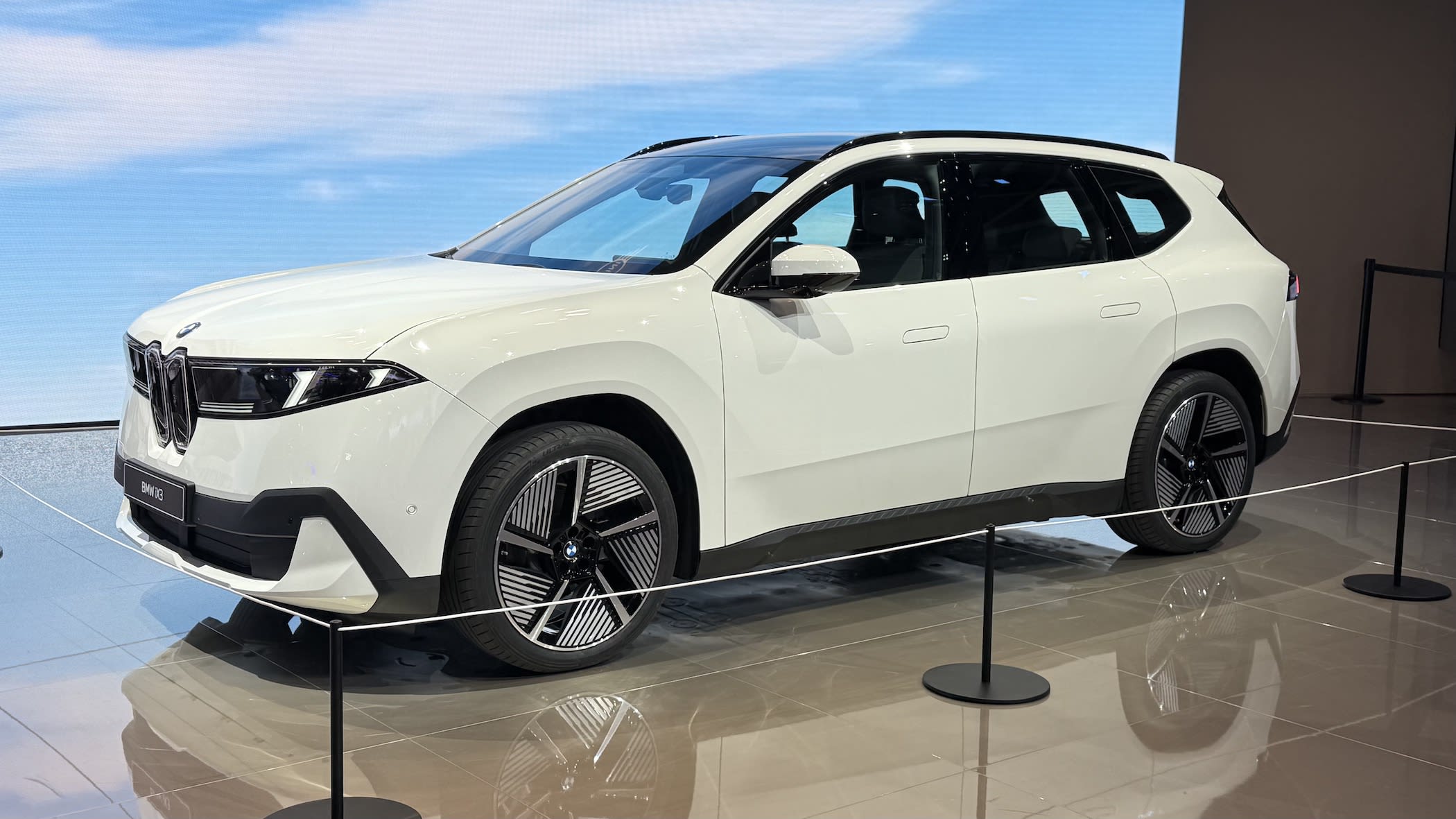
One of the biggest splashes at IAA Mobility 2025 in Munich was the debut of the technology-packed iX3, the first of the BMW Neue Klasse line. Inside its shapely contours lie four Superbrains, including the Heart of Joy. These units represent the hometown OEM’s big bet on zonal architecture – and on Qualcomm Technologies, Inc. as a co-development partner.
That’s because Qualcomm co-developed the Snapdragon Ride AD software stack in the Heart of Joy, which uses Qualcomm’s Snapdragon Ride Pilot automated driving system, with BMW. The version of Ride Pilot that made its global debut in the iX3 uses a newly developed Snapdragon Ride AD software stack that runs on the Snapdragon Ride Platform.
The way Ride Pilot was developed and certified means it will be available to automakers in over 100 countries by next year. The AD software’s perception system can scale from one to a dozen or more cameras and multiple radar and as many lidar sensors as needed to provide an OEM with everything from basic assisted driving features to more complex functionality expected in, say, an upscale vehicle with Bavarian roots.
Anshuman Saxena, Qualcomm vice president of Product Management, said Qualcomm started working with BMW a little over three years ago, first by delivering SOC platforms and soon turning the conversation to what Qualcomm could offer in the way of compute platforms and a vision perception stack. BMW and Qualcomm formed a partnership with Arriver to develop the stack.
“It became evident that to ensure that we really deploy these things and that there is a very close correlation of hardware and software design, it was becoming evident that we had to have Arriver under the same roof,” Saxena told SAE Media at IAA. Qualcomm acquired Arriver Business from SSW Partners in April 2022.
“That was our aspiration, to become a really relevant player in the AD/ADAS space, to deliver a full end-to-end system, versus just doing the hardware platforms, which we do with multiple automakers already,” Saxena said.
It’s not like Qualcomm is putting Ride Pilot’s future into just one kidney-shaped basket. The co-development deal allows any automaker to create its own version of Ride Pilot as a way to bring ADAS features to its own vehicles.
Co-developed with BMW, available to all
Ride Pilot will be available to other OEMs, just not in the way BMW uses it. The Ride SOC core compute platforms, the set of SOCs that go into different variants of the vehicle, and the vision perception stack, which runs on the Ride SOC, are all available. What other OEMs can’t access is how BMW integrates Ride Pilot into its vehicles, which includes customer functions and localizations driven by the Heart of Joy. For the Neue Klasse, BMW and Qualcomm are jointly working to define the interfaces that would also remain off-limits. Still, some of the work that BMW has done here will be available to other OEMs.
“BMW is building it as a generic software product, along with Qualcomm,” Saxena said. “As part of the development, all the IP that is being developed is co-owned by BMW and by Qualcomm. So they have the right to put it in their vehicles on the Qualcomm SOCs, and we have the right to take the whole system as a Ride Pilot system, adapt it and implement it into other automakers.”
The partnership involved over 1,400 engineers working on three different continents, and it wasn’t just BMW and Qualcomm pulling this together. The two companies had a variety of partners, including Valeo, about which more below, and AWS for hyperscaling and a variety of partners for sensors, data collection, and annotation. The global effort included collecting rich vehicle and sensor data from over a million kilometers and getting validated in 60 countries (this will expand to over 100 by the end of 2026). The data cycle of collecting information and using AI to improve the underlying stack is what Qualcomm calls a data flywheel.
“We keep collecting data, we keep improving. Most importantly, we are improving it at global scale,” said Nakul Duggal, group general manager for Automotive and Industrial & Embedded IoT at Qualcomm, at IAA. “All of this culminates in what we call the Snapdragon Ride Pilot.”
Qualcomm’s data simulation factory takes the vehicle fleet information and then evaluates and refines the system’s machine learning models. This then improves the driver assistance system’s capability to detect objects. Qualcomm said the data simulation factory’s bit-accurate reprocessing allows new features to be developed in the cloud and then deployed in the vehicle.
Integration help from Valeo
As mentioned, Qualcomm is preparing an ecosystem that will make it possible for other OEMs to get Ride Pilot into their vehicles by working with Valeo. This means that Valeo, which is also a Tier 1 supplier to BMW, will become a Ride Pilot system integrator.
“Think about it,” Saxena said. “This Ride Pilot system is proven inside a BMW. I take it to OEM A and OEM B. Not everybody understands the complexity of integrating. They have been relying on traditional Tier 1s or software houses, right? They might not understand.”
Saxena said an OEM where the software development team and the integration team aren’t tied together as closely as they are at BMW might also have difficulties integrating Ride Pilot, which is why verified partners are vital.
“That's how this whole ecosystem has to grow, because the next automaker, otherwise, is gonna struggle,” he said. “How do I put it in the car? How do I validate it? Qualcomm has the know-how. Qualcomm plus Valeo will have the know-how with this strategic partnership.”
UN Regulation No. 171? Covered
One tangible benefit of this cooperation is that the iX3 will be the first vehicle to earn the new UN Regulation No. 171 Driver Control Assistance Systems (DCAS) certification. This regulation, which came into effect in September 2024, approves DCAS (as part of ADAS) under four areas. To obey all traffic rules, to avoid driver distraction, to ensure and prove vehicle controllability and, fourth, to ensure that the system can reproduce its behavior.
“This is an issue if you have a kind of data-driven, AI approach only,” said BMW Group’s senior vice president of Driving Experience, Mihiar Ayoubi at IAA. “It’s a black box. You can’t ensure that the system would react in the same way again. This is the reason why we agreed on having a hybrid stack, combining the cutting-edge and the benefits of data-driven systems with physical implementation and modeling, giving a kind of white box programming to the stack.”
“Safety means you have to be able to convince the regulator that you have traceability for every single possible scenario,” Qualcomm’s Duggal said. “These are complicated regulatory requirements, and this is something that we are very proud that we were able to pull together in this very short period of time.”
More From SAE Media Group
Autonomous Vehicle Engineering
ADAS Computing on a Greater Scale

Autonomous Vehicle Engineering
Rewriting the Code
Autonomous Vehicle Engineering
Making Data Logging, Replay, and Prototyping More Efficient
Automotive Engineering
CES 2026: Qualcomm Expands Partnerships For More Snapdragons
Autonomous Vehicle Engineering
Phone Alliance’s Standard Targets Automotive Sensors
Automotive Engineering
Fusing Sensors for the Automated-Driving Future
Autonomous Vehicle Engineering
An Holistic Approach to Verifying Cybersecurity in Design
Automotive Engineering
Accelerating Down the Road to Autonomy
Autonomous Vehicle Engineering
Nvidia’s ‘Kitchen Sink’ for AV Testing
Autonomous Vehicle Engineering
ZF Establishes Level 2+ ADAS
Automotive Engineering
DSpace Launches Simphera AV Development Simulator
Photonics & Imaging Technology
Total Versatility: Flexible Test Station With a Cobot and Camera
Off-Highway Engineering
Commercial Vehicle ADAS: Testing, Testing and More Testing
Automotive Engineering
Snapdragon Ride Flex Puts Safety, Infotainment onto Single Chip
Automotive Engineering
Autonomy and Operating Systems
Tech Briefs
Vehicle Design with System-Level Modeling

Automotive Engineering
Nvidia Partners with AdaCore to Secure Self-Driving Firmware

ADAS & Autonomous Vehicle Engineering
Mercedes-Benz Architecting Its Own Operating System
Off-Highway Engineering
Design Tools Ensure Component Compatibility, Create Autonomous Driving Tests


Sensor Technology
The Industrial Nervous System: IIoT and PLCs
Automotive Engineering
NXP S32 CoreRide Platform Simplifies Development of Software-Defined Vehicles
Tech Briefs
SAE WCX™ Digital Summit Preview
Automotive Engineering
Engineering at the Crossroads

Top Stories
INSIDERManufacturing & Prototyping
 How Airbus is Using w-DED to 3D Print Larger Titanium Airplane Parts
INSIDERManned Systems
 FAA to Replace Aging Network of Ground-Based Radars
NewsTransportation
 CES 2026: Bosch is Ready to Bring AI to Your (Likely ICE-powered) Vehicle
NewsSoftware
 Accelerating Down the Road to Autonomy
EditorialDesign
 DarkSky One Wants to Make the World a Darker Place
INSIDERMaterials
 Can This Self-Healing Composite Make Airplane and Spacecraft Components Last...
Webcasts
Defense
 How Sift's Unified Observability Platform Accelerates Drone Innovation
Automotive
 E/E Architecture Redefined: Building Smarter, Safer, and Scalable...
Power
 Hydrogen Engines Are Heating Up for Heavy Duty
Electronics & Computers
 Advantages of Smart Power Distribution Unit Design for Automotive...
Unmanned Systems
 Quiet, Please: NVH Improvement Opportunities in the Early Design...
