




Autonomous Quarry Haulage in High Demand
Komatsu works with Pronto to upfit a growing fleet of haul trucks operating at Komatsu’s Arizona Proving Grounds and customer sites.

At Komatsu’s Quarry Days 2025 event at its Arizona Proving Grounds (AZPG) outside of Tucson, dealers, customers and media got the opportunity to operate Komatsu mining and construction equipment, learn about its latest technology innovations and talk to product experts.

A highlight of the event was the first public demonstration of Komatsu’s HD605-10 haul truck outfitted with Pronto’s Autonomous Haulage System (AHS), spotlighting the equipment maker’s partnership with the AI tech startup to pilot autonomous quarry haulage operations. Several HD605-10 trucks have been equipped with AHS as part of this program currently being tested by quarry operators in Texas. The AZPG site currently has just the one automated truck.
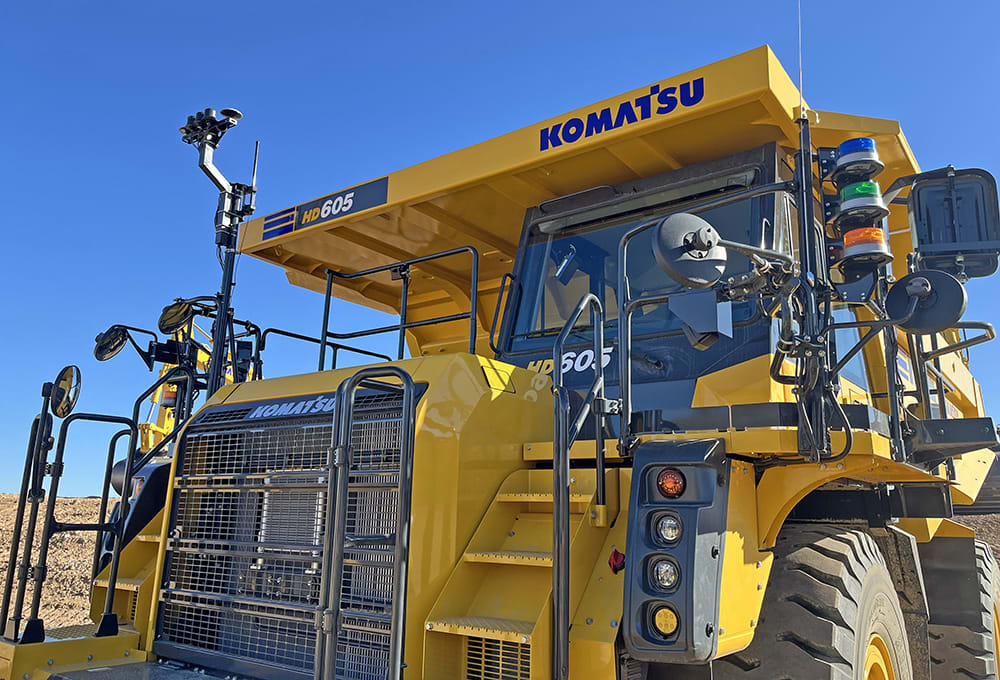
The standard HD605-10 was featured at MinExpo in September 2024. The new 70-ton rigid frame machine is engineered with 5.5% more horsepower, 12% higher peak torque and a higher-tensile steel body to reduce operating weight and increase payload. The truck is said to be up to 8% more productive when hauling loaded uphill compared to the HD605-8. It is available with Smart Quarry Site, a fleet management solution that offers remote jobsite monitoring and machine performance data.
“The scope of our work with Pronto is Komatsu North America serving quarry aggregate customers on the HD and HM lines,” Mark Anderson, autonomy manager at Komatsu North America, said at the Quarry Days event. “Currently we have the HD605-7, -8 and -10 integrated. We’re releasing the HD785 later this year and hope to release the HM400 later this year as well.”
Komatsu launched its FrontRunner autonomous system more than 17 years ago for mining operations, and it has over a billion tons moved, according to Anderson. “We’re excited to build on this history with Pronto and to extend our autonomous offering from electric-drive trucks to the HD rigid body and HM articulated trucks.”
“A key feature of the Pronto system is that there’s dynamic dumping and loading locations,” Anderson said. “In a mine, you progress through a bench or a dump throughout the day and it does not work if you’re going to a fixed point. So Pronto’s done a lot of work around this and utilizes its dynamic zones to have the truck find its own path to deliver dirt to where it needs to go.”
The truck can also reverse park autonomously, a “trick” that Pronto demonstrated at AZPG. Blue lights have been added to illuminate when the truck is in autonomous operation mode; green lights mean the truck is being manually operated. A switch inside the cab can turn the system off, and there’s also a lockout/tagout in the cab and down below.
How it all works

The HD605-10 with Pronto AHS looks similar to the standard model, a notable modification being the mast added to the front for the LTE and GPS to allow the truck to communicate across the network as it’s navigating the quarry. Vehicles are connected through network stations – supplied by Pronto’s subsidiary Pollen Mobile – that Pronto installs on-site. The system communicates outside of the sites typically through Starlink satellite connectivity or the wireless network available onsite.
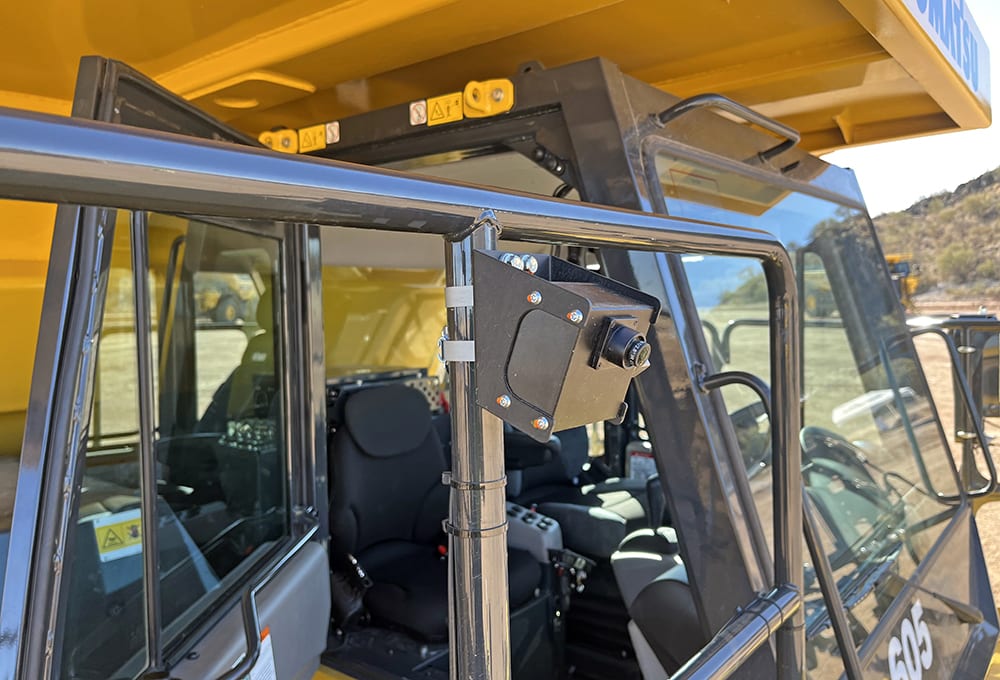
“For the technology stack, we use for navigation a small number of sensors, GPS, RTK [real-time kinematic positioning] and we have two cameras – one on the front of the vehicle and one on the back,” Martijn Hoppenbrouwers, VP of operations and customer success at Pronto, said during an autonomous demonstration at AZPG. “There is no lidar. There is no radar. Reasons to keep it simple is it allows us to be nimble and go to a variety of sizes very quickly. It also makes us a very economical solution for customers.”

Only two cameras on such a large vehicle may seem insufficient, but Anders Klemmer, VP of business development at Pronto, assured the setup is effective. “Cameras with the advent and acceleration of artificial intelligence have really proven themselves to be more than adequate for quarry operations in all sorts of conditions,” he told SAE Media at AZPG. The boxes support up to eight cameras, he noted, “but for these trucks we have not seen a need to add any additional.”
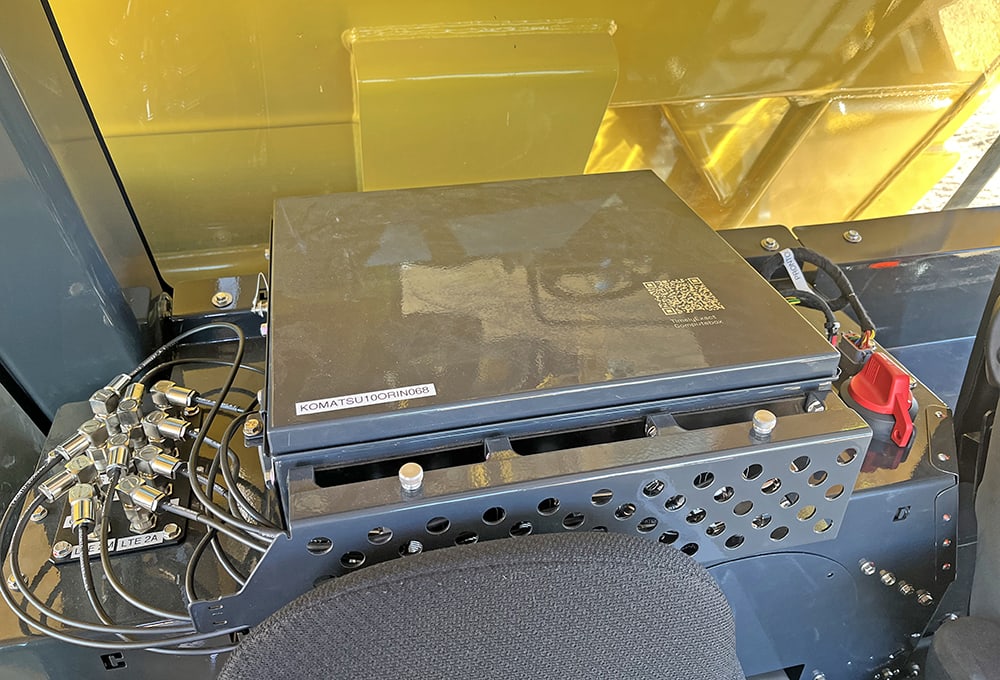
The brains of the truck – the CPU/GPU compute box – is mounted behind the jump seat in the cab. It processes all the data for the artificial intelligence that assists the truck with obstacle detection. Nvidia provides the AI chip. “Decision-making is made here in the truck,” Hoppenbrouwers said.
The automated HD605-10 operates via a retrofit drive-by-wire system that connects to OEM electronically controlled sensors on the truck, including braking, accelerator, parking brake, retarder, horn and blinkers. There’s added hardware for steering.
The drive-by-wire system is Pronto’s “bread and butter,” Klemmer said. “The CPU/GPU connects into the bulkhead bringing the messages to the CAN bus for the throttle, braking, all the instrumentation, horn, lights, and bin raising. Certain circuitry is customized to match the CAN bus of the actual truck that the compute box is installed on, to make sure that we’re capturing everything,” he explained. “The only mechanical interception we do is with the steering kit. We add a motor that connects down to the steering kit, a bar that has a linear encoder on it that measures the exact steering angle. There’s one on each wheel.”

Redundancy is key to the system. “Critical components like the steering would have triple redundancy, and other things have double redundancy in terms of battery backup within compute boxes, for example,” Klemmer said. The communications network is also redundant. “Here we have the Starlink and the LT network running. And the cameras, for instance, if you ran into an issue where their health was deteriorating and they got to a point where the system says this is no longer safe, it will stop the truck. But before that even happens, it’s messaging the fleet management system and the operator to come out and wipe them down with a micro cloth and resume operations.” He noted that they’ve been running full shifts in dusty quarries without the need to wipe the cameras even once.
Everything on the customer side can be controlled by a keypad that is installed in the cab, or through a fleet management interface that runs on a tablet or laptop, Hoppenbrouwers said. “We do not require or have a control room where people have to manage this continuously. The system runs itself unless the machine actively asks for help.”
The automated trucks interact with other vehicles – water trucks, motor graders, supervisor trucks, for example – that are not automated and must do so safely. “So, every vehicle will have a rover installed, which just tells our system that this is an approved vehicle,” Hoppenbrouwers said. “When our truck sees an approved vehicle, it knows that it can keep operating, as opposed to an unauthorized vehicle on site where our system would come to a safe stop.”
The system is designed to be managed by a single operator that can be in the supervisor truck, for example, and control the fleet and respond to any situations that emerge. For example, if the automated truck sees something in the road that it doesn’t expect, like a big rock, the truck will automatically stop and signal the supervisor, who can check the cameras or drive up to the vehicle and respond appropriately.
Upfitting, training and operating

The Pronto system is OEM, vehicle and application agnostic, so it can be used in mixed fleets. It takes about two days to upfit an HD605-10 truck with the Pronto hardware, Klemmer said. “Then there’s a period of commissioning the truck and testing it, which is generally three to five days after that. And then the period of actually operating the truck to get it burned in and teach it all the cycles,” he said.
Pronto’s technology is in production, operating in the U.S. and globally. One customer that can be named is Heidelberg Materials at its Lake Bridgeport, Texas quarry, which is running five AHS-equipped HD605-8 haul trucks combined with Komatsu’s Smart Quarry technologies. That number soon will be seven, Hoppenbrouwers said. “That’s a good size operation for us.”
“There’s been demand for autonomy in quarries,” Anderson said, commenting on Komatsu North America’s working relationship with Pronto. “The clearest path for us is to enable great technology like Pronto. So, we’re enabling them to have all the information they need to succeed on these trucks, and we hope that [results in] a better solution and it’s a faster process to automate [our vehicles].”
At the AZPG site near Tucson, the plan is to automate more haul trucks and have demos with multiple AHS-outfitted vehicles by the end of 2025. “It will be three trucks – we’ll have a truck in queue, a truck getting loaded and we’ll have a truck on full haul or dumping, all at the same time,” Anderson said. “There’s a lot more to come here.”
More From SAE Media Group
Autonomous Vehicle Engineering
Platform-Agnostic Interface Aims to Accelerate Truck Autonomy
Off-Highway Engineering
ZF Premieres AxTrax 2 Electric Axle Platform at ACT Expo
Aerospace & Defense Tech Briefs
The CAN Bus: Driving the Future of Autonomous Military Vehicles
Sensor Technology
The Sensing Systems That Make ADAS Work
Photonics & Imaging Technology
Text Tech: Navy Vessels Use Shipboard Signal Lamps for Text Messaging

Off-Highway Engineering
Over-The-Air Affair
Automotive Engineering
Nvidia Partners with AdaCore to Secure Self-Driving Firmware
Autonomous Vehicle Engineering
StreetDrone: Rolling R&D Vehicle for Small-Scale AV Developers
Off-Highway Engineering
Digitalizing Off-Highway Machines Delivers Actionable Data
Autonomous Vehicle Engineering
Far and Away: Remote Drivers Monitor Autonomous Vehicles
Off-Highway Engineering
Data Connectivity in Heavy-Duty Vehicle Environments
Off-Highway Engineering
Yanmar CE Adds to Growing Compact Track Loader Segment
Off-Highway Engineering
Sensing Changes in Autonomous Trucks
Off-Highway Engineering
Rexroth Takes Aim at Electrification for Off-Highway Vehicles
Off-Highway Engineering
Securing CAN Networks in Commercial Vehicles
Sensor Technology
Driverless Forklifts
Off-Highway Engineering
Caterpillar Reveals Seven New Next-Gen Excavators, Increases Push for Remote Control

Off-Highway Engineering
Big Data and Next-Gen Prognostics for Heavy-Duty Vehicles
Sensor Technology
Next-Generation MEMS IMUs — High Performance, Scalable
Autonomous Vehicle Engineering
The Building Blocks of Autonomous Tech
Off-Highway Engineering
Stoneridge Innovation Truck Envisions a Digital-vision Future
Off-Highway Engineering
Peloton Develops a Level 4 Automated Platooning System, but Keeps the Driver in Charge
Off-Highway Engineering
CES 2025: Deere Advances Off-Highway Autonomy
Off-Highway Engineering
Electrification’s Impact on Commercial-Vehicle Chassis Design
Off-Highway Engineering
‘Electronification’ of Working Hydraulics in Compact Machines
Off-Highway Engineering
Shifting Design of Autonomous Architectures
Sensor Technology
RTK and Sensor Fusion for Autonomous Vehicle Navigation & Guidance
Top Stories
NewsSensors/Data Acquisition
 Microvision Aquires Luminar, Plans Relationship Restoration, Multi-industry Push
INSIDERRF & Microwave Electronics
 A Next Generation Helmet System for Navy Pilots
INSIDERWeapons Systems
 New Raytheon and Lockheed Martin Agreements Expand Missile Defense Production
NewsAutomotive
 Ford Announces 48-Volt Architecture for Future Electric Truck
INSIDERAerospace
 Active Strake System Cuts Cruise Drag, Boosts Flight Efficiency
ArticlesTransportation

Webcasts
Aerospace
 Cooling a New Generation of Aerospace and Defense Embedded...
Energy
 Battery Abuse Testing: Pushing to Failure
Power
 A FREE Two-Day Event Dedicated to Connected Mobility
Automotive
 Quiet, Please: NVH Improvement Opportunities in the Early Design Cycle
Electronics & Computers
 Advantages of Smart Power Distribution Unit Design for Automotive &...
Unmanned Systems
 Sesame Solar's Nanogrid Tech Promises Major Gains in Drone Endurance