




FEV Simplifies Off-Highway Electrification
FEV has a solution to downsize and reduce the complexity of off-highway machines via its electrified planetary gearset architecture.
IVT Expo 2025 in Chicago featured a summit where industry professionals presented and discussed the nuts and bolts of the technology that powers the off-highway vehicle industry. Electrification continues to be a centerpiece of these discussions, but OEMs and suppliers are beginning to supply answers to many of the questions that this challenge presents.
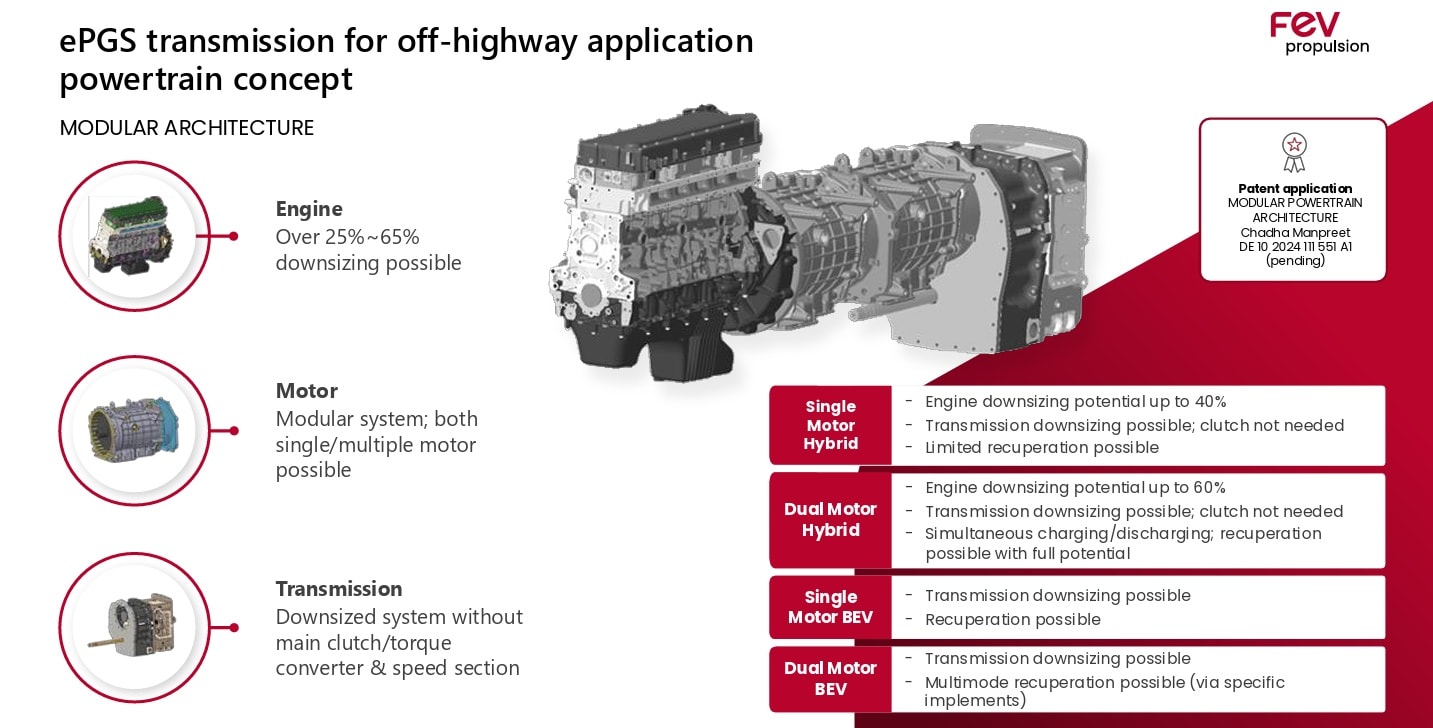
During the expo, several presentations covered the integration of electric powertrains at the component and architecture level. One presented by Thomas Wellman, chief engineer, drivetrain systems, FEV North America, detailed an EPGS (electrified planetary gearset) off-highway drivetrain architecture that is modular and scalable for a variety of powertrain configurations.
According to Wellman, this system enables the transformation of an existing conventional powertrain to an electrified system (mild hybrid, full hybrid, PHEV, BEV) with minimal changes in the overall drivetrain architecture. The modularity of the system is augmented by the ability to integrate multiple motors while also enabling downsizing of the engine/transmission, removal of launch elements and the employment of regen.
“The goal was to have something that could use a single or dual motor, but that also can be potentially used to take the combustion engine out of the equation,” Wellman said. “Another goal was to eliminate at least some of the gears on the transmission side if possible. Typically, for passenger cars, this sort of transition means going from say an eight-speed transmission in a conventional driveline to maybe one or two speeds. So one of the goals and challenges of creating this system was figuring out how to achieve this.”
Downsizing drivelines
Wellman described the basic premise behind FEV’s EPGS architecture during his presentation and the benefits it offers for off-highway machines. “Say we have a design that still has a transmission behind a combustion engine. We could instead include an electric motor, which is connected to a planetary gearset. In this case, you have the carrier’s output, you have the electric motors as your ring gear, and you got your electric by your combustion engine.”
Wellman presented a use case that was equipped with one motor that could be operated as a hybrid. “We can downsize the combustion engine and also the transmission. You can then operate the system as a hybrid, meaning either with an electric motor only or with the combustion engine, and we can also use a dual motor and add another planetary,” he explained. “Obviously, there are some cost disadvantages to that approach. But the benefit is you can further downsize the engine and transmission and have more torque as needed from the electric motors.”
Wellman also outlined how the system can integrate with features such as electric PTOs. “Basically, one electric motor has a propulsion system, and the other one still generates some of the power back that allows you to operate the combustion engine at its best operation point,” he said.
“You can also take the combustion engine out of the equation and operate it as an electric drive only. There is one important thing you must consider though. In this case, there is a one-way clutch to make sure that the combustion engine doesn’t spin backwards if you have too much torque from the electric motor,” Wellman said. “If you take the engine out of the equation, you basically have an electric drive system combined still with a transmission. So how do we integrate this? We looked at different transmission configurations that had 24, 12 and eight speeds. From there, we can determine how much downsizing we can do.”
More with less
Wellman described how this system simplifies overall powertrain complexity. “We’ve studied use cases that would normally have a forward and reverse gearset, then we have a speed section [of the transmission] and finally a mechanical power take-off,” he said. “We would then hybridize and integrate it with an electric motor and the planetary gearset. You still have forward and reverse gears, but the speed section is basically eliminated, so you essentially reduce the system to a two-speed transmission.”
One use case that FEV examined resulted in two key questions: “Does it fulfill all requirements, and how do you size the electric motors? You also have to ask what hardware you have to work with for the specific application,” Wellman said. “In some cases, you may look at those questions and say that you have to develop a new transmission or a new combustion engine, but with these planetary gearsets, you can really reduce the number of components and downsize others such as the transmission by removing the variable speeds from the gearbox.”

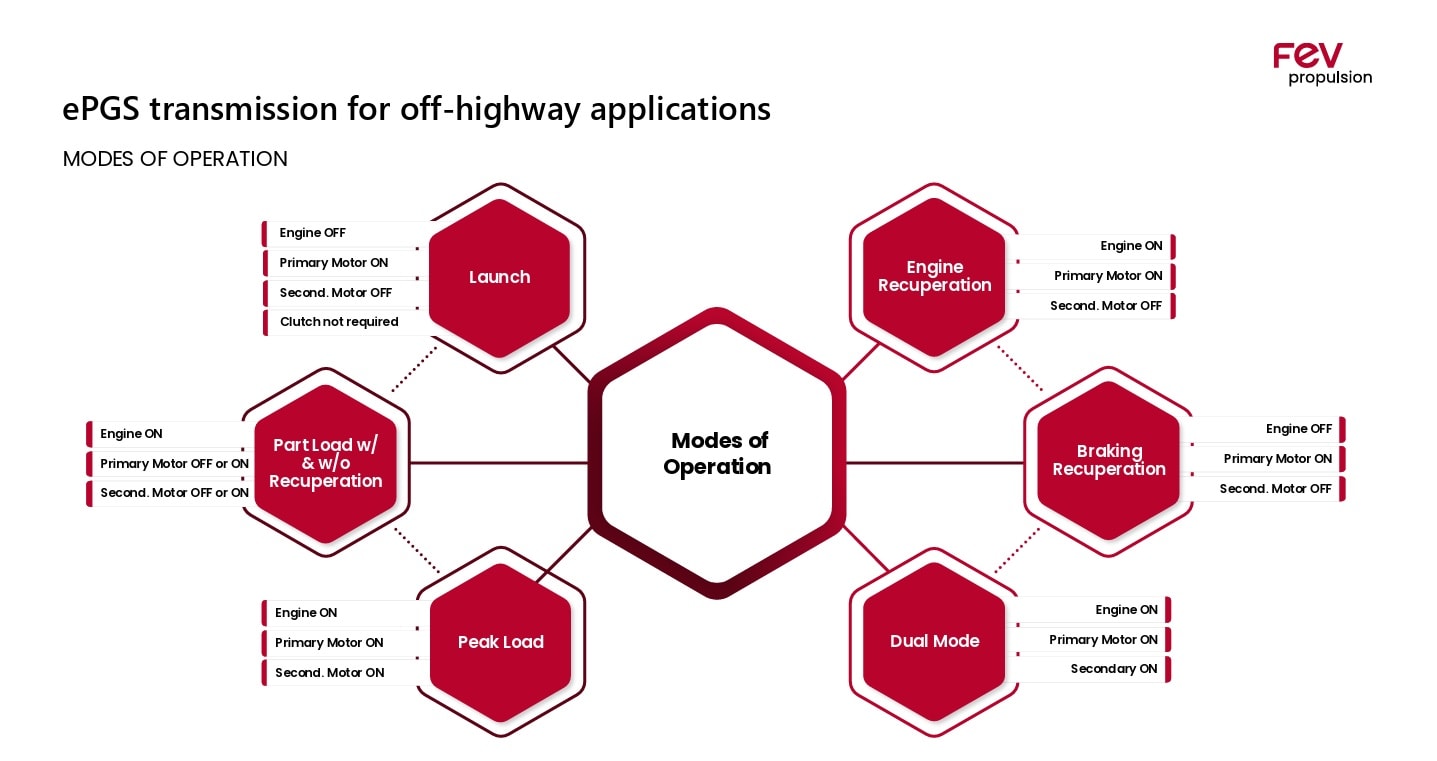
Considering hybrid operation, Wellman noted that there are certain things engineers need to be mindful of and realize they can and cannot do. “For example, the launch of the vehicle from a standstill is really with the electric motor,” he said. “You could have a launch clutch integrated into the system. However, from what we see with our simulations, it’s not needed because the electric motor has enough torque to launch the vehicle.”
“You can also have engine recuperation with this system,” Wellman added. “When you look at the efficiency map of a combustion engine, there’s always one point where it’s most efficient. And now, with electric motors, you can shift this operation point so that the combustion engine always operates at the best efficiency. It might then have more power than you need, but then this power can be used to charge the battery as needed.
“You basically want to operate in the best way from the combustion engine side as much as you can,” he continued. “You always have the opportunity to recuperate by harvesting kinetic energy. For some off-highway applications, the opportunity to recover this energy may be limited, but the capability is always there.”
Well driven

Another important aspect of electrifying off-highway machines has been managing variable drive modes depending on the type of machine and the work it must perform. “In respect of drive modes, we can run a dual mode system that will supply power from the combustion engine and from the electric motor(s),” Wellman said. “When we run at peak power, obviously, you want to have power from the combustion engine, and then in addition to this, the power of the electric motor as well.”
“Under hard load, depending on the mapping of the engine and on the electric motors, you can operate with just the combustion engine and have the electric motors basically on a low volt setting as needed for best efficiency,” he explained. “Or you can run a very light load operation with the electric motors only and you can completely shut the engine off. Multiple operation modes are possible, and then it really depends on how we calibrate it, what the application is, and what cycles give you the best bang for the buck in respect of the overall system efficiency, while still meeting all requirements.”
“We looked at different life cycles to see what strategies we could use in respect of driving on electric power only,” Wellman said. “When does the machine drive in high gear versus low gear, for example. We also looked at load when we run with and without a PTO load. We really wanted to consider all use cases.”
Conserving energy
The FEV team also looked at energy consumption and how much recuperation is available. “When you run on electric power only, you have to determine at what point does it really deplete the battery and how much of your SOC do you have to save when power comes solely from the battery,” Wellman explained. “This applies to not just kinetic energy, but also what electric energy you generate by having the combustion engine at its best fuel-economy point.”
This energy may not be needed to propel the machine, but rather help charge the battery or just not have the battery as depleted. “I might use more fuel than just driving on electric power, but it might be more efficient,” he said. “It’s important to understand that on any hybrid system, you have energy from the battery, and if it’s a plug-in hybrid system, for example, we also have to charge it. So that has to be considered. The focus is always the overall efficiency of the system and not from one subsystem.”
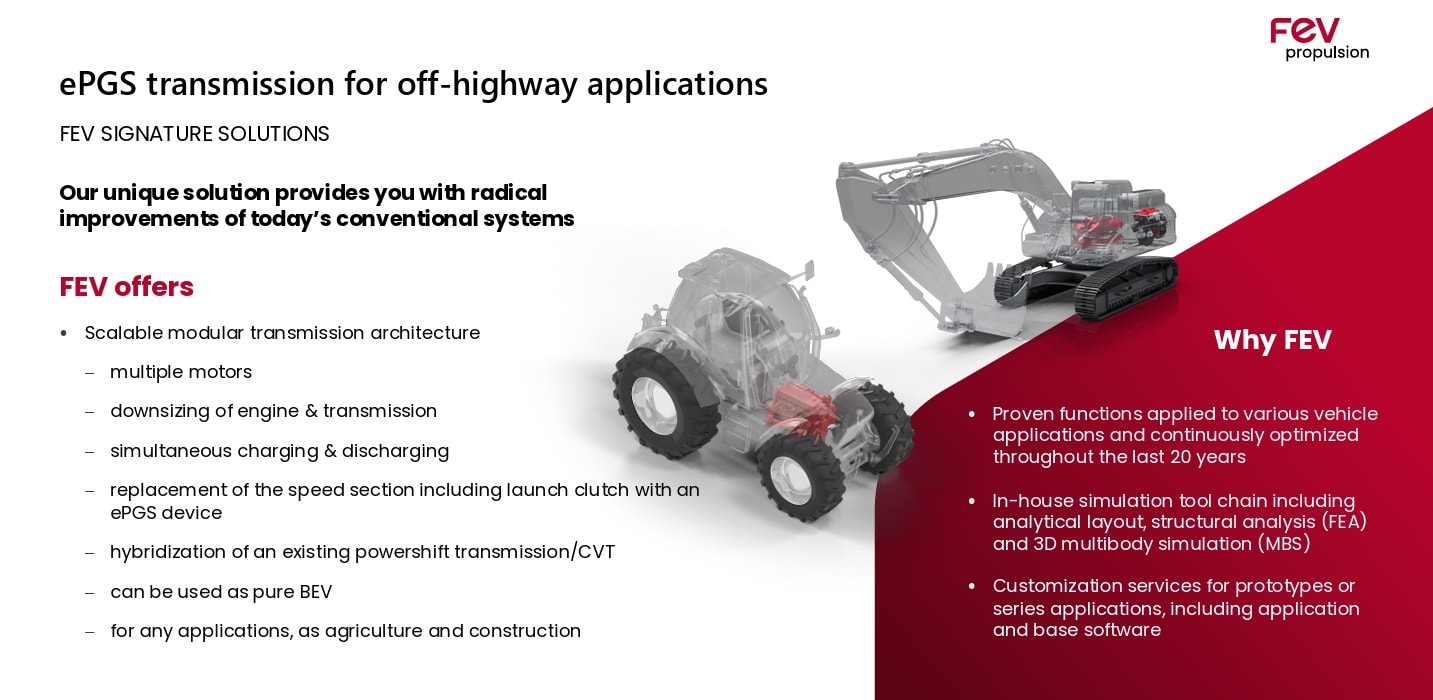
The “real beauty” of the EPGS system, according to Wellman, is its modularity, which allows it to be used for multiple applications. “You can use the same architecture without any big changes on the EPGS module or big changes on the transmission side,” he said. “There are some applications where you really don’t have a way to charge a battery in the field, or maybe the battery will be too big to get the runtime you need. That’s always a case-by-case decision. But if you have the option and you don’t have to change any major hardware or equipment, it also allows different levels of powertrain electrification.”
Positive possibilities
While not without its pitfalls, the electrification of off-highway machines presents abundant possibilities in terms of modularity and scalable architectures. The capability to downsize combustion engines and transmissions via hybridizing or completely removing components such as torque converters or primary clutches not only reduces cost and complexity but also provides potential benefits in extended service intervals and powertrain flexibility.
The multimode operational capabilities that can be offered by this EPGS architecture ultimately results in a more efficient powertrain that can be configured for single-, dual- or multi-motor applications. The result is an architecture that is easily adaptable to a variety of applications depending on the level of hybridization and required uptime.
More From SAE Media Group
Automotive Engineering
More Gears, More Challenges
Off-Highway Engineering
Electrification Not a One-Size-Fits-All Solution
Automotive Engineering
Transforming Propulsion with Tula’s Digital-Control Magic
Automotive Engineering
Democratizing Hybrid Technologies
Automotive Engineering
Flywheel Hybrids Offer New Efficiency Potential
Autonomous Vehicle Engineering
Autonomy and Electrification: A Perfect Match?
Off-Highway Engineering
AI Influence on ICE Design
Automotive Engineering
Prodrive Helps Fast-Track Ford’s New PHEV Van Program
Off-Highway Engineering
Miserly Power Systems
Automotive Engineering
VW’s New E-Golf May Lead the Way to Lithium-Air Power
Off-Highway Engineering
Making the Case for Mild Hybrid Systems for Heavy-Duty Vehicles
Automotive Engineering
Executive Insights: BorgWarner VP and CTO Hakan Yilmaz
Off-Highway Engineering
AxleTech Develops Electric Independent Suspension Concept for Vehicles Up to 58,000-lb GCWR
Off-Highway Engineering
Daimler Trucks' Lessons Learned from SuperTruck Program
Automotive Engineering
Powertrain Testing: Coping with Complexity
Off-Highway Engineering
Can Hybrid-Electric Drivelines Be a Solution for Off-Highway Vehicles?
Automotive Engineering
Mazda Plots Wankel-powered Range Extenders, HCCI Mild Hybrids
Off-Highway Engineering
Hyundai CE Debuts Hydrogen and Electric Excavators at Bauma 2022
Automotive Engineering
Inside Honda’s New Two-motor 50-mpg Accord Hybrid

Automotive Engineering
Integrated and Open Development Platform (IODP)
Automotive Engineering
Inside the Bolt EV
Battery & Electrification Technology
Ultracapacitor Solutions to Address Energy-Storage Needs of Vehicles

Automotive Engineering
Bosch’s EV Efficiency Upgrade: Continuously Variable Transmissions
NASA Spinoff
Bringing Hybrid Power to the Rescue
Autonomous Vehicle Engineering
Why America Needs a National Autonomous-Vehicle Development Policy
Automotive Engineering
Dana Opens New Chapter on CVTs
Automotive Engineering
JLR's All-New 2015 Modular Engines Feature Roller-Bearing Cams, Balance Shaft
Off-Highway Engineering
GKN Develops Electric Flywheel Hybrid System for Buses
Top Stories
INSIDERAerospace
 How Airbus is Using w-DED to 3D Print Larger Titanium Airplane Parts
NewsAutomotive
 Microvision Aquires Luminar, Plans Relationship Restoration, Multi-industry Push
INSIDERManned Systems
 A Next Generation Helmet System for Navy Pilots
INSIDERDesign
 New Raytheon and Lockheed Martin Agreements Expand Missile Defense Production
ArticlesManned Systems
 Accelerating Down the Road to Autonomy
NewsPower
 Ford Announces 48-Volt Architecture for Future Electric Truck
Webcasts
Electronics & Computers
 Cooling a New Generation of Aerospace and Defense Embedded...
Test & Measurement
 Battery Abuse Testing: Pushing to Failure
Internet of Things
 A FREE Two-Day Event Dedicated to Connected Mobility
Unmanned Systems
 Quiet, Please: NVH Improvement Opportunities in the Early Design Cycle
Transportation
 Advantages of Smart Power Distribution Unit Design for Automotive &...
Aerospace
 Sesame Solar's Nanogrid Tech Promises Major Gains in Drone Endurance