




Electrification Not a One-Size-Fits-All Solution
Efforts in the off-highway industry have been under way for decades, but the technology still faces implementation challenges.
Some electrification efforts in the off-highway in dustry have been quite successful, yet others still need either time to catch on or may just flat-out not be suited for electrification. It is not an across-the-board solution, nor does it necessarily need to be one.
Talking with several industry experts, they generally agree: the movement to electrification in off-highway equipment is driven by several factors and there are different considerations. Emissions regulations, air quality concerns, performance, cost and economics. There are also different value propositions to consider for the various segments of the industry.
Government mandates are forcing changes. “But, underlying these are three big drivers — environmental needs, costs and performance,” Oerlikon Fairfield’s Robert Kress, business development director, told Truck & Off-Highway Engineering. The relative importance and influence of each in off-highway applications is dependent of the operating conditions encountered by the machines.
According to Darren Almond, John Deere Power Systems’ (JDPS) manager of drivetrain product planning, each segment of the off-highway market presents different value propositions for vehicle hybrid or full electrification solutions. Take, for instance, the underground hard rock mining market. This segment may turn to electrification to eliminate all engine exhaust, avoiding the costly process of ventilating mines.
“Other segments, like vehicles that move containers at ports, may be motivated by emissions regulations and zero-emissions zones to pursue electrification,” Almond said.

Cummins Inc.’s Vinoo Thomas, director of electrification business development, agrees. “One of the main drivers to electrification of off-highway equipment is carbon emissions and general air quality concerns in urban areas and attainment zones near ports; green initiatives are driving early adoption of electric vehicles,” he said.
Economics is another driver. “Battery costs are beginning to drop as demand increases,” Thomas said. “However, incentives/subsidies to offset vehicle and infrastructure costs are likely to be needed to continue to drive adoption.”
“Overall, the established on-highway benefit of improved fuel economy from hybrid solutions also applies to the off-highway market to a degree,” Almond said.
As far as cost considerations are concerned, the price of gas or diesel is often compared to what is touted as the low operating costs of electric. “But, I also believe the manufacturers ultimately hope to lower costs by simplifying the vehicle designs, for example, by removing many components found in traditional IC vehicles,” Kress said.
There is also the short-term potential to hybridize some vehicles, allowing for smaller internal combustion (IC) engines that fall below the threshold where additional expenses for emission controls are avoided.
Kress opined that performance can be a factor that probably gets the least consideration. “But, in certain situations, electric vehicles have a better performance ‘feel.’ Elon Musk has already demonstrated that electric passenger vehicles, and now trucks, offer impressive acceleration,” he said. With off-highway equipment, some hybrid designs can supplement the energy needs during peak duty cycles to create a better performance.
A compact electric drive system
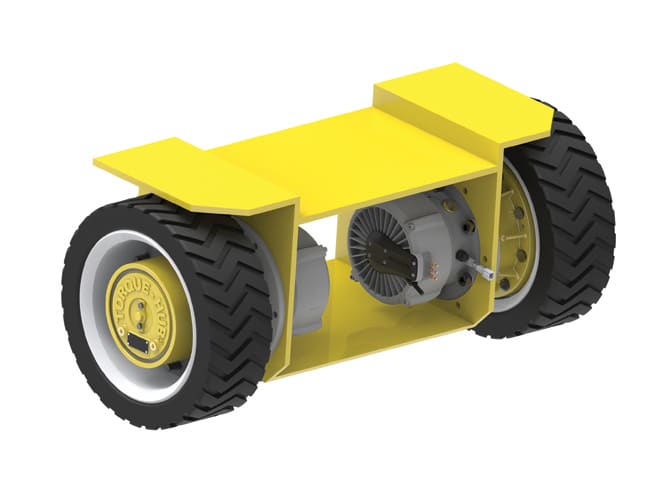
At Agritechnica 2017 in November, Oerlikon Fairfield introduced a new electric drive system for off-highway vehicles. The company worked on the system with Ashwoods Electric Motors, a company in which OF has a minority investment. The system integrates an Oerlikon Fairfield Torque Hub planetary drive with the Ashwoods-produced interior permanent magnet (IPM) motor to create an ultra-compact drive.

“With the battery-operated vehicle marketplace, certainly efficiency is king; everyone is looking to do more with less,” Kress said. “The two real sweet spots of this motor are greater efficiency and smaller package size.”
With the IPM motor’s smaller size, it is also lighter. It is one-third the weight of a typical incumbent induction motor for the same rated output. Depending on the application, “that can be a very big deal to OEMs as they’re trying to build their battery-operated vehicles,” he said. It offers about two-thirds more motor space.
The company claims the unit is so compact that it enables vehicle manufacturers to provide a steerable four-wheel-drive configuration where previously there was not enough space to offer this possibility.
The complete unit can deliver 4000 N·m (2950 lb·ft) of drive torque and 5600 N·m (4130 lb·ft) of braking torque, yet the motor is up to 30% smaller and lighter than current production solutions that use larger brushed DC or induction motors coupled to a planetary gearbox. The Oerlikon Fairfield/Ashwoods Electric Motors solution provides a triple planetary ratio in the length of the standard double planetary design.
Combining the two technologies with an integrated electric parking brake has enabled the elimination of several duplicated or redundant components. For example, a common shaft can be used for motor, brake and transmission, saving weight, cost and package space.
“Smaller product envelopes free the equipment designers to utilize space more efficiently,” Kress said. Areas reserved formerly to contain the motors/drives can now be utilized more productively for other purposes — e.g., cabling, controllers, etc.
Hurdles to electrification
Electrification has been successfully used in material handling applications, as the industry experts TOHE talked with detailed. The nature of the work lends itself to electrification: the enclosed environment with a limited range and manageable infrastructure.
Implementation of the technology faces challenges in other off-highway equipment due to issues such as battery technology, cost and weight of electrification, getting the market to accept something new, as well as electrical system component costs.
“Additionally, the price of the equipment has to offer acceptable ROI,” Cummins’ Thomas said. “Without subsidies it could be challenging to implement electrified equipment economically.” Companies interested in moving toward electrified equipment will need to be able to identify available subsidies and be able to apply for and be awarded them.
According to JDPS’ Almond, components and systems for the off-road implementation of electrification are in their early stages. On-highway electrification solutions don’t require as much power or durability than what is needed for off-highway applications — the requirements and value propositions of which are so varied that developing a singular solution becomes very challenging.
“Because of this, there is an opportunity to create customized electrification solutions for individual segments, resulting in a wide variety of solution types. This is what makes electrification very exciting right now,” Almond said.
Overcoming hurdles
Battery technology has and will continue to advance. Supply chains will gradually reduce their price points, “but it may take another 10-15 years,” Kress offered.
According to Thomas, lithium-ion battery prices need to continue to drop to a level that allows for reasonable payback without the use of incentives.
“There are various market studies that predict that the turning point for electric-vehicle adoption will occur when batteries are equal or better than diesel engines in terms of cost, and estimates show that could be anywhere from 5 to 10 years out,” he said.
According to Almond, one of the keys to success in overcoming these hurdles is to account for the entire system solution. “John Deere seeks to offer integrated solutions that address the interfaces between the electrical generator and/or motors, power electronics and mechanical interfaces. Because we have already done the development work to manage these interfaces, the end users can have confidence in the fact that all this new technology on their machines will simply work,” he said.
“Furthermore, advances in battery, power electronic, generator and motor, and drivetrain technology are being made every week,” he offered.
Promising candidates
Material handling applications have a long history of use of electrification. Lift trucks have been battery powered since the late 1960s. “Since then other applications of material handling have adopted electrification,” Thomas told TOHE. “Most of the sites are static or have a limited (fixed) range. In other words, the equipment doesn’t have to go outside of its normal ecosystem.”
However, Thomas says it is becoming apparent that many different types of applications are experimenting with electrification. “Many OEMs are seeing the high level of interest in electrified equipment and want to be seen as an early adopter — or, at least, be viewed as evaluating it,” he said. Acceptance of electric applications will be different by customer and region depending on their initiatives.
One of the unique advantages of an electric system is the ability to recycle braking energy. Thus, applications that tend to change direction or repeatedly go through a stop/start cycle are the ones acting as early adopters of electrification.
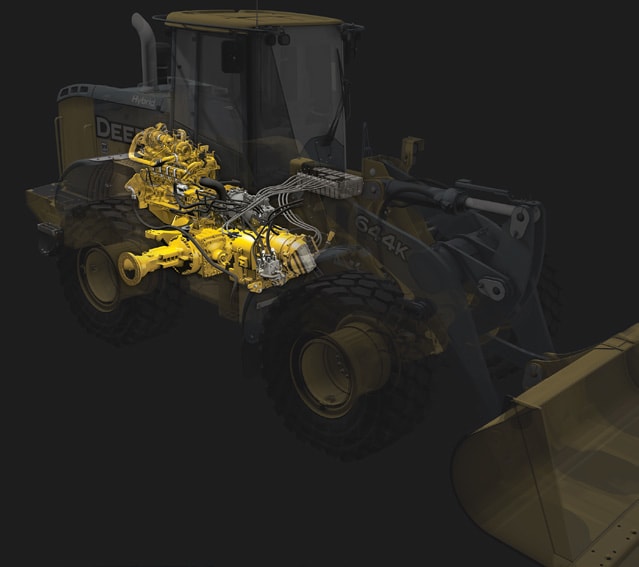
“This is why the first applications of electric hybrid technology in John Deere equipment is for wheel loaders,” Almond said. The braking energy in the wheel loader cycle often occurs precisely when hydraulics are required. The hybrid system allows for the transfer of that braking energy to hydraulic energy via the electric drive components.
“Other applications are continually being investigated to meet our customer’s needs,” Almond said.
New electric-drive wheel loader
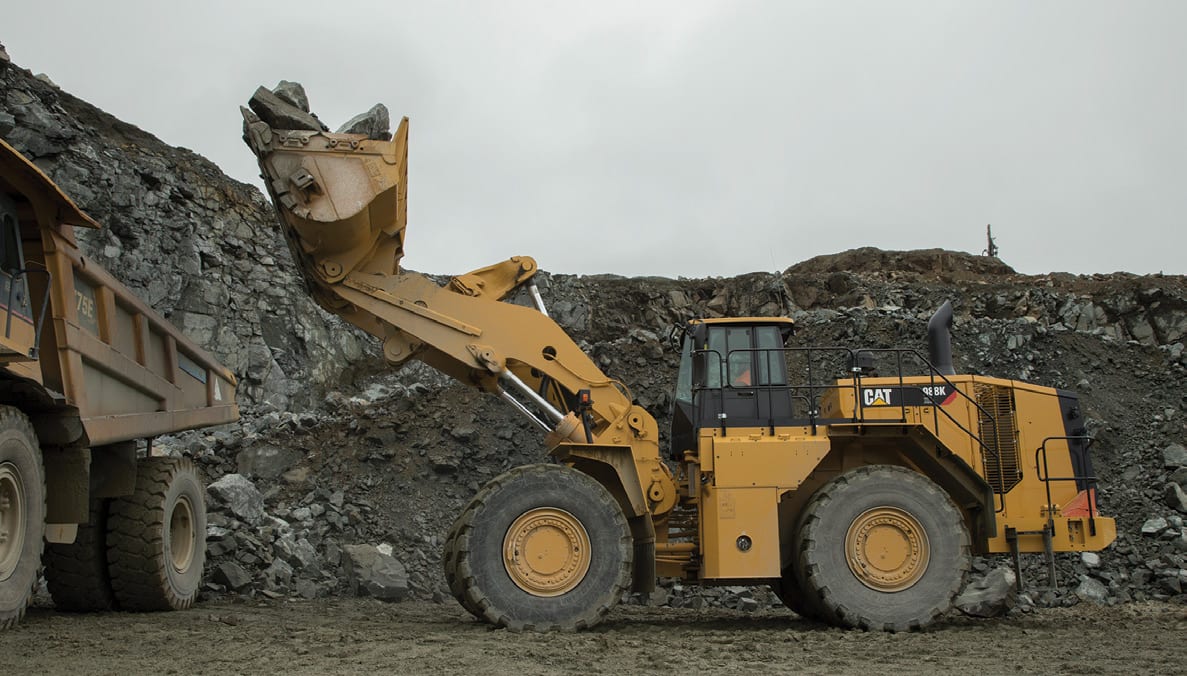
At a recent press event, Caterpillar revealed its first electric drive wheel loader. The new 988K XE offers 25% greater overall efficiency and up to 10% more productivity in load-and-carry applications than the standard Cat 988K loader. It is also up to 49% more efficient for truck loading.
The 988K XE, which is a new addition to the 50-ton (45-tonne) loader lineup, is 90% identical to the 988K. Featuring switched reluctance and more than four years of testing in a range of applications, the C18 ACERT engine, mechanical dropbox, driveline and axles from the 988K remain in the electric drive machine.
“We still leveraged the C18 engine that we have on the 988K, but we took the generator, inverter and motor for our powertrain. So the torque inverter and transmission came out,” Todd Tuntland, Caterpillar product application specialist, told media at the press event in Peoria, IL. He explained that effectively this is a transmission replacement.
The XE is said to be easier to operate. It has a variable speed motor and no longer has gears. Directional changes are very smooth. Operators can control ground speed with virtual gears. “You don’t have to pull clutches to shift anymore,” Tuntland said. “So when you’re operating this machine, compared to the mechanical drive, it’s much quicker and it’s very smooth.”
Headed to production in March 2018 at Cat’s Decatur, IL plant, the 988K XE is targeted for applications such as haulage fleet up to 70-ton (64-tonne) trucks, truck loading (shot rock) up to 840 tons (760 tonnes), and load-and-carry up to 660 tons (600 tonnes).
The electric-drive wheel loader uses 40% less powertrain oil and offers extended oil change intervals of 2000 hours (1000 more than the 988K).
“We are going to target applications likely north of 2500 hours; that’s because the payback on the XE will be very attractive for customers,” Tuntland said. “They need the production and they’re conscious about the efficiency — the tons per gallon.”
Tuntland claimed that for 2500 hours “at current fuel prices, depending on where you’re at in the world, you would be in that two- to four-year payback. The 2500 is hours per year for the end user, so obviously the more you run it, the higher the fuel price, the bigger the payback.”
Caterpillar claims greenhouse gas (GHG) reductions on the 988K XE are equivalent to one year of electricity use for nearly 10 homes and equivalent to 13.5 passenger cars driven for one year.
Whether Caterpillar will bring the electric drive to other classes or machines remains to be seen. “We’re always evaluating ways to reduce cost-per-ton for our customers.” Tuntland said. “So it’s certainly something for us to consider going forward.”
Hybrids best?
Despite the electrification movement in the off-highway market, don’t dismiss the IC engine’s value particularly when coupled with an integrated hybrid system.
“I believe it is important to recognize that the IC engine is not going away anytime soon,” Kress told TOHE. “There is still a lot of room to improve the efficiency of these engines, and these advances will slow the adoption of electric-only systems in some off-highway applications.”
That said, operating conditions for the application probably have the greatest influence on the type of electric system.
“As an example, with a road construction site, unless operators have the ability to charge machines in remote locations, fully electric vehicles are difficult to operate effectively due to charging dependency,” Thomas said. “But, a hybrid application could work well in these undeveloped locations or work sites.”
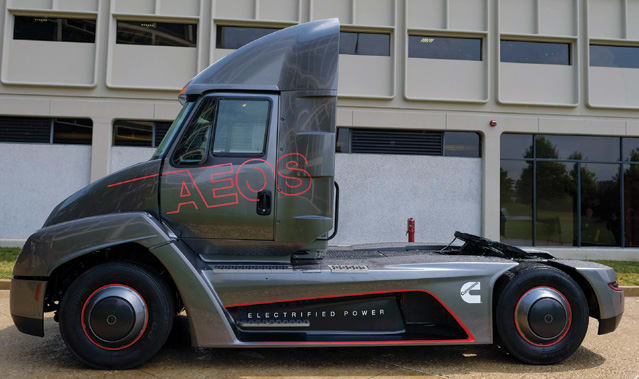
Thomas explained that diesel will play a strong role in many of Cummins’ markets for years to come, and the company will continue to invest in those technologies accordingly. “With that in mind, we continue to invest in a variety of technologies to provide our customers with a broad portfolio of powertrain solutions that meet their needs,” he said. Having invested in electrification technologies for more than 10 years, Cummins has produced several hybrid and fully-electric demonstration vehicles. In August 2017, the company unveiled the Aeos 1 fully electric Class 7 Urban Hauler EV concept truck.
“Duty cycle plays a big role in determining the electric system, as it forces the vehicle manufacturer to think more about how the vehicle works within the larger production system. This is especially true when considering battery technology, as the total energy usage of a daily work cycle needs to be considered,” Almond said.
“If a vehicle can work for eight hours, then sit around for 16 and can be plugged into a wall — that may influence the type of technology,” Almond detailed. “If it has to run 24/7 — how you’re dealing with the energy management really has an influence on what type of electric system needs to be employed.”
More From SAE Media Group
Off-Highway Engineering
FEV Simplifies Off-Highway Electrification
Power Electronics INSIDER
Highway Segment Charges Electric Vehicles
Off-Highway Engineering
Eaton and BAE Gear up a New Electrified Truck
Off-Highway Engineering
AxleTech Develops Electric Independent Suspension Concept for Vehicles Up to 58,000-lb GCWR
Automotive Engineering
Executive Insights: BorgWarner VP and CTO Hakan Yilmaz
Automotive Engineering
Off-Highway Hybrids Are Entering Prime Time
Off-Highway Engineering
Regulatory Landscape Challenges Commercial-Vehicle Engine Development
Battery & Electrification Technology
Ultracapacitor Solutions to Address Energy-Storage Needs of Vehicles
Off-Highway Engineering
Transmissions, Axles Aid in Fuel Conservation for Commercial Vehicles
Automotive Engineering
Proving Grounds Are the Hush-Hush Heroes of the Latest Automotive Test Technology
Off-Highway Engineering
Narrower Focus, Bigger Payoff for Commercial EVs
Off-Highway Engineering
Hybrid Powertrains in the Product Mix
Off-Highway Engineering
Danfoss and Sany Extend Electrification of Off-Highway Machines

Battery & Electrification Technology
Upcycling Commercial Fleets into Circular EVs
Off-Highway Engineering
Hybrids Are Having a Moment
Off-Highway Engineering
Bosch Stresses Need for E/E Architecture Upgrade
Off-Highway Engineering
The Case for 48V in Commercial Vehicles
Off-Highway Engineering
Hyundai CE Debuts Hydrogen and Electric Excavators at Bauma 2022
Battery & Electrification Technology
Leading the Charge: Fast 40
Automotive Engineering
Orbis Says HaloDrive Axial-Flux Motor Available for In-Wheel, Other Uses
Tech Briefs
EVs Are Growing Up—and Getting Practical
Off-Highway Engineering
Many ICE Paths Lead to Reduced Emissions
Off-Highway Engineering
Electric Mobile Machines Won’t Abandon Hydraulics
Automotive Engineering
Transforming Propulsion with Tula’s Digital-Control Magic
Autonomous Vehicle Engineering
Autonomy and Electrification: A Perfect Match?
Off-Highway Engineering
eCitaro to Replace Conventional City Buses
Automotive Engineering
Who Wants Afreecar?
Automotive Engineering
Bosch’s EV Efficiency Upgrade: Continuously Variable Transmissions
Top Stories
INSIDERManufacturing & Prototyping
 How Airbus is Using w-DED to 3D Print Larger Titanium Airplane Parts
INSIDERManned Systems
 FAA to Replace Aging Network of Ground-Based Radars
NewsTransportation
 CES 2026: Bosch is Ready to Bring AI to Your (Likely ICE-powered) Vehicle
NewsSoftware
 Accelerating Down the Road to Autonomy
EditorialDesign
 DarkSky One Wants to Make the World a Darker Place
INSIDERMaterials
 Can This Self-Healing Composite Make Airplane and Spacecraft Components Last...
Webcasts
Defense
 How Sift's Unified Observability Platform Accelerates Drone Innovation
Automotive
 E/E Architecture Redefined: Building Smarter, Safer, and Scalable...
Power
 Hydrogen Engines Are Heating Up for Heavy Duty
Electronics & Computers
 Advantages of Smart Power Distribution Unit Design for Automotive...
Unmanned Systems
 Quiet, Please: NVH Improvement Opportunities in the Early Design...
